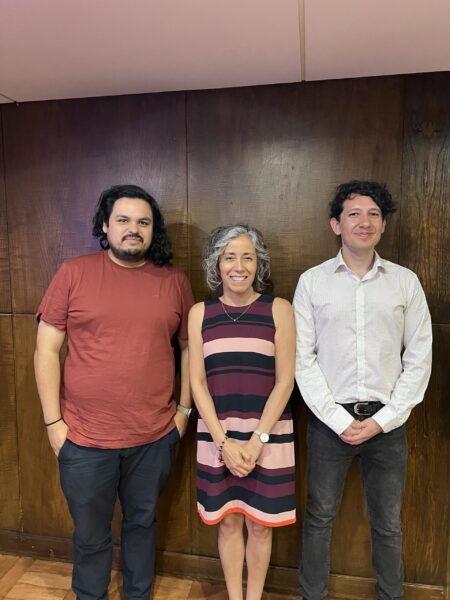
IMFD Innovation collaborates with the Superintendency of Social Security on a project using advanced NLP techniques
January 2025.- One of the most interesting challenges in the field of natural language processing (NLP) is free text recognition. This is the challenge faced by the Innovation and Technology Transfer Division of IMFD in collaborative work with the Superintendencia de Seguridad Social (SUSESO), which had as its main focus the optimization of claims filing from a citizen’s perspective. The objective of this collaboration is to develop and evaluate the performance of natural language processing (NLP) models for the automatic classification of subjects, sub-subjects, and grounds for claims at SUSESO.
“When a person files a claim with the Superintendencia de Seguridad Social (SUSESO), there is a range of options to choose from for the grounds of the claim. A user might mistakenly select the wrong option, ending up with a negative outcome at the end of this process,” explains Hernán Sarmiento, IMFD Innovation Engineer and project lead. After this first step, there is a field for entering free text called “account,” where the person explains why they are filing the claim.
“The question is how we can leverage this free-text account to somehow automatically assign it to one of the grounds that the user should have selected. Here we find accounts with spelling mistakes, typos, and grammatical errors, so during this project we tried to experimentally evaluate whether we could train classification models and see with what percentage one of the existing grounds options could be accepted,” the engineer highlights.
This initiative was part of a total of 7 components driven by SUSESO, called “Natural Language Processing for the Optimization of Claims Filing,” which not only seeks to streamline the process, but also to provide a faster and more accurate response to those seeking solutions to their problems.
SUSESO is the autonomous state body in charge of overseeing compliance with social security regulations and ensuring respect for people’s rights, especially those of workers, pensioners, and their families. The organization worked for the first time on solutions involving data science and artificial intelligence, in this case with natural language processing (NLP) as part of its efforts to improve service and modernize its processes.
Main results
The project was divided into three key stages: Exploratory data analysis, in which claims were reviewed to identify patterns. Linguistic characterization of the accounts, where NLP tools were used. And finally, model training and validation, which involved training artificial intelligence models to automate claim classification.
Reaching Stage III, with the model training already done, they arrived at the test set, in which a thousand accounts corresponding to 17 grounds were used. Different language models were evaluated in order to assess the ability to predict a ground from an account.
The main results indicate that it is possible to build language models that can learn from the accounts submitted with claims, and that this can improve the correct classification of these filings or claims into a specific ground.
Hernán Sarmiento notes that “being able to use existing language models and adapt them to the accounts that SUSESO has, can somehow improve classification, achieving over 10 times better results than selecting a ground at random”. He adds that “With this finding, we can say that indeed the accounts may contain a certain type of language very specific to the domain that allows this classification to be improved automatically.”
Innovation at the service of society
“This is about making something that sometimes seems far off, like artificial intelligence, into something concrete. Innovation comes in to improve the user experience of the people who come to knock on our door to resolve claims. We are very pleased with the project’s results, because it can have a citizen impact with a high level of technology,” said Pamela Gana, Superintendent of SUSESO.
The IMFD team behind this project is led by Hernán Sarmiento, IMFD Innovation Transfer Engineer, with Francisca Cona and Camila Henríquez as data scientists, and Jocelyn Dunstan as consultant, an academic at the Departamento de Ciencia de la Computación UC in a joint appointment with the Instituto de Ingeniería Matemática Computacional UC, researcher at AC3E and IMFD.
“It was a project that addresses a need and a problem common to the public. Working with SUSESO allows us to tackle problems that truly exist in society through methodologies or scientific experimentation, all with the aim of improving certain processes,” Sarmiento highlights.
For IMFD, this project is part of a series of initiatives that seek techniques to apply the advanced data science research developed in academia in Chile to solving problems that impact our society, which aligns with the objectives of the institute and its innovation division.