
UC honors Marcelo Arenas for his career trajectory
August, 2023.- A recognition of academic contribution and the dissemination of knowledge is the distinction awarded by the P. Universidad Católica to more than a hundred faculty members of the Pontificia Universidad Católica de Chile who have completed between 25 and 50 years of outstanding work.
One of these recognitions went to Marcelo Arenas, former director and currently Researcher at the Millennium Institute for Foundational Research on Data (IMFD), and faculty member of the Department of Computer Science and the Institute of Mathematical and Computational Engineering of the School of Engineering of the P. Universidad de Chile.
The ceremony was held in the Salón Juan Francisco Fresno at Casa Central and was led by Rector Ignacio Sánchez, who praised the commitment and outstanding work of professors who have dedicated a significant part of their professional lives and intellect to contributing to the country through teaching and research, and in the training of today’s and tomorrow’s professionals.
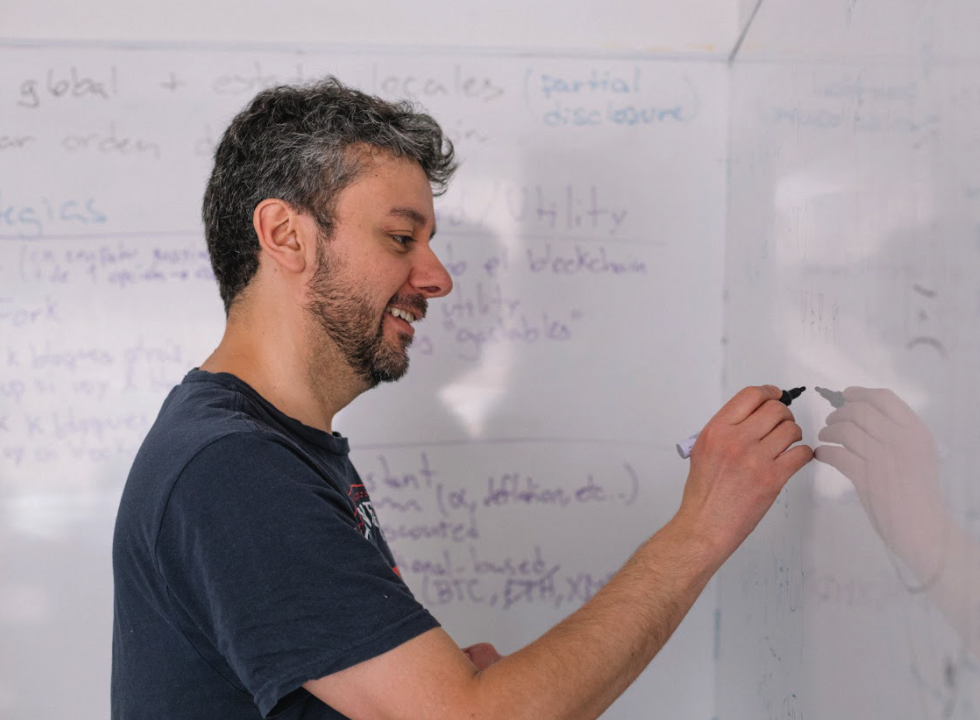
Marcelo Arenas holds a PhD in Computer Science from the University of Toronto (Canada), and his areas of interest include data management, applications of logic in computer science, and the semantic web. At the end of 2021, he received the recognition of “Distinguished Member” from the prestigious Association for Computing Machinery (ACM), the world’s largest scientific and educational computing society. Those who receive this distinction are selected for their contributions in three categories: education, engineering, and science. It was in this last category that Marcelo Arenas was selected, “For Outstanding Scientific Contributions to Computing.”
Shortly after, at the beginning of last year, the ACM featured the researcher in its “People of ACM” section, which highlights members of the Association whose scientific achievements have made a difference in advancing computing as a science and profession. Through an interview, the piece highlighted Arenas’ professional career as well as his personal story.
When asked how the World Wide Web will evolve in the next five to ten years, he stated: “I can imagine that the capacity of machines to understand web data will be much greater in five to ten years. This may seem obvious to some, but what I think will be interesting is the combination of techniques from different areas. On one hand, we have the techniques and standards developed in the semantic web to represent the semantics of data on the web. On the other hand, we have artificial intelligence techniques that are making giant strides in handling human tasks, such as translating text from one language to another. It will be very interesting to see the proper integration of such techniques to deal with web data.”
Source: IMC UC