
International School on Computational Social Sciences in Uruguay
August, 2023.- With the goal of establishing an initial theoretical and practical approach to computational and data science tools applied to social research, the International School in Computational Social Sciences seeks to train participants in the use of computational tools for the analysis of social data.
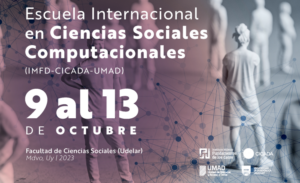
Organized jointly by the Millennium Institute for Foundational Research on Data (IMFD-Chile), the Interdisciplinary Center for Data Science and Machine Learning (CICADA-CSIC/Udelar) and the Unit for Methods and Data Access (UMAD-FCS/Udelar), the International School in Computational Social Sciences will be held in person from Monday, October 9 to Friday, October 13, 2023, at the Faculty of Social Sciences of the Universidad de la República de Uruguay.
“With this school, we seek to give participants an initial theoretical and practical approach to computational and data science tools applied to social research,” highlights Camila Diaz, Executive Director of the Millennium Institute for Foundational Research on Data. “As IMFD, we have experience in interdisciplinary work that combines social sciences with data science; we have developed research and application projects in which the combination of knowledge and techniques allows for work that represents a great contribution to all areas and the development of new methodologies,” she adds.
The school’s content falls within the field of computational social sciences, which, while a long-established area, currently faces new challenges aimed at the dialogue between social research and the digital era, both in theoretical reflection, on one hand, and methodological/technical reflection, on the other. The intersection of social research with other disciplinary fields such as data science, engineering, and computing opens new possibilities for the social sciences in the study of traditional social problems, while incorporating and innovating in methodological and technical terms.

The interdisciplinary perspective also appears central in computational social sciences, as skills from other disciplines are incorporated, such as programming or the application of Artificial Intelligence (AI) models, in order to contribute, for example, to the management of large volumes of data (numerical, textual, spatial) to answer questions specific to the social sciences, but from an innovative and comprehensive approach to social behavior.
The activity has 40 free spots, will be held in person at the Universidad de la República, Montevideo, and is aimed at master’s or doctoral students, or professionals in Social Sciences or related fields, who wish to use computational tools for the analysis of social data. Computer Science students who wish to deepen their knowledge related to the social field may also apply.
Content:
Data-intensive societies and social research
Juan Pablo Luna, Full Professor at the Institute of Political Science and the School of Government of the Pontificia Universidad Católica de Chile and researcher at the Millennium Institute for Foundational Research on Data.
Manual and automated methods for textual data analysis
Sebastián Valenzuela, Director of Research and Creation at the Faculty of Communications of the Pontificia Universidad Católica, Principal Researcher at the Millennium Nucleus on Digital Inequalities and Opportunities and chair of the Scientific Panel of the International Panel on the Information Environment (IPIE), and researcher at the Millennium Institute for Foundational Research on Data.
Magdalena Saldaña, Associate Professor at the Faculty of Communications of the Pontificia Universidad Católica, alternate director of the Millennium Nucleus for the Study of Politics, Public Opinion and Media in Chile (MEPOP), and researcher at the Millennium Institute for Foundational Research on Data (IMFD)
Natural Language Processing over the last decade: from Shannon to GPT 4
Felipe Bravo, Assistant Professor at the Department of Computer Science of the Universidad de Chile and Researcher at the Millennium Institute for Foundational Research on Data.
Modeling and visualization of textual data
Natalia da Silva, Adjunct Professor at the Institute of Statistics – FCEA of the Universidad de la República (Udelar-IESTA).
Nicolás Schmidt, Assistant Professor of the Department of Political Science and of the Unit for Methods and Data Access at the Faculty of Social Sciences of the Universidad de la República (Udelar).
Elina Gómez, Assistant Professor at the Unit for Methods and Data Access of the Faculty of Social Sciences of the Universidad de la República (Udelar).
Graph Databases/Network Science
Juan Reutter, Associate Professor of the Department of Computer Science and the Institute for Mathematical and Computational Engineering at the Pontificia Universidad Católica de Chile.
Lorena Etcheverry (INCO-Fing), Adjunct Professor at the Institute of Computing of the Faculty of Engineering (FING-Udelar)
Registration at: Registration Form for the International School in Computational Social Sciences in Uruguay