
Crowdsourcing launched to digitize texts of National Congress records dating back to 1810
Santiago, January 2021.- Putting the historical information and knowledge of Chile’s republican trajectory at the service of the constitutional process: that is the goal of the Letelier project, an initiative that is digitizing the text of all the records of the National Congress from 1810 to the present day.
The work, led by Naim Bro, researcher at the Millennium Institute for Foundational Research on Data (IMFD), will make it possible to perform natural language searches in these archives, allowing constituents, their teams, and everyone who needs it in the future to have access to this source of information.
“The National Congress Library (BCN) did a tremendous job scanning, page by page, all these handwritten documents. But the final files are images, and it is not possible to automatically extract the text from them, so it is not possible to perform searches or track topics,” explains Naim Bro. “Our project is converting the content of these images into words, using the Tesseract program, which is based on a neural network trained by Google. However, there are times when it does not recognize specific terms, numbers, or symbols,” he adds.
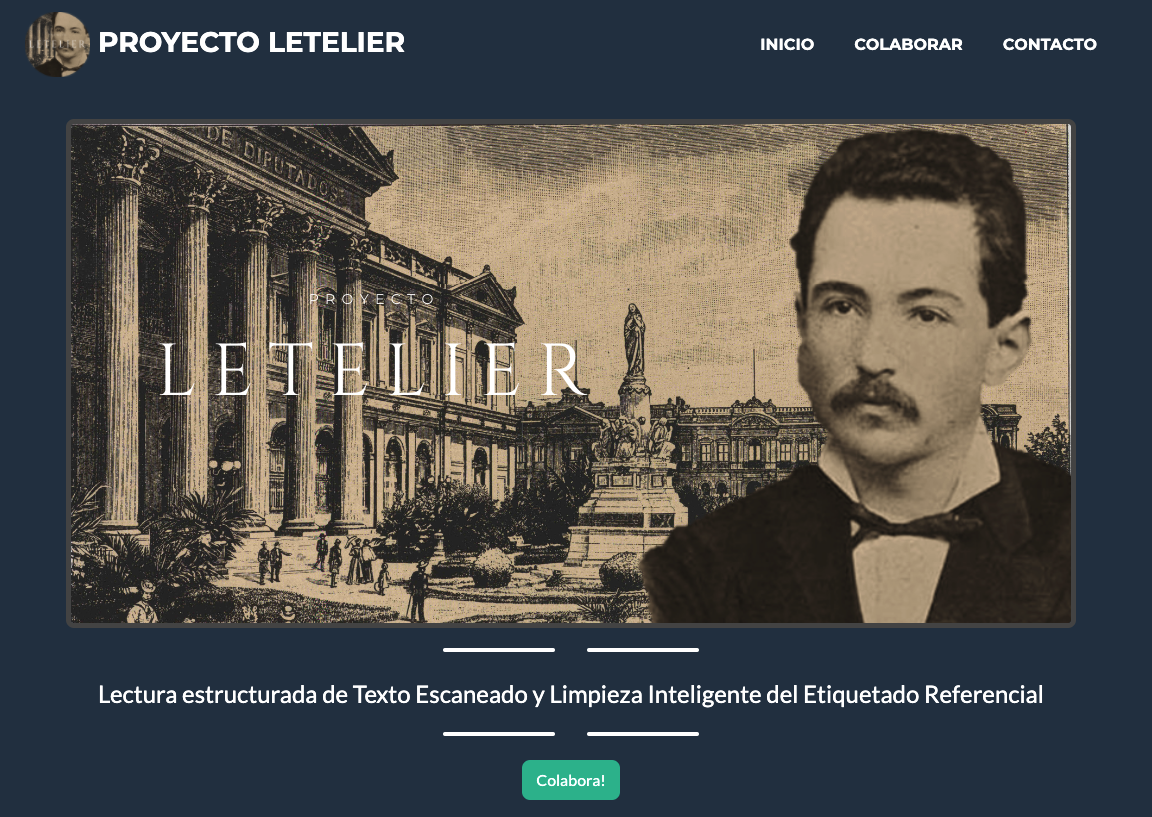
The challenge, then, is to digitize the text that Tesseract has not been able to recognize and train the Letelier neural network with this information. Since the task requires many hours of manual work, the IMFD team has turned Letelier into a crowdsourcing project, so that anyone who wants to collaborate can do so openly, identifying the words, symbols, and phrases that the system has not been able to identify.
How does it work? By going to https://letelier.imfd.cl/ an image appears showing a section of some record, with the term that Tesseract could not recognize marked in red. Contributors type the text in a window and click “Correct.” This allows the program to complete the recognition of the paragraph and learn to identify those words.
For example, slightly blurry words, terms cut off by a hyphen, or terms in parentheses may appear highlighted in a red rectangle. The idea is for contributors to teach Tesseract what that segment says: if congre- appears in the red rectangle, contributors must type congre- in the correction window and click Correct. The key is to respect exactly what the image says, with the original symbols and spelling: that is, if the term (estranjero) appears, users must type (estranjero).
“Our society will have access to high-quality information that can be used both in the constitutional process and in any future research, since the data will remain on the same page, serving as a query platform,” concludes the researcher.
The Letelier team consists of Naim Bro and Juan Pablo Luna, IMFD associate researcher and academic at the Institute of Political Science UC and the School of Government UC. Josué Tapia, Antonio Montalva, Fernanda Sanchirico, and Clemente Sánchez took part in its development; and Denis Parra, IMFD researcher and academic at the Department of Computer Science at U. Católica, and Ivania Donoso, a doctoral student in the same department, will be joining the team.
Check out a brief tutorial here: