
IMFD researchers present work analyzing the architecture of the “Transformer” neural network
“On the Turing Completeness of Modern Neural Network Architectures” is the title of the research that Jorge Pérez, academic of the Department of Computer Science (DCC) at U. de Chile and IMFD researcher, presented at the International Conference on Learning Representation (ICLR 2019), held in the city of New Orleans, United States. It is the most important international conference in the field of Deep Learning.
This work was carried out jointly by Jorge Pérez, Pablo Barceló –also a DCC academic and deputy director of the Millennium Institute for Foundational Research on Data (IMFD)- and Computer Science undergraduate student, Javier Marinkovic.
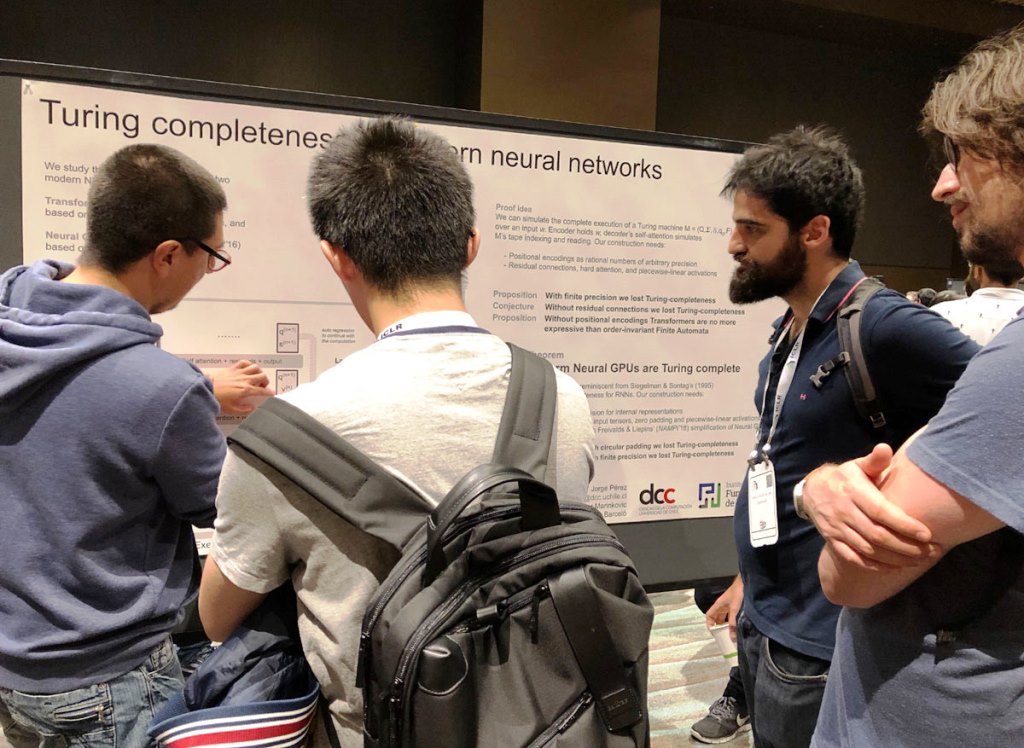
Jorge Pérez explained that deep neural networks are used today to make decisions in many areas such as image and text classification, machine translation, and content recommendations. However, he stated that the computational power of these networks is not one hundred percent understood from a theoretical point of view. “In our paper we analyze the computational power of one of the most popular deep neural network architectures today, called Transformer. This architecture is the one used by Google, for example, for its machine translation system, but it has been used for many other tasks, even generating music” (a piece of music created by this network can be found here: https://bit.ly/2HlOoV2).
In this research, the academics demonstrated that the computational power of the Transformer is as high as possible for an automatic machine, a notion known as Turing Completeness. “This means that the architecture used by Google to translate or generate music has the power to implement any possible algorithm. Until our result, it was not clearly known what the power limit of this neural network was. The paper also shows which parts of this neural network’s architecture make it so powerful and that if we removed certain parts it would indeed lose power,” concluded Pérez.
You can find a summary of the paper (in English) at https://bit.ly/30q2E6q
Source: DCC Communications.