
Bárbara Poblete at Congreso Futuro 2019: critical thinking is key to consuming information on social media
“Is technology forcing us to live increasingly alone?” That was the question that served as a prologue to the panel “Alone and hyperconnected, the paradox of our times,” one of the topics featured at Congreso Futuro 2019, on Friday, January 18. On that stage was Bárbara Poblete, associate researcher at the Millennium Institute for Foundational Research on Data (IMFD) and academic at the Computer Science Department of Universidad de Chile.
Bárbara Poblete —who currently works in the areas of data mining, social network analysis, and web information retrieval— began her talk by explaining the research she has been developing over the last 10 years on social networks and, specifically, on how society behaves through these platforms.
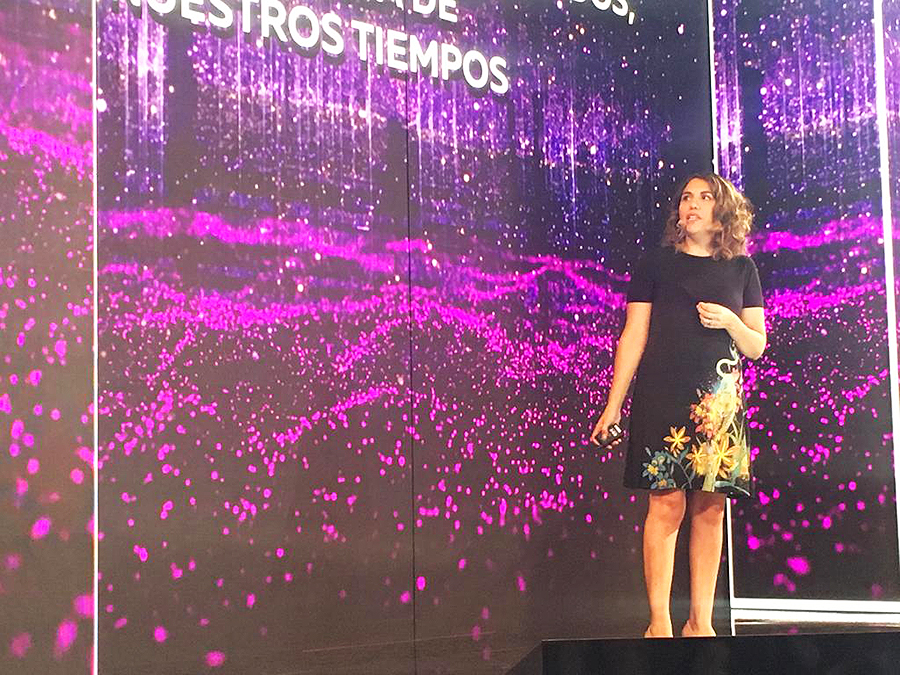
“They are a facilitating agent of social interaction,” she said regarding applications such as Twitter, Facebook, Instagram, or WhatsApp, which have exponentially increased the content circulating on the web.
A pioneer in researching credibility on social networks, the researcher delved into a topic she has scientifically focused on: how social networks became a communication medium and, for some people, even came to replace newspapers or television. This is because users learn about what is happening in the world through social networks, without being subject to a media outlet’s editorial line. In this new scenario, she noted, users become creators and editors of their own content.
Hyperconnected, but vulnerable
However, the PhD in Computer Science warned that one of the threats brought by hyperconnectivity is that “we become vulnerable to believing everything we read, to blindly trusting our networks.” She also referred to so-called “filter bubbles,” which cause people to have “biased views of reality,” insofar as they choose who their friends are on Facebook or who to follow on Twitter, for example, considering that the tendency is to establish these virtual relationships with like-minded people.
Bárbara Poblete explained, in a didactic way, how the most polarized and strong opinions tend to spread faster on social networks like Twitter. “If someone wants to insert political propaganda or fake news, the places to do so are within these more radical communities,” she stated. And she cited the 2016 United States elections as an example where these mechanisms were used.
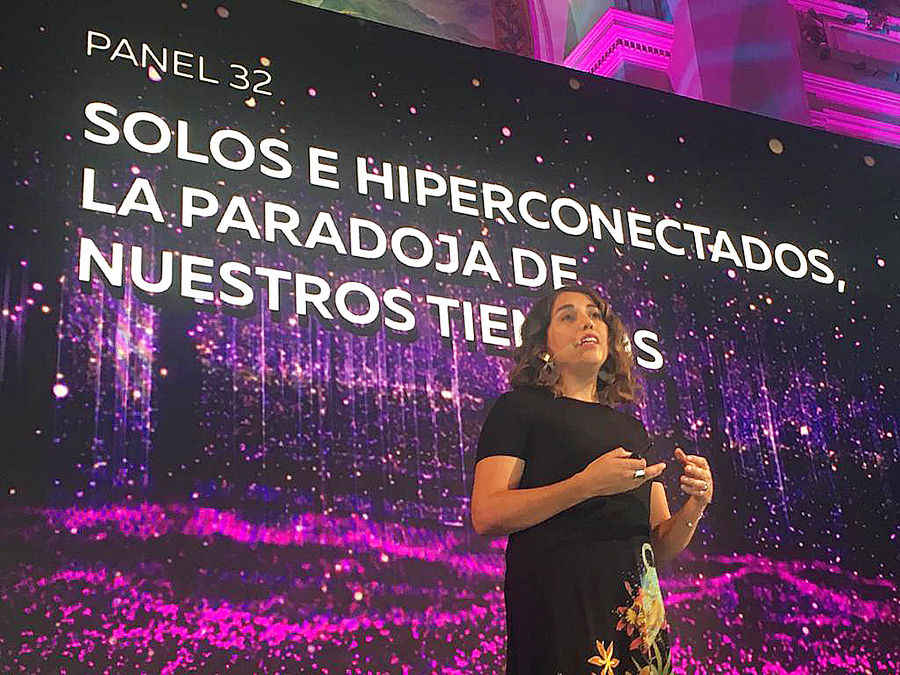
The researcher discussed the nuances in the spread of fake news on social networks, according to age or political ideology, and at the close of the talk she proposed a solution: “In order to work with social networks, we need to look at the collective and not rely so much on individual opinions,” and she cited the work she has carried out at IMFD based on collective intelligence: Galean —a historical event browser based on the opinions people have expressed about these events— and Twicalli, a social seismograph that detects earthquakes using Twitter.
At the end of her presentation, she outlined the future challenge facing social network users: “Developing critical thinking, even if it goes against our impulses, for the responsible consumption of information.”
Summit of scientists
On Monday, January 14, the director of the Millennium Institute for Foundational Research on Data, Marcelo Arenas, Full Professor at the Computer Science Department of Universidad Católica, took part in the opening ceremony of Congreso Futuro 2019.
“I think it is very significant that the topic of data is becoming increasingly relevant in all its dimensions, from the volume of information that society is generating and —above all— how to use it to improve decision-making, to the impact that data has on society, the issues surrounding privacy protection, and the uses people give to social networks,” the director stated after the opening ceremony.
Meanwhile, on Wednesday, January 16, Marcelo Arenas joined Bárbara Poblete at the dinner hosted by President Sebastián Piñera, at La Moneda, for the Congreso Futuro speakers. The event was attended by members of parliament, prominent figures from the scientific community in Chile and abroad, the Minister of Science and Technology, Andrés Couve, and the Undersecretary of that ministry, Carolina Torrealba.
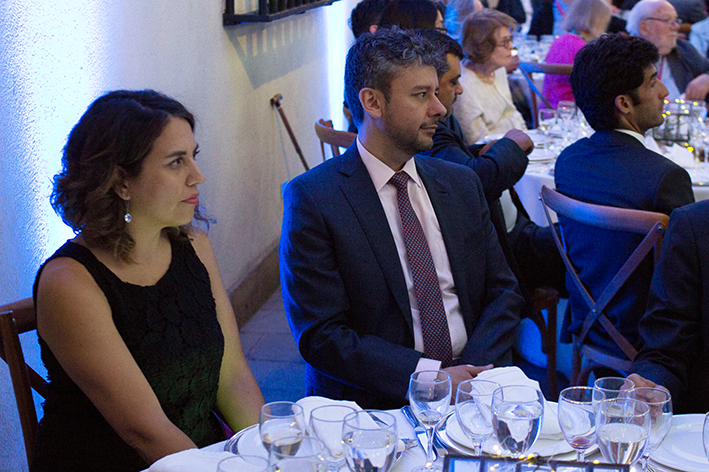
Bárbara Poblete was part of this event, along with Martin Hilbert, scientist and academic at the University of California, Davis, who visited IMFD during January. “In this setting, the topic of data was also present. The scientific community in general knows that it is an urgent matter,” concluded Arenas.