Aidan Hogan Opens FOIS 2026 with Talk on Wikidata’s Ontological Modeling
The academic from the Department of Computer Science at Universidad de Chile (DCC UChile) and deputy director of the Millennium Institute for Foundational Research on Data (IMFD) delivered the first keynote and took part in the “Ontologies & Artificial Intelligence” panel at the international FOIS 2026 conference.
From September 21 to 25, the sixteenth edition of the International Conference on Formal Ontology in Information Systems (FOIS) took place in Vitória, Brazil, the flagship conference of the International Association for Ontology and its Applications (IAOA). The event brought together researchers working in formal ontology, a field that studies how to represent entities and relationships within information systems, with applications in areas such as artificial intelligence, databases, software engineering, and the Semantic Web.
Aidan Hogan, an academic at DCC U. de Chile and researcher and deputy director of IMFD, delivered the conference’s first keynote lecture, titled “Wikidata: The Final Frontier for Ontology?” His talk focused on Wikidata, the knowledge base that allows information from Wikipedia and other Wiki projects to be organized and reused.
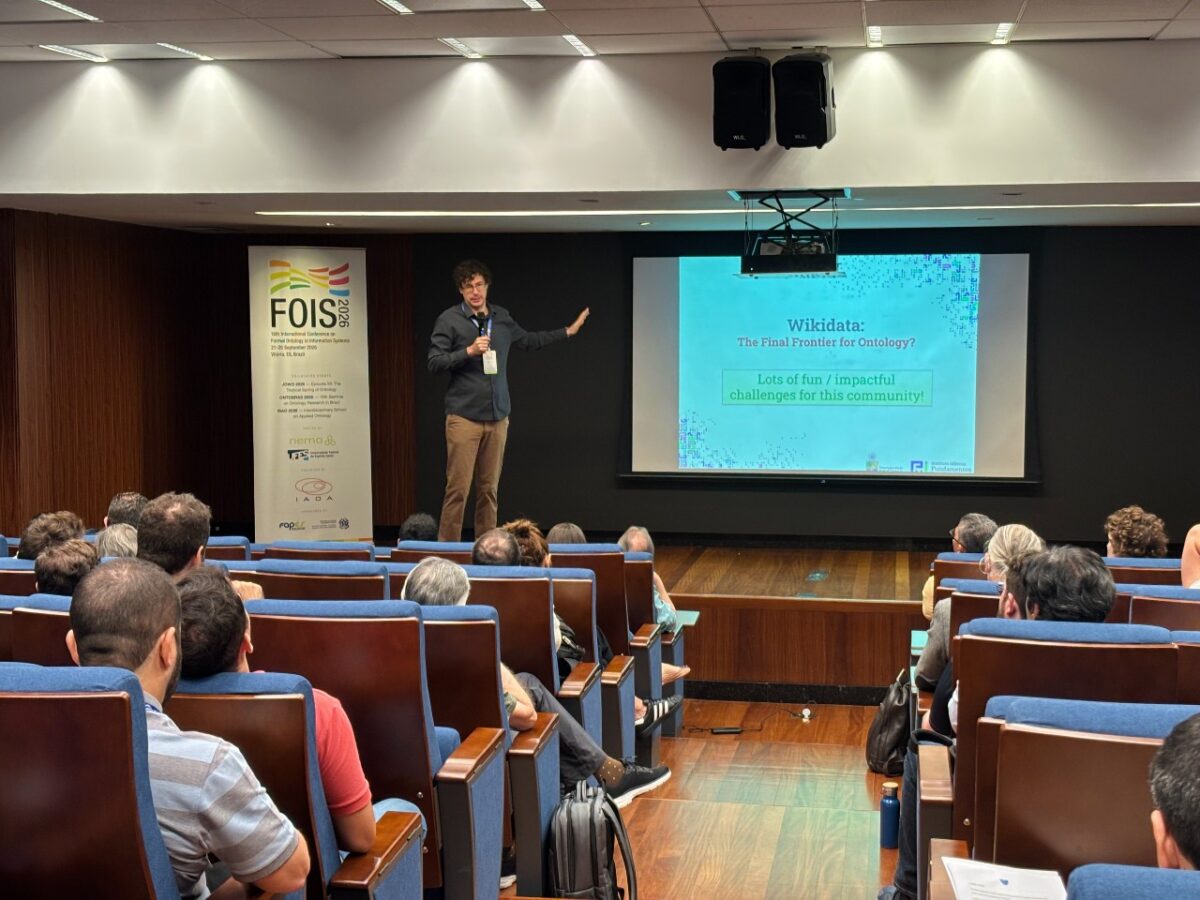
The talk introduced the modeling behind Wikidata and presented the platform as a unique example in ontology for information systems, given that it operates at a massive scale—through a knowledge graph describing 121 million entities connected by 13,000 different types of relationships—supports more than 300 languages, and involves more than 40,000 non-expert editors working on it. All of this within an information system that keeps growing constantly, recording more than 600,000 edits and 3.5 million SPARQL queries every day.
One of the challenges Hogan addressed was how ontological modeling can help those querying Wikidata’s enormous knowledge base: “One of its main benefits is that it enables automated reasoning, since we can answer questions using Wikidata,” he explains, giving as an example a query about people who studied in Chile and won an Academy Award. “Without reasoning, that query may return no results, because the data does not contain the facts phrased in that particular way. With automated reasoning, however, the system can chain together the facts that Gabriel Osorio Vargas studied at Universidad de Chile, that the university is in Santiago, that Santiago is in Chile, that Osorio won the Academy Award for Best Animated Short Film, and that this award is indeed an Oscar,” he adds.
The second benefit is that ontological modeling “makes it possible to formalize a consensus on what something represents in Wikidata.” Hogan illustrates this with the same example: the Academy Award for Best Animated Short Film can refer to the award series, established in 1932, or to the specific statuette. Without that distinction, the information becomes incoherent. Given that more than 40,000 editors contribute data and knowledge to the platform every month, the researcher states, “it has to be clear what is being described and how it should be described” for a platform like this to work.
For Hogan, Wikidata is the largest collection of encyclopedic data and knowledge openly available in the world. Its main contribution is centralizing information that can then be reused across different articles and language versions of Wikipedia.
“For example, the fact that Osorio Vargas won this award in 2016 is represented, redundantly, in many Wikipedia articles: the article on Osorio Vargas, the article on that year’s Oscars, the article on the Academy Award for Best Animated Short Film, and it may also appear in other tables, lists, and so on. Without Wikidata, every occurrence of this fact has to be written and updated by hand by users. Wikidata then makes it possible to centralize encyclopedic data in one place and then reuse that data in different places across Wikipedia”, he says.
You can learn more about Wikidata here.
Ontology and artificial intelligence: how to represent and use knowledge
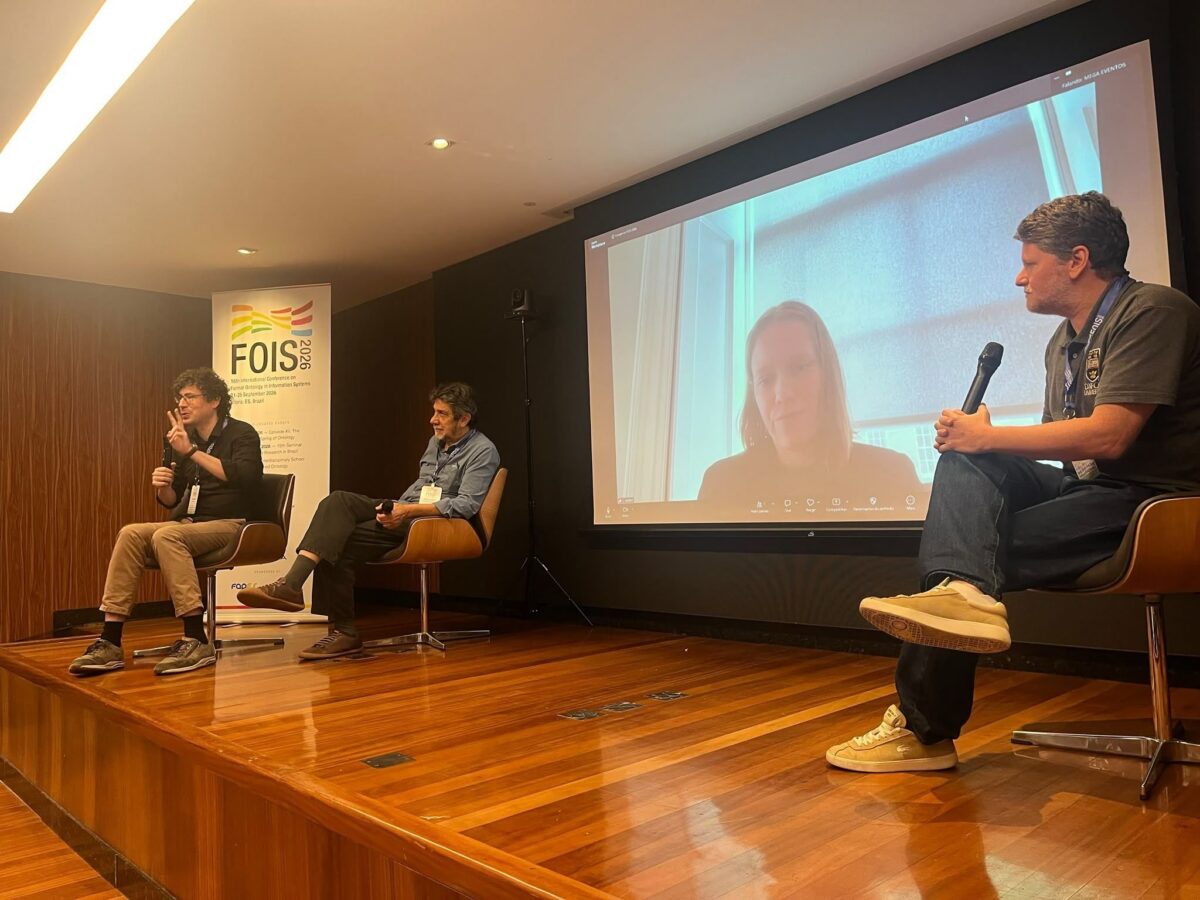
In addition to the opening talk, Hogan took part in the panel “Ontologies & Artificial Intelligence,” alongside other keynote speakers from the conference. The discussion addressed how ontology can contribute to the design, evaluation, and governance of artificial intelligence systems, and how recent advances in AI are raising new challenges for this field.
“When people talk about artificial intelligence today, they are mainly talking about the rapid advances in machine learning. But the notion of ontology also arises from symbolic artificial intelligence, whose goal is to define and instruct the machine on how to represent and use knowledge about the world,” explains Hogan.
The researcher notes that there is growing interest in combining ontologies with modern AI. In this context, the panel discussed “how ontologies can help improve AI platforms, and also what may happen if machines learn their own ontology (distinct from our human ontology): their own concepts, types of relationships, or ways of modeling the world”, he adds.
The conversation also addressed the social effects of AI, the need to avoid anthropomorphizing these technologies, the challenges associated with their concentration in a small number of companies, and the demand for greater control, explanation, and transparency. “On this last point, ontology can play a key role,” Hogan concludes.