
Congress Data: Query Congress Activity from Claude and ChatGPT
Developed by the Millennium Institute for Foundational Research on Data (IMFD), Datoscongreso.cl allows users to look up questions about bills and parliamentary votes from 1990 to the present, with links to official sources to verify each piece of data.
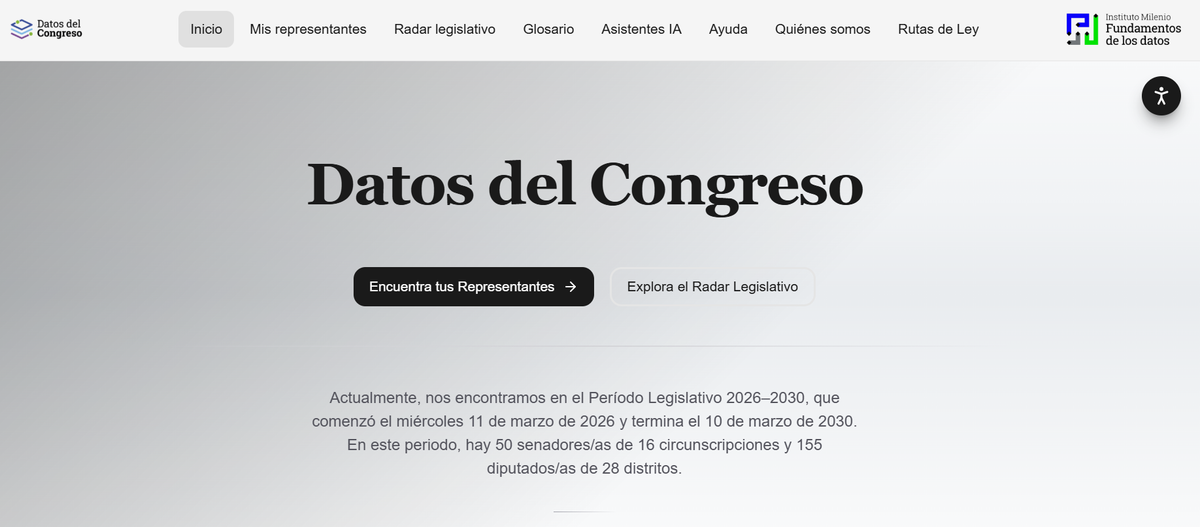
Datos del Congreso is a new platform that organizes information from the National Congress and translates it into understandable language, so that anyone can understand what Congress does and how it represents them.
Developed by the Millennium Institute for Foundational Research on Data, a scientific center hosted by several universities, the platform also offers the option of connecting to Claude and ChatGPT through a connector (MCP, for its acronym in English), which allows users to ask questions about legislative activity directly from those assistants. When it receives a question, the AI consults the platform’s database and responds with verifiable information, including links to official sources.
More than 35 years of bills and votes:
The site brings together bills processed since 1990, with every vote in their proceedings, and the activity of senators and deputies over the last 10 legislative periods. The information, which comes from the Senate, the Chamber of Deputies, and the National Congress Library (BCN), is structured using data science and artificial intelligence and is updated daily.
“The technical complexity lies in processing information scattered across multiple sources, structuring it using artificial intelligence algorithms, and presenting it on a platform that is simple to use“, explains Camila Díaz, executive director of IMFD, political scientist, and one of the project’s leaders. “Datos del Congreso seeks to build a bridge between the Congress’s public data and the people, so they can look it up and understand it in a clear, verifiable format“, she adds.
Institutional trust and access to information
The initiative emerges in a context of low institutional trust. According to an analysis by Pivotes based on the OECD’s Survey on Drivers of Trust in Public Institutions (2026), only 16% of people in Chile trust the National Congress, and 11% trust political parties. Facilitating access to legislative information is a precondition for informed participation.
According to the Dean of the Faculty of Social Sciences and Arts at Universidad Mayor, Ph.D. in Political Science and Researcher at the Millennium Institute for Foundational Research on Data, Sergio Toro, “Datos del Congreso has been an unprecedented effort to organize information about the legislative branch, complementing Congress’s institutional platforms. This very organization of the data will allow artificial intelligence tools to be used much more efficiently in searching for bills and parliamentary work“.
What can you find on Datos del Congreso?
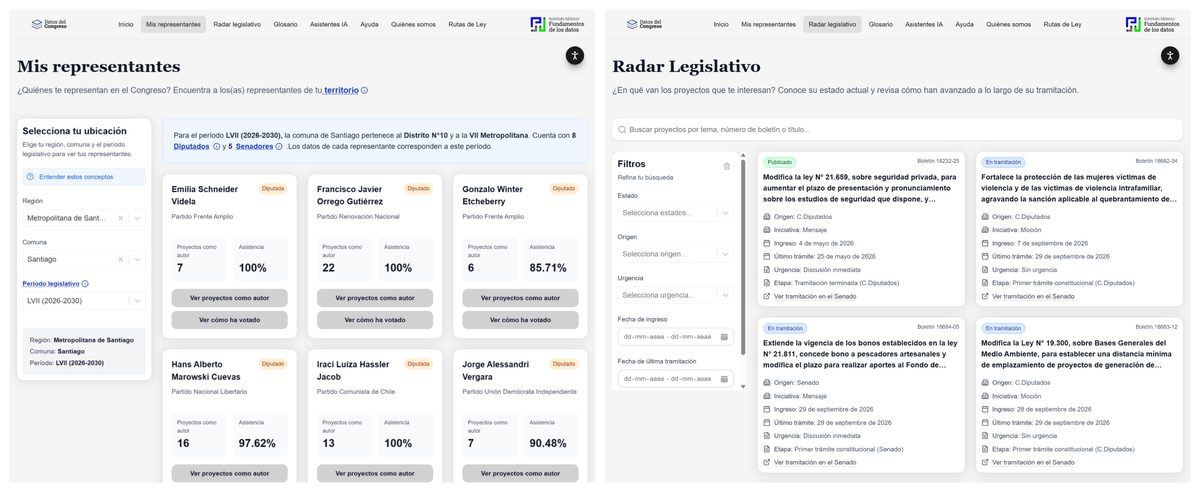
- Mis Representantes: Lawmakers’ votes by district, their attendance, and the bills they have introduced from 1990 to the present.
- Radar Legislativo: Allows users to check the status of legislative initiatives —in process, approved, rejected, archived, or inadmissible— with bulletin number, filing date, origin, urgency status, and links to official documentation.
- Rutas de Ley (coming soon): Explains, with historical context and visual storytelling, how laws that affect citizens are built in Chile, from the general process to specific cases, such as the Personal Data Protection Law.
The site also includes a glossary of the fundamental concepts of the Chilean legislative system.
How to use Datos del Congreso from Claude or ChatGPT?
First, link the Datos del Congreso connector to a Claude or ChatGPT account, following the instructions at datoscongreso.cl. Then simply ask about legislative activity, and the assistant will respond with information from the platform. For example: How did deputies from my district vote on the 40-hour work week law? Or what stage is bill X at, and what have been the main milestones in its proceedings?