
Assault for assault: award-winning study reveals dynamics of hostile comments on social media
"What an unpleasant girl" could be a comment on any social network, but it is also the title of one of the recent studies by Magdalena Saldaña, an academic at the Faculty of Communications of the Pontifical Catholic University of Chile and a researcher at the Millennium Institute Foundational Research on Data and Valentina Proust, professor at the Pontifical Catholic University of Chile. In this study, the researchers delve into the world of social media comments to analyze the dynamics that give rise to aggression among users, especially how gender affects them.
"Men are significantly more aggressive than women on social media, which was a result we expected. However, we found that women do not necessarily receive more hostility, which was an unexpected result." The explanation for this finding has to do with how conversations start on social media. The literature has shown that when a person is aggressive, they receive responses that are also aggressive. Since incivility attracts more incivility, men tend to post uncivil comments and therefore also receive more uncivil responses," explains Magdalena Saldaña. And when a person is not aggressive, she points out, "they may receive aggressive comments, but most likely they will not, and if you present yourself to the world in a civilized manner, you will most likely receive non-aggressive comments in response."

And women tend to comment in a normal way, Saldaña points out, which is not the case with men: they receive more hostility because they start by commenting in a very aggressive manner. "They start trolling, so those who respond to them do so in an uncivil manner." One of the conclusions of the study is that the more women are present in the conversation, the level of civility improves, since they do not initiate aggressive conversations and a dialogue or exchanges can develop that are free of hostility.
The study recently received dual recognition from the Association for Education in Journalism and Mass Communication (AEJMC): "Top Faculty Paper,", awarded by the Commission on the Status of Women; and second place in research on Latin America, "Latino/Latin American Communication Research Award", awarded by the AEJMC's International Communication division. These awards highlight both the quality and the results of the research, positioning the study, conducted in the context of Latin America and Chile, on a global level.
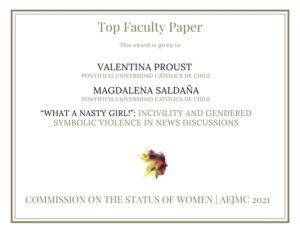
"What a nasty girl: Incivility and gendered symbolic violence in news discussions"was conducted using data collected from news comments on Radio Bío Bío's Facebook page over a limited period. This information was systematized by a team of IMFD researchers with the aim of measuring the levels of trolling and incivility in news comments. This study is one of the analyses carried out with this information, which has been worked on from different research angles. The infrastructure generated by the IMFD to carry out the analysis—created by Juan , DCC UC academic and IMFD researcher, and Florencia Barrios, P. Universidad Católica de Chile—"is what allows us to analyze in depth and study the behavior of People social media, particularly in news comments. This article is an example of what we can achieve with the interdisciplinary work of the IMFD," Saldaña points out.
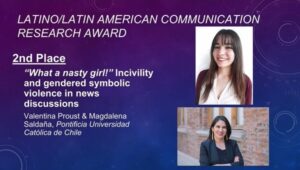
In addition to its outstanding results, the study also positions itself within the wave of feminist movements that have emerged in Latin America, which are giving significant impetus to gender studies in various areas. For Magdalena Saldaña, "it is likely that we will continue to delve deeper into these types of issues, which are particularly relevant in our society."