B-Call: A new compass for understanding volatility and ideology in Congress
In an increasingly fragmented political landscape, understanding how our representatives actually vote has become a challenge for traditional political science tools. Researchers from Millennium Institute Foundational Research on Data IMFD), together with specialists from the Catholic University, Mayor University, and Catholic University of Temuco, have developed B-Call (Bidimensional Analysis of Roll Call), an innovative methodology that allows legislative behavior to be mapped with unprecedented accuracy.
This research was conducted by an interdisciplinary team composed of Sergio Toro-Maureira, director of the School of Government and Public Administration at Universidad Mayor; Juan , professor in the Department of Computer Science at Universidad Católica de Chile; Lucas Valenzuela, from the Department of Computer Science at Pontificia Universidad Católica de Chile; Daniel Alcatruz, from Millennium Institute Foundational Research on Data Macarena Valenzuela, from the Department of Political Science, Sociology, and Public Administration at the Catholic University of Temuco. The study, recently published in the journal Frontiers in Political Science, proposes a paradigm shift for analyzing congresses that no longer respond to strict bipartisan logic.
The problem with traditional models
Historically, models such as W-NOMINATE have been the standard for placing legislators on a left-right spectrum. However, these tools were designed for stable two-party systems. In volatile contexts such as Chile or Brazil, these models often fail: when a legislator is unpredictable in their votes, the system tends to artificially place them in the ideological "center," when in reality their behavior reflects a lack of cohesion or ambiguity, not moderation.
In Chile, during the last legislative period, around 16% of deputies resigned from their parties. Beyond the political implications of this, these resignations complicate efforts to measure, as this behavior (resigning from the party) would artificially place them in the middle of the ideological spectrum, when their behavior reflects ambiguity and a lack of control on the part of the parties. This is one of the dimensions that the B-Call model seeks to remedy with a new proposal.
What makes B-Call different?
Unlike its predecessors, B-Call integrates two fundamental dimensions by treating each vote as a random variable:
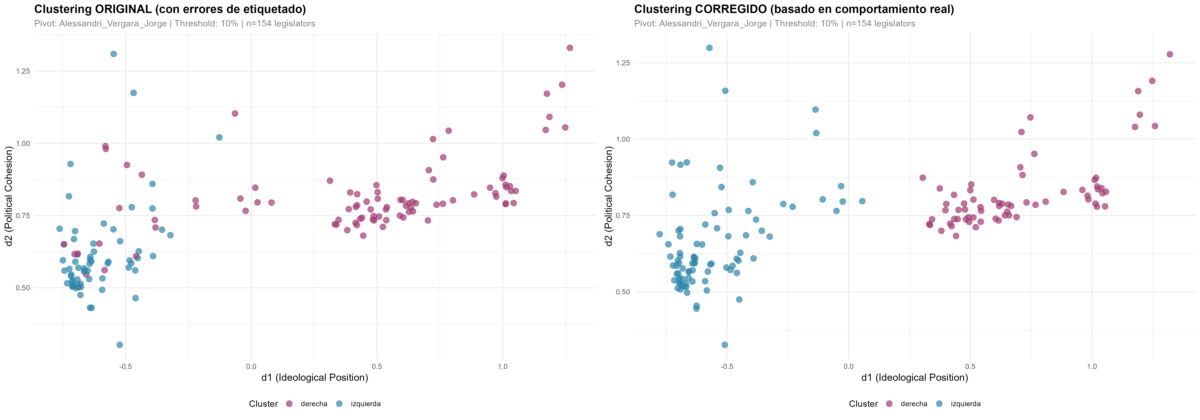
1. Dimension 1 (Ideological Position – d1): Places the legislator on the left-right axis based on the average of their votes.
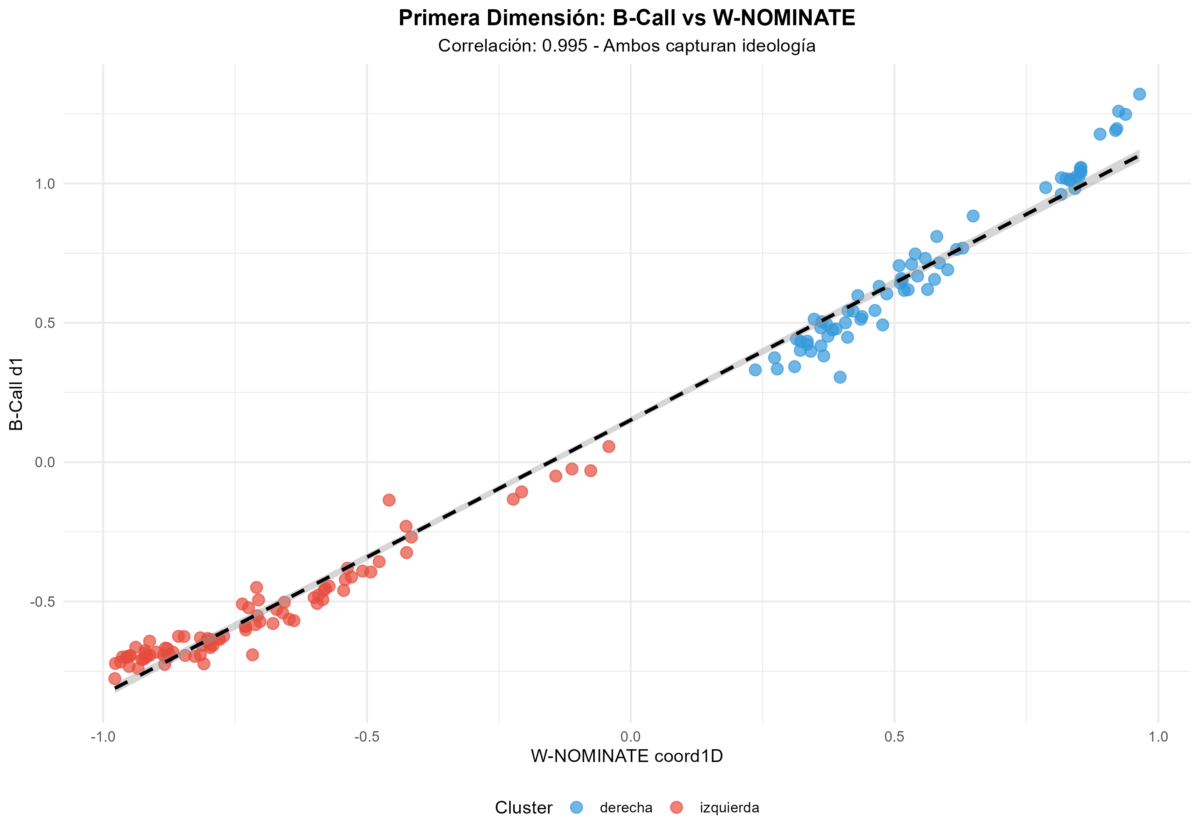
2. Dimension 2 (Cohesion – d2): Measures how consistent or volatile a person's voting behavior is.
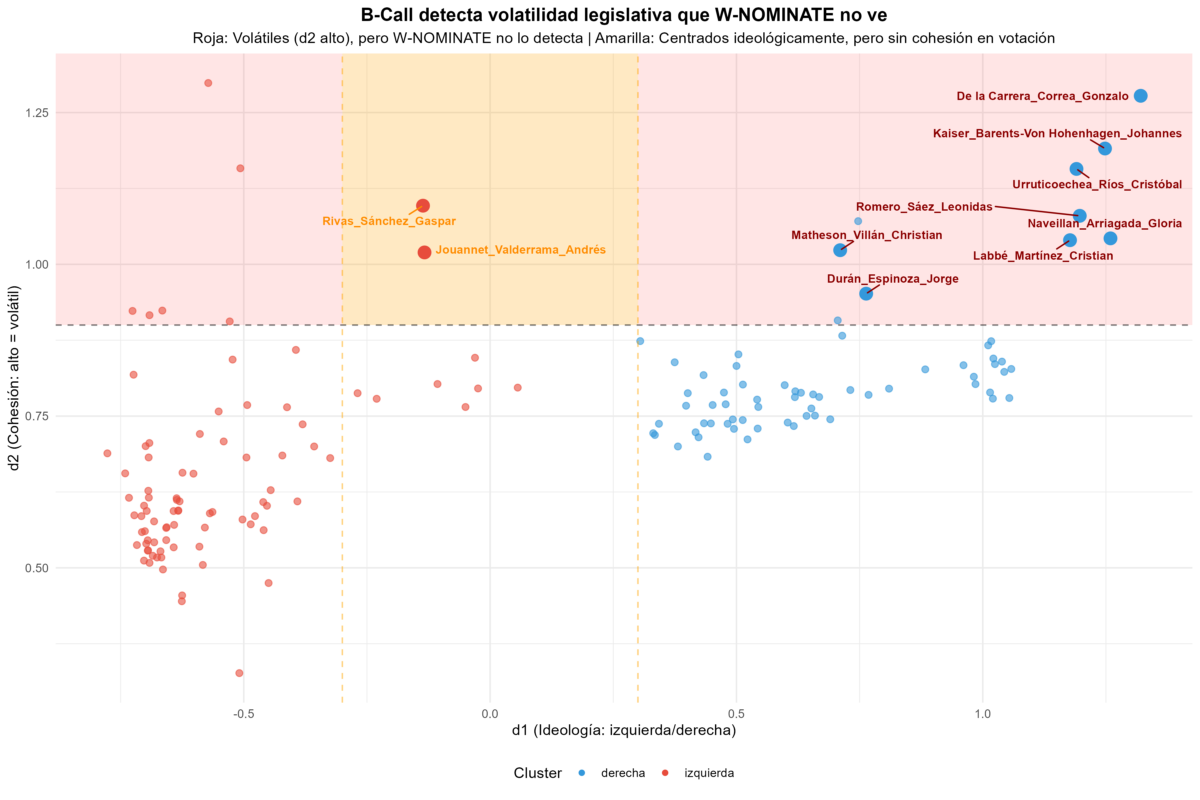
A low d2 indicates predictable behavior aligned with their sector, while a high d2 reveals a "volatile" legislator who fluctuates in their decisions. This distinction is vital: it allows us to separate politicians who are genuinely centrist from those who simply vote erratically.
Key findings in Chile, Brazil, and the US.
The study, which analyzed data from the last two decades, showed that B-Call corrects significant distortions in the perception of parliamentary behavior:
• The case of Gabriel Boric (Chile 2014): While traditional models placed him as a "centrist" within the left during his first term as a congressman, B-Call correctly positioned him on the far left, identifying that his apparent "moderation" was actually low cohesion with the traditional blocs of the time.
• Jair Bolsonaro (Brazil 2010): Before becoming president, the W-NOMINATE model placed him in a moderate position; however, B-Call identified him as one of the most conservative and least cohesive representatives in his sector.
• United States: The model detected areas of high volatility in figures such as Justin Amash and Bernie Sanders, who often display independent behavior that challenges the discipline of their respective parties.
Innovation from the IMFD for political analysis
This work, supported by the Millennium Science Initiative, not only provides a theoretical tool, but also a practical resource: the team has released the bcall package for the R programming language, allowing any analyst or citizen to replicate these studies with updated data. It is available here: https://alcatruz.github.io/bcall-example/
B-Call is emerging as an essential tool for political systems in transition, where coalitions are dissolving and personality politics are gaining ground over party discipline. By quantifying vote variability, this model offers the transparency needed to understand the real strategies behind every decision in Congress.