
With more than 170 attendees, the 11th ChileWiC 2023 Women in Computing Conference comes to a close
December, 2023.- With more than 170 enthusiastic participants filling the main auditorium of the Teaching Innovation Building at the University of Santiago, Chile (USACH), the 11th ChileWiC2023 Women in Computing Conference, which is supported by the Millennium Institute Foundational Research on Data.
The meeting was attended by the presence of the Undersecretary of the Ministry of Science, Knowledge, Technology, and Innovation, Carolina Gainza, as one of the keynote speakers. "Our gender analysis , the results of which I presented at this event, shows us that we need more women in STEM, in science, technology, engineering, and mathematics. It is very important that the academics and researchers who are in ChileWiC convey this so that we can continue to move forward," said the undersecretary.

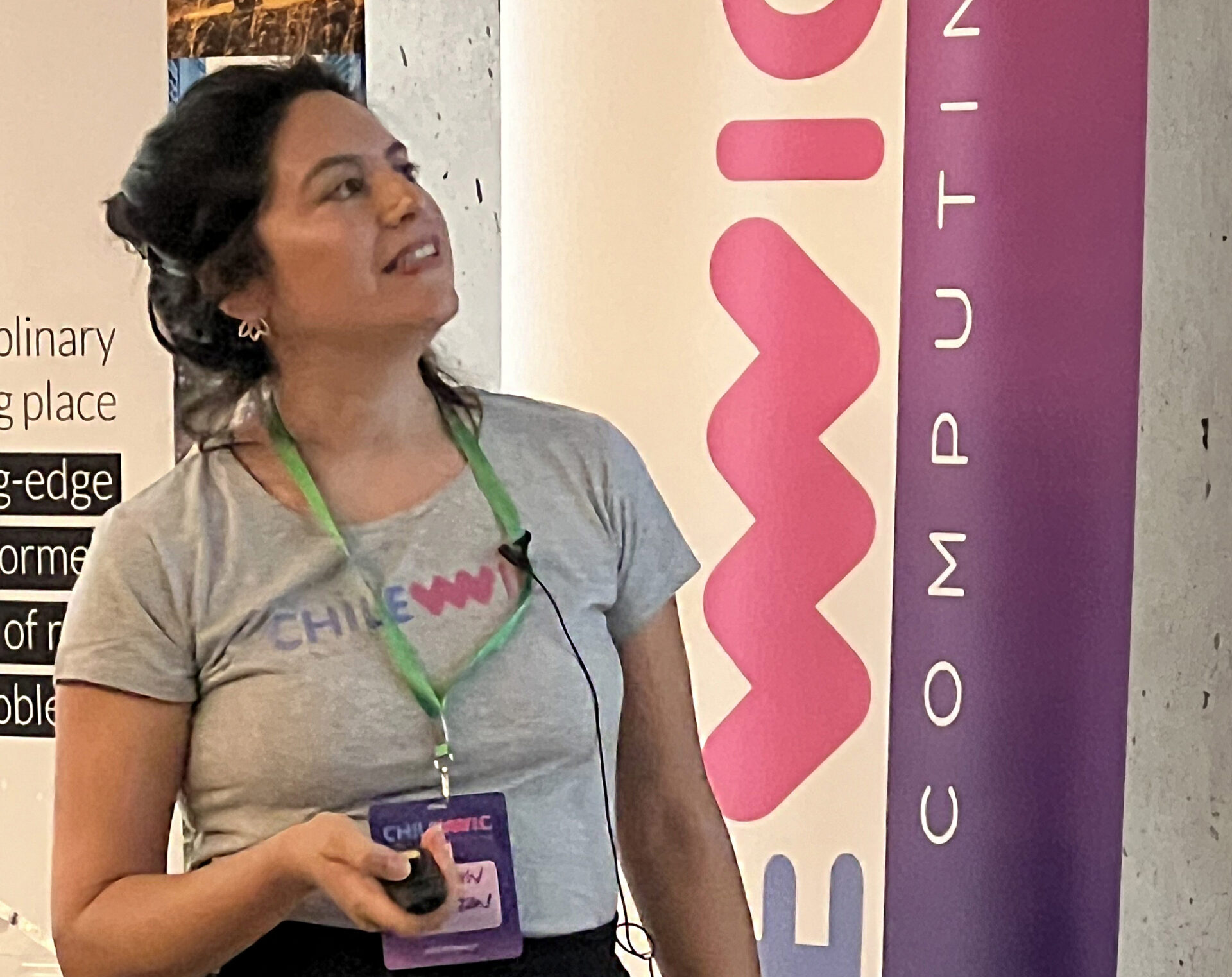
The event also featured the participation of Jocelyn Dunstan Escudero as the first keynote speaker. The academic from the Department of Computer Science and the Institute of Mathematical and Computational Engineering at the Pontifical Catholic University of Chileshared her career path, which took her from studying physics to currently leading research in data science applied to the field of health. "Having a space like ChileWiC to share our experiences as women in a highly male-dominated field is extremely necessary. Talking about our challenges, sharing our work, and especially how we approach the various situations that unite us is very useful and rewarding: it helps us realize that we have many things in common and that, indeed, we can do things to change what we want to change," says the academic, who is also a researcher at the Center for Mathematical Modeling (CMM) and the Millennium Institute Foundational Research on Data IMFD).
Student competition
One of the most important segments of ChileWiC is the student competition. Each participant gives a short presentation on their initiative, which is then reinforced in scientific poster sessions. "The student competition is one of the most relevant parts of the day. We love having participants from different universities and different regions, and when we review the topics they are researching, we see that, indeed, the inclusion of women also means including topics that broaden the diversity of what is addressed," says Claudia López, an academic at the Technical University Federico Santa María (UTFSM), researcher at the Artificial Intelligence Center (Cenia) and the FAIR Millennium Nucleus, and co-chair of ChileWiC.
The winner of the individual competition is Isabel Alvarado, a doctoral student at Benito Juárez University (Mexico) and professor of computer science at Universidad Mayor. "My project is called AgustiSpeaks. It is just getting started and was inspired by my son, who has level 2-3 autism. My idea is to contribute new ideas to therapies that address the communication needs of children with autism," says Isabel.
Meanwhile, the winners of the team competition are Michelle Naour and Sofía Medina from the University of La Frontera, who are studying how to create an early warning system for landslides.
The audience award went to the project by Antonia Bravo, from the Federico Santa María Technical University, Catalina Lenck, from the University of Santiago de Chile, and Constanza Contreras, a doctoral student at the University of Chile, which seeks to investigate techniques that enable the location of illegal businesses.
For Violeta Chang, head of the Computer Engineering and Informatics at USACHand host of ChileWiC 2023, "these initiatives are essential not only to motivate more girls and women to study STEM careers, but also to keep them in them, because—even if they enroll—many do not continue. We believe that the lack of role models has an impact on this, and the academics and professionals at ChileWiC seek to show them that they can study computing and be successful, and that there is a community of women willing to give them energy and support to keep going."
ChileWiC 2023 was organized by the Pontifical Catholic University of Chile, the Federico Santa María Technical University, the University of the Andes, the University of Chile, the University of La Frontera, the Mayor University, and the University of Santiago de Chile.
The meeting was sponsored by the Institute for Complex Engineering Systems (ISCI) and NIC Chile. It also had the collaboration of the National Center for Research in Artificial Intelligence (Cenia) and the Millennium Institute Foundational Research on Data (IMFD).
Source: ChileWiC.cl