
Regional special edition of Communications of the ACM recognizes the work of IMFD researchers
July, 2024.- Three IMFD papers are featured in the recent edition of Communications of the ACM: Latin American Regional Special Section. The special section, coordinated by Fabio Kon (University of Sao Paulo, Brazil), Sebastian Uchitel (University of Buenos Aires), and IMFD researcher and DCC UCH academic Barbara Poblete, seeks to present the most interesting and impactful advances in the region in the field of computer science.
Latin America is a highly heterogeneous continent, with great cultural, geographical, demographic, ethnic, linguistic, scientific, and technological diversity. When it comes to computer science, Latin American researchers have made significant contributions in multiple areas, such as software engineering, databases, networks and distributed systems, artificial intelligence, computer theory, and computer science education. In this Special Regional Section, we present only a small part of the work that researchers in Latin America are currently carrying out," the committee highlights in the video presentation of the special.
Better understanding the constitutional process
In Telar and TelarKG: Data-Driven Insights into Chile’s Constitutional Process, the multidisciplinary team at Millennium Institute Foundational Research on Data presents its work to analyze and better understand Chile’s first constitutional process. The aim was to weave together diverse data from disparate sources related to the constitutional process in order to obtain information and communicate the results to the Chilean public. "The analyses carried out were diverse and included observation of the use of bots on social media, the most discussed topics on social media during the process, the categorization and cohesion of emerging ideologies within the constitutionalists based on their voting patterns, etc. To disseminate the results, we had a weekly program on CNN Chile dedicated to the Telar Project to present and discuss our results and disseminate them directly to Chilean society," says Aidan Hogan, an academic at the DCC U. Chile and IMFD researcher.
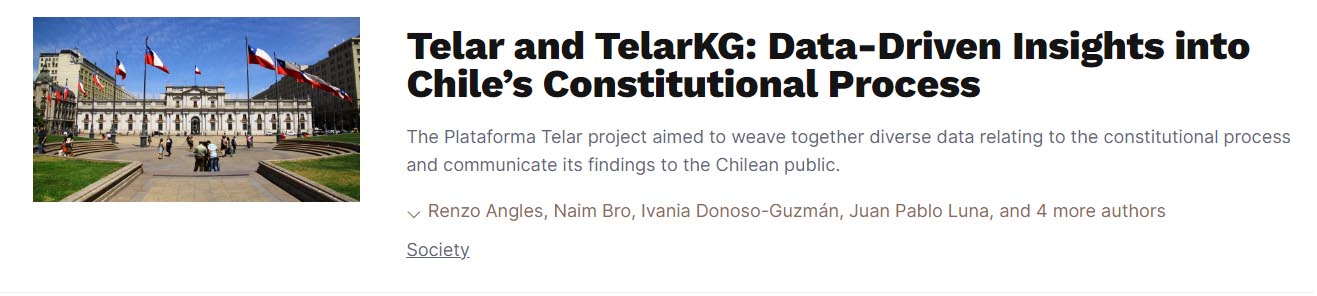
Renzo Angles (University of Talca), Naim Bro (Adolfo Ibáñez University), Ivania Donoso-Guzmán (Catholic University of Chile), Juan Luna (Catholic University of Chile), Aidan Hogan (University of Chile), Juan (Catholic University of Chile), Henry Rosales-Méndez (University of Chile), and Sergio Toro (Mayor University).
Differential privacy
Another published article is "Gradual Differentially Private Programming" by IMFD researchers and academics from the University of Chile Matías Toro, Federico Olmedo, and Éric Tanter, who explains that this research tackles the problem of how to develop software systems that use user data without violating their privacy, using a technique known as differential privacy. "Specifically, what we propose there is to make type systems designed to support programmers in respecting differential privacy more flexible by using a gradual approach, i.e., one that combines static verification with dynamic verification. This approach will facilitate the progressive and selective adoption of privacy annotations in programs that exploit sensitive individual data, thus providing early feedback to developers so that they can avoid accidentally violating data privacy," he says.

Efficient implementation of graph databases
Finally, Communications of the ACM includes in its edition on research in Latin America the article "Tackling Challenges in Implementing Large-Scale Graph Databases"by researchers Diego Arroyuelo (Catholic University of Chile), Aidan Hogan (University of Chile), Gonzalo Navarro (University of Chile), Juan (Catholic University), and Domagoj Vrgoč (Catholic University). This work reports on the research being conducted at IMFD on the efficient implementation of graph databases. "These databases make it easy to represent objects and the relationships between them, and they are rapidly emerging as an alternative to traditional relational databases in cases where the information is more heterogeneous and unstructured. All the major Internet companies are developing their own graph database engines. An example of a public graph database is Wikidata, which is used to provide information on Wikipedia pages," explains Gonzalo Navarro.
The article reports on the main results obtained and what they are working on. On this point, Navarro notes: "One challenge with these databases is that resolving queries on them is computationally expensive. For example, a more efficient alternative to BlazeGraph is being sought to replace it, and the IMFD is proposing one of our prototypes, MillenniumDB, to be the support that maintains Wikidata." The researcher also comments that they describe Ring, a development carried out at the IMFD, which allows queries from a very significant subset of SPARQL to be resolved using far fewer storage resources. He also points out that this article "describes the challenges they currently face, which are related to providing access to multimodal information, that is, not only about the relationships represented in the graph, but also about other information that objects may contain, depending on the type of data they represent."

—