
Marcelo Mendoza discusses polarization, disinformation, and political discourse on “Cómo te lo explico” podcast by La Tercera
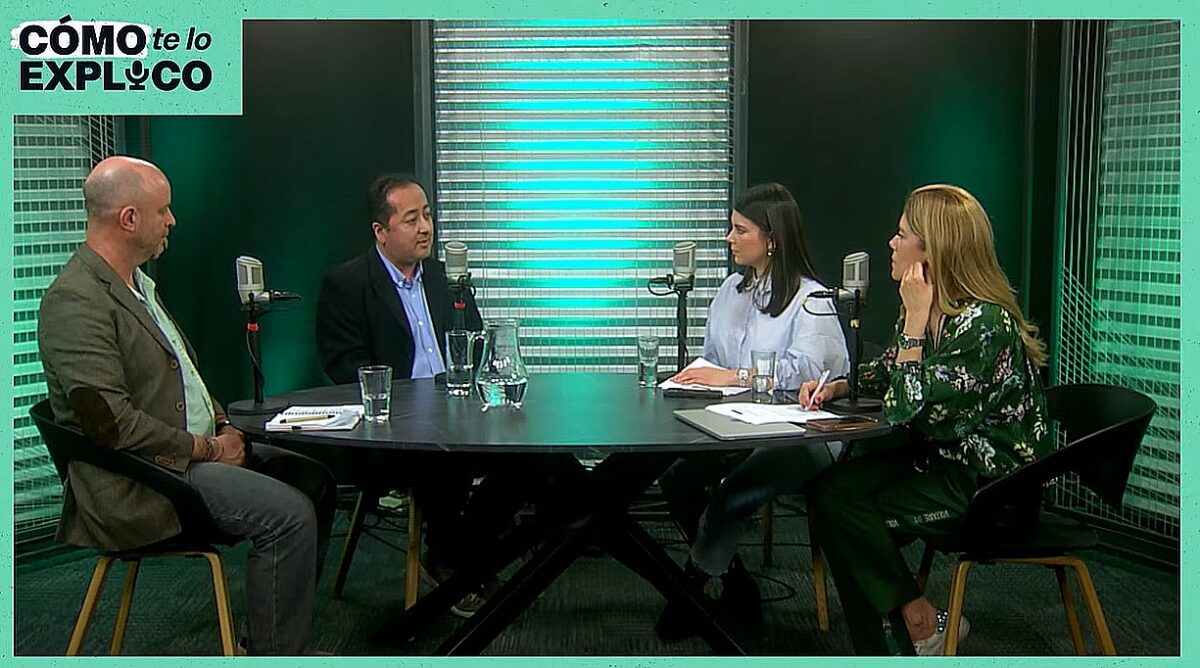
The UC academic and researcher at the Millennium Institute for Foundational Research on Data (IMFD) and the National Center for Artificial Intelligence (CENIA) joined Marcelo Santos, academic at Universidad Diego Portales (UDP), on La Tercera’s podcast “Cómo te lo explico,” hosted by Mónica Rincón and Paula Catena.
Marcelo Mendoza, academic at the Department of Computer Science of the Pontificia Universidad Católica de Chile (UC) and researcher at the Millennium Institute for Foundational Research on Data (IMFD) and the National Center for Artificial Intelligence (CENIA), took part in September in La Tercera’s podcast “Cómo te lo explico.” He was joined by Marcelo Santos, academic at Universidad Diego Portales (UDP) and researcher at the Millennium Nucleus for the Study of Politics, Public Opinion and Media (MEPOP), in the episode titled “Los seis meses de Kast” (“Kast’s Six Months”).
The researchers analyzed the relationship between hate speech, both on social media and in political discourse, starting with remarks made by Argentina’s President Javier Milei during the V Madrid Forum. The summit, held in Santiago, brought together right-wing leaders from 25 countries. In his opening speech, Milei described those who adhere to left-wing ideas as “filthy leftists.”
Asked how close Chile is to that kind of discourse, Marcelo Mendoza argued that what Milei does is introduce polarization within the elite. In other words, hate speech within public political discourse and communication among leaders. “That is something largely absent from the way politics is communicated in Chile,” he emphasized.
Social media: hostility and affective polarization
In the same conversation, the Millennium Institute for Foundational Research on Data researcher drew a distinction between polarization within the elite and affective polarization. The latter refers to the emotional distance between political groups: sympathy toward members of one’s own group and rejection of those who support opposing options. On social media, this polarization can manifest through hostile reactions and messages.
“Affective polarization occurs on social media and does not necessarily involve politicians, but rather people’s reactions. What we have measured is that, in general, hostility on social media is much greater among ordinary people than among the elite”, Mendoza explained. “This growing distance ultimately leads to irreconcilable positions; we are increasingly moving toward extreme discourse”, she added.
Disinformation and coordinated accounts in the 2025 elections
Disinformation is false information created and spread intentionally to deceive. It differs from misinformation, which is also false but shared without the intent to deceive. Both can circulate and be amplified on social media, especially in electoral contexts.
In this context, Mendoza and Santos referred to a case of disinformation that occurred during the campaign leading up to the first round of the 2025 presidential elections, in which manipulated videos were spread on social media claiming that candidate Evelyn Matthei suffered from Alzheimer’s disease.
According to Mendoza, the data show patterns of overlap between the accounts that amplified this disinformation and those that supported José Antonio Kast’s campaign: “The troll accounts that helped spread this disinformation about the candidate are the same ones that supported the messaging during the current President’s first- and second-round campaign. So that coordination, which exists both in terms of supporting a campaign and supporting a prior disinformation campaign, is something that is in the data and that we were able to measure in 2025”, Mendoza said.
To add to this, Santos explained the concept of an information cascade using the example of a troll’s tweet. According to his description, studies show a recurring pattern in which a troll account posts a tweet that is later shared by an organic user, and is subsequently amplified by a network of bots.
Civility in debates, disparagement on social media
Mendoza also stated that, during the 2025 campaigns, discourse adopted different strategies depending on the communication space. In debates, the tone was cordial and constructive, while on social media the language was considerably more hostile. “If we imagine it on a scale of energy intensity, it is like the difference between a tremor and an earthquake“, she stated.
According to the researcher, moral terms, insults, and hate speech predominate on social media. This is part of a strategy that, in his view, seeks to polarize audiences. “That can be measured, it is not something subjective (…) and it indeed shows that there is a design to the strategy that is specifically crafted for social media, one that is much more aggressive than the approach used in front of cameras or in the media,” he concluded.