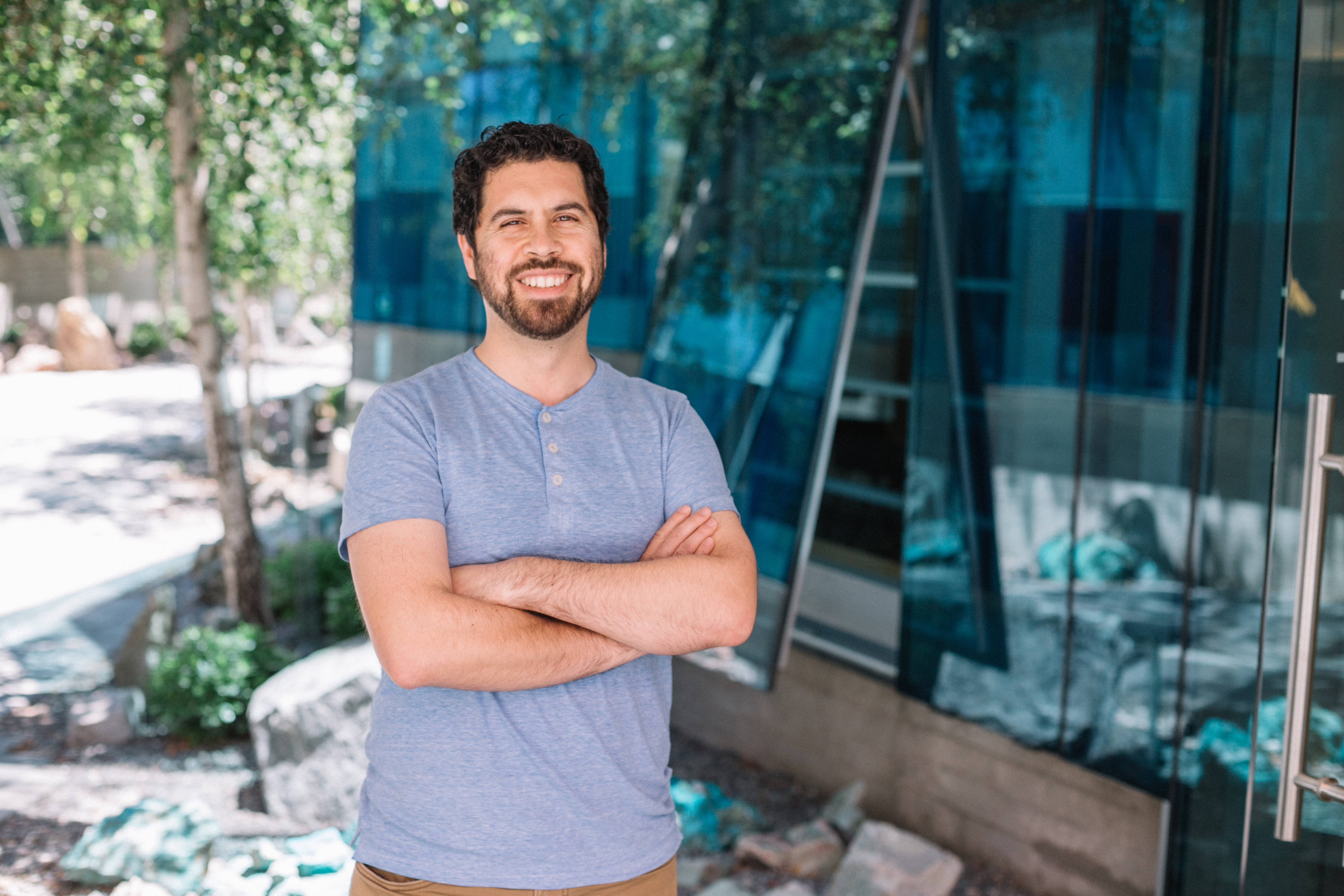
Denis Parra and his work on AI and art: replacing human beings is far from happening
Denis Parra, Computer Science academic at Universidad Católica and researcher at the Millennium Institute for Foundational Research on Data (IMFD), has been working for years in a less explored area within artificial intelligence (AI): its application in art and creative processes in general.
-What impact is the use of AI having on art and creative processes?
-The impact in recent times has been significant due to the number of techniques and tools available. But at the same time it is somewhat overvalued because, although some things have been automated, it is still not possible to eliminate the human being from the artistic process and creative processes in general.
-How would you describe that use or application, in practice?
-On one hand, AI tools that allow diversifying and supporting the creative process have increased a lot, both visually -for painting, photography and video- and sonically, for generating music. There is also text generation, thanks to the AI model called GPT2, which was invented last year. This shows that it is possible to start a sentence and have the AI develop a story from that statement, which reads as if it had been written by a human. There is also the possibility of combining these different art modes. However, completely replacing a human, both in the creative process and in choosing the message or theme to present, is still somewhat far from happening.
–Have pieces of art developed by AI been sold, for example?
-Yes, paintings made by AI have been sold, such as a painting that was sold in 2018 at the well-known auction house Christie’s, called “Portrait of Edmond de Belamy” (https://bit.ly/2IvFtQp), by the collective Obvious. They are based in Paris, France. This painting was created with an AI model called GAN and sold for more than US$400,000. However, there was still human intervention involved: which paintings to use to train the network and which painting to choose to bring to auction.
The process is not 100% automatic. This sale of “Portrait of Edmond de Belamy” generated a lot of interest and a second work of art, by Mario Klingemann, which is more of an installation with a system that constantly generates portraits. This was auctioned at Sotheby’s auction house, in March 2019, achieving a sale of 40 thousand pounds, that is, just over US$50,000.
-When and where did this emerge as an area of research or application?
-The use of AI for art has been seen for decades, but in recent years there have undoubtedly been important advances. Among the major advances in the last five years, which include the emergence of Deep learning models, we can count the so-called generative models: GANs (Generative Adversarial Networks) and VAEs (Variational Autoencoders).
Recently, “flow-based models” have also appeared, which, unlike GANs and VAEs, are reversible, meaning it is possible to go back in the creative process with AI and better modify/manipulate certain “inputs.” These latter have the potential to be more efficient than the original generative models in some tasks.
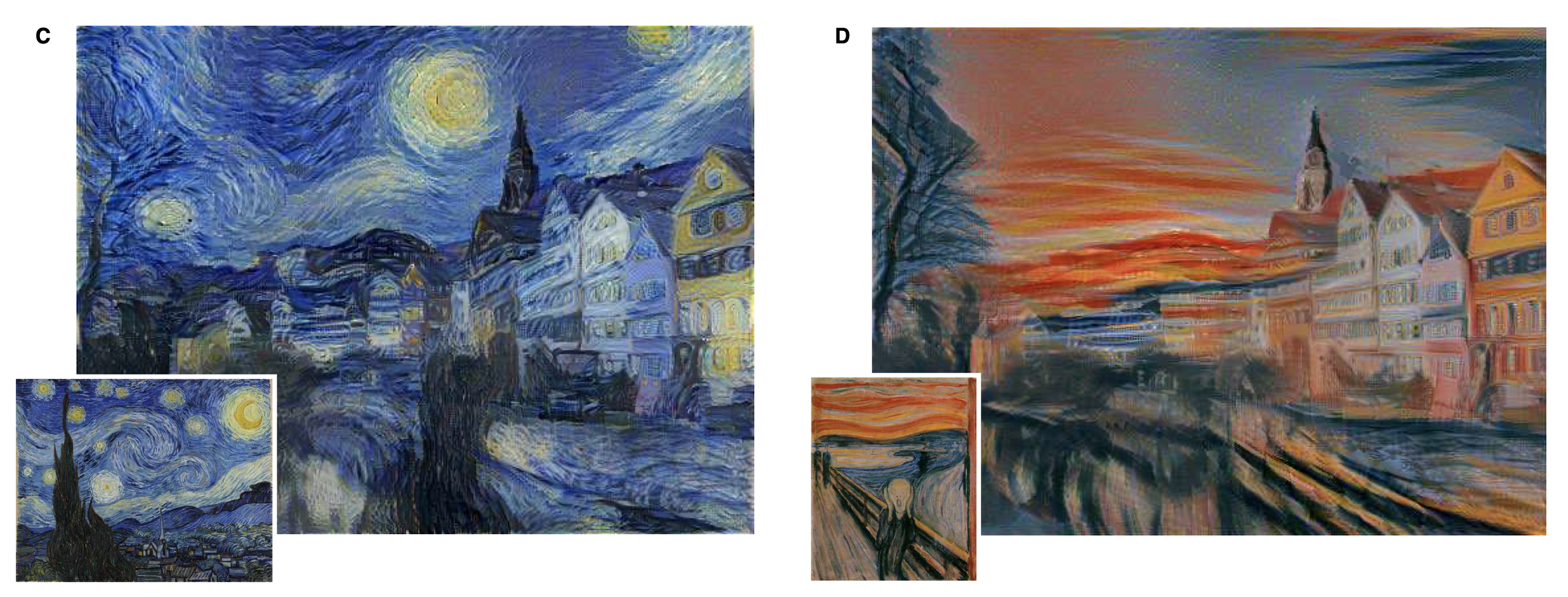
Another example that is much talked about and which even has applications today is the so-called “style transfer,” which emerged from a 2015 work by Gatys and other authors, from the University of Tübingen, in Germany. This allows giving a chosen artistic style -such as the paintings of Picasso or Van Gogh- to any input image (https://bit.ly/2TM4Brl)
Visual and musical recommendation systems
-What is the work you have developed on AI and art about?
-We have been working for about 3 to 4 years on art recommendation systems. This has been the starting point because we began using deep neural network models to recommend music and paintings. One of these papers is called “Content-based artwork recommendation: integrating painting metadata with neural and manually-engineered visual features.” There we show how to make painting recommendations using neural networks: https://link.springer.com/article/10.1007/s11257-018-9206-9
Another work I developed is a system that allows visually exploring musical artists and obtaining recommendations, as a user, based on the emotion projected by the artists the person chooses. It is called moodplay: http://moodplay.pythonanywhere.com/
-What is your research in this area aiming at? What impact could it have?
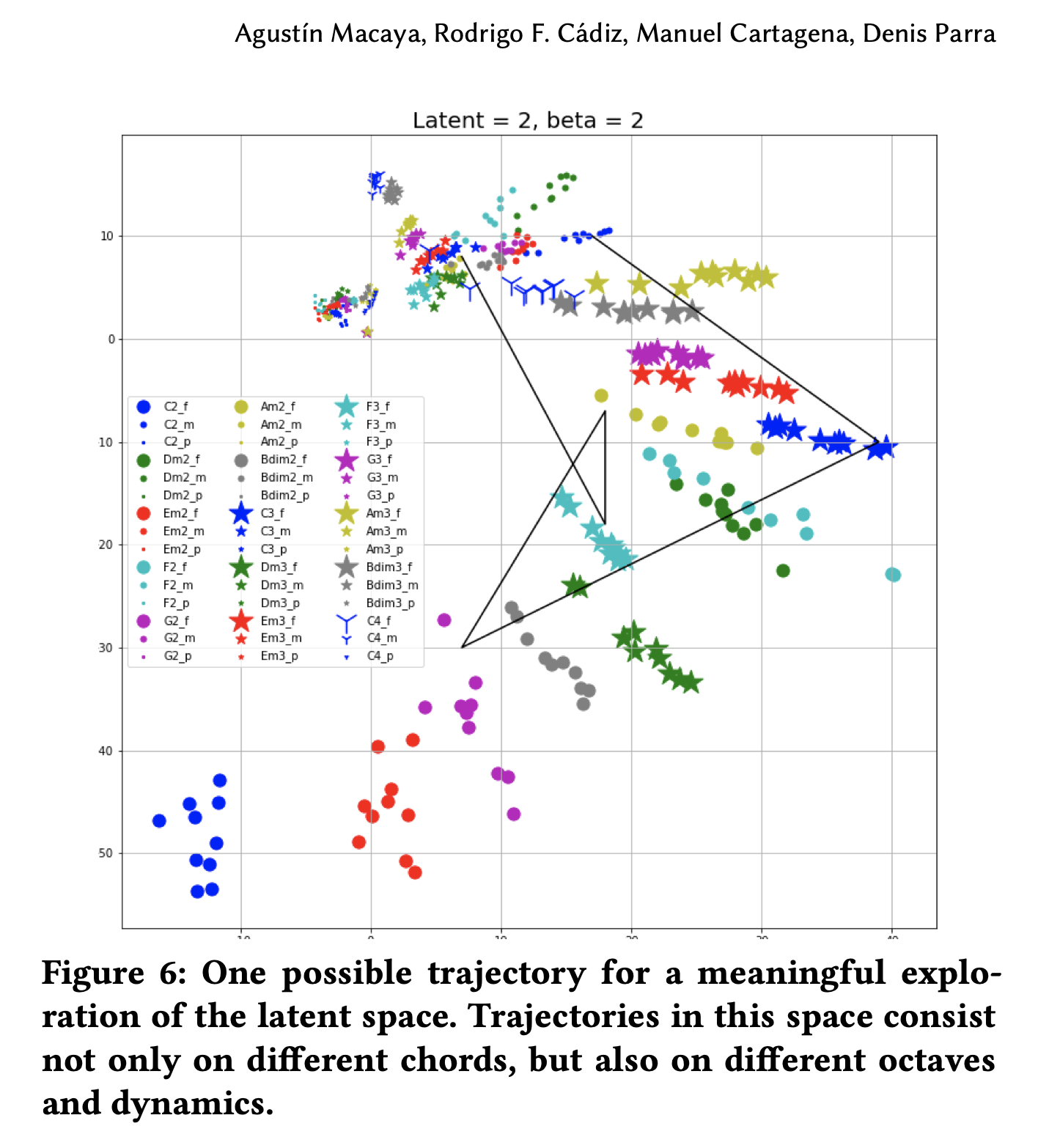
-My current research covers both the visual and musical areas; the latter in collaboration with Professor Rodrigo Cádiz, academic at the Institutes of Music and Electrical Engineering at U. Católica. Since last year we have had a group of students working at the CreativAI UC Lab (https://creativai-uc.github.io/) and the first result is a system based on VAEs, which learns to encode and reconstruct piano chords. But it can also create new chords not previously heard by the network. From this, it is even possible to create chord sequences mixing both new chords and those generated in real time. We hope to implement and release this tool on the web during 2020.
From this point we were able to move on to using models to generate content. In fact, we are training students in musical and visual content generation topics, creating tools that can be useful for the general public and for artists in their creative process. We hope to have some results in the coming months.
-And specifically in the visual area?
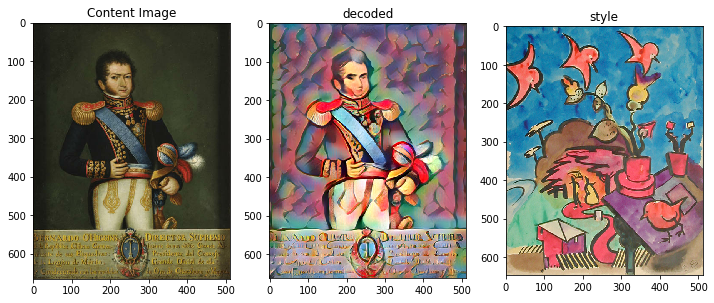
-We are working on image recommendation; artistic style transfer of works present at the Museo de Bellas Artes de Santiago; and personalized art generation, as well as some applications for architecture.
-Are there students working on these projects?
-Yes, in visual recommendation there are the students Pablo Messina, Felipe del Río, Patricio Cerda and Manuel Cartagena. In visual generation, Jorge Pérez Facuse and Eugenio Herrera. In music, Agustín Macaya and Manuel Cartagena. And in visual generation for architecture, Isidora Palma. They are all students at U. Católica.
-How can your line of work help artists?
-The work presents new AI possibilities for disseminating the art that artists currently create. It also broadens the current horizon of artistic creation, showing them AI tools that can be useful for visual, musical and text art.
-Does this use of AI threaten to put an end to the creative processes carried out by people?
-Although there is some disagreement on this point, I share the opinion of researcher Aaron Hertzmann, who in an article called “Can Computers Make Art” draws a parallel between current AI technology and the emergence of the photographic camera. In summary, he believes that art lies mainly in the message the artist wants to convey. The truth is that, being still far from general AI -independent and flexible systems that can decide for themselves what to learn, how to do it, and make inferences and connections between different areas of knowledge and art-, I do not see current models having the intention to express something and thus generate art. In practice they remain tools, sophisticated but tools nonetheless, and not creators of art.
-Are there other aspects to consider regarding the impact of AI on art?
-Yes, unresolved copyright aspects, such as who holds the rights to the work. The artist or the algorithm that produces it?
Additionally, artistic-type applications such as those that allow manipulating style can be used to synthesize images or videos for political purposes, or to blackmail people, such as deep fakes. Finally, there is a potential risk of facilitating plagiary or the black market for copies of originals.