
Martin Hilbert: it is now possible to predict human and social behavior with over 80% accuracy
The digitization of all data produced by humankind through technology (from the earliest record-keeping systems to the present day) has taken less than 30 years: while in the mid-1980s less than 1% of information was in digital format, today that figure reaches 99%. Its magnitude is such that digital information today is comparable to that contained in the entire biosphere and, even more astonishing, behaves in a similar way: data on the internet grows exponentially, replicates with high fidelity, evolves by developing differentiated abilities, expresses itself through artificial intelligence, and has a virtually limitless capacity to recombine.
These are just some of the ideas that Martin Hilbert, an academic at the University of California, Davis, United States, uses to illustrate the significance of the size the digital universe has reached and—above all—the level of precision in understanding and predicting human behavior that artificial intelligence systems can provide.
Hilbert, who holds a PhD in Economic and Social Sciences (2006) and in Communication (2012), recently visited the Millennium Institute for Foundational Research on Data (IMFD) and gave a talk at the Department of Computer Science of the Universidad de Chile, where he addressed advances in artificial intelligence and the risks of generating biased readings (in terms of gender or ethnicity, for example) of reality.
Artificial intelligence here and now
As just one example of how deeply embedded artificial intelligence (AI) is in society, Hilbert noted that 85% of stock market transactions are carried out by these systems. Political campaigns and consumption patterns are other scenarios in which AI already plays a highly relevant role, processing, understanding, and predicting people’s behavior, and identifying the factors that influence their decisions.
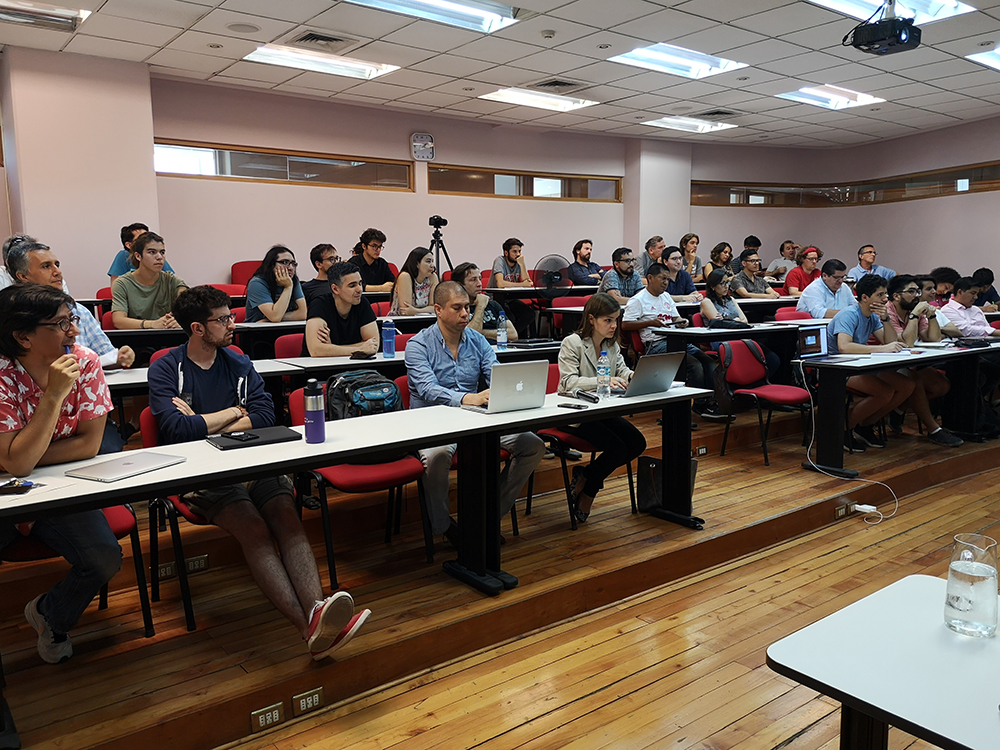
For Hilbert, the problem is not the technology itself, but the uses being made of it, which can affect democracy. For this reason, he stressed that it is extremely important to strengthen research that studies data from its foundations to its applications. “We can now make predictions with up to 95% accuracy, based on data, its analysis, and theory. Data has given social sciences the push they needed to become a science,” said the academic at the Universidad de Chile.
Information, development, and outreach
Martin Hilbert is the creator and coordinator of the Information Society Program at ECLAC. For 15 years, he served as an Economic Affairs Officer for the United Nations, a role in which he acted as a technical advisor for the digital development of more than 20 countries. He also worked as a former advisor to the Library of Congress of the United States.
His work has been published in some of the most renowned journals, such as Science, Psychological Bulletin, Trends in Ecology and Evolution, and World Development, and he regularly appears in media outlets such as The Wall Street Journal, Washington Post, The Economist, NPR, BBC, Die Welt, among others.
During his time in Chile, Hilbert was a speaker at the 2019 edition of Congreso Futuro and took part in Lo Mejor de las Noches Nerd en Chile, in a joint talk with Marcelo Arenas, director of the Millennium Institute for Foundational Research on Data and Full Professor at the Universidad Católica.
More information at www.martinhilbert.net.