
From the Wikipedia Edit-a-thon to Publication: 10 Chilean Scientific Institutions Now Have Published Articles
The Science and Technology Editathon 2026, organized by the Millennium Institute for Foundational Research on Data (IMFD) together with Wikimedia Chile and with the collaboration of the Department of Computer Science of Universidad de Chile, brought together 14 institutions. Ten completed all stages of the process and already have articles published in the free encyclopedia.
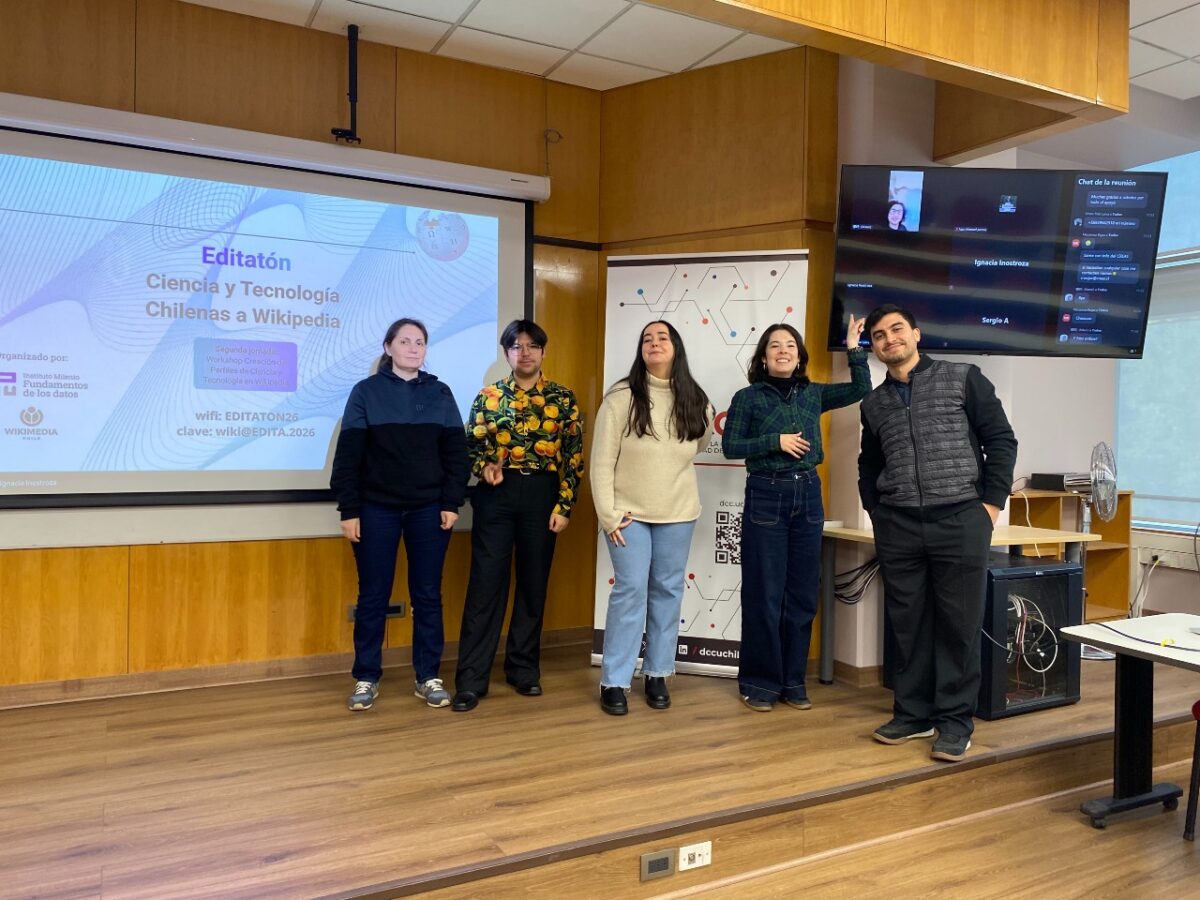
In June of this year, 14 scientific and technological research institutions from Chile participated in the Science and Technology Editathon 2026, organized by the Millennium Institute for Foundational Research on Data (IMFD) together with Wikimedia Chile and with the collaboration of the Department of Computer Science of Universidad de Chile. After the editing, review, and publication process, ten of them already have a new article on Wikipedia.
The initiative sought to bring scientific and technological research institutions and centers closer to the tools and editing criteria of this digital platform, promoting a greater presence of Chilean science on one of the most consulted open knowledge platforms worldwide.
The criteria behind a Wikipedia article
One of the main lessons of the editathon was that Wikipedia operates under specific editorial principles. These include encyclopedic relevance, verifiability, the use of reliable and independent sources, a neutral point of view, and the absence of original research.
Encyclopedic relevance, for example, means that an institution must have significant coverage in external sources to justify the existence of its own article. It is not enough for it to have a track record, a website, or institutional publications: there must be information about it in independent sources, such as media outlets, books, academic publications, or documents from public institutions.
On the other hand, verifiability requires that relevant data can be verified through published references. Thus, information about the founding of an institution, its research lines, awards, or projects must be backed by sources that allow readers to check and delve deeper.
Another fundamental aspect is neutrality. Wikipedia articles do not seek to promote or defend an institution, so they must avoid subjective descriptors and prioritize the description of concrete, verifiable facts.
Finally, the principle of no original research establishes that Wikipedia is not a space for presenting new interpretations or conclusions. Its purpose is to compile and synthesize knowledge that has already been previously published in reliable sources.
10 institutions are now on Wikipedia
As a result of the process, so far, editors responsible for ten institutions have completed the editathon stages and their articles are now published on Wikipedia:
- Instituto Milenio Fundamentos de los Datos (IMFD)
- Centro Regional de Estudios de Alimentos Saludables (CREAS)
- Centro de Investigación Avanzada en Educación (CIAE)
- Instituto Milenio de Investigación en Óptica (MIRO)
- Centro Científico Tecnológico de Valparaíso (CCTVal)
- Centro Avanzado de Transporte, Logística y Competitividad Económica (CATLEC)
- Núcleo Milenio de MXenos Avanzados para Aplicaciones Sostenibles AMXSA
- Instituto de Estudios Indígenas e Interculturales (IEII)
- Fundación Ciencia & Vida (FCV)
- Instituto Milenio en Inmunología e Inmunoterapia (IMII)
The publication of these articles helps expand the information available about institutions conducting scientific and technological research in Chile and facilitate access to their histories, areas of work, and contributions through an open platform with global reach.
Want to learn the basic principles for editing on Wikipedia?
Read here the “Brief manual for editing articles on scientific and educational institutions on Wikipedia in Spanish”, prepared by Wikimedia Chile and used in this editathon.