
Chilean universities launch Vincula: the collaboration network between academia and Congress developed by IMFD Innovation
May 2023.- With the attendance of representatives from the Executive Branch, Legislative Branch, and academia, the Vincula project held its official launch on May 26 at the Casa Central of the Universidad Católica, with the goal of strengthening legislative work through collaborative efforts, data intelligence, and better access to scientific evidence.
The platform facilitates connections between people from academia and congresspeople and their advisors, through a system created by the Innovation area of the Millennium Institute for Foundational Research on Data (IMFD). This web application applies natural language processing (NLP) techniques that, using information generated by both universities and Congress, make it possible to establish links between topics of interest and academics who specialize in those areas, so that knowledge and scientific evidence are readily accessible to those working on the creation of legislation in our country.
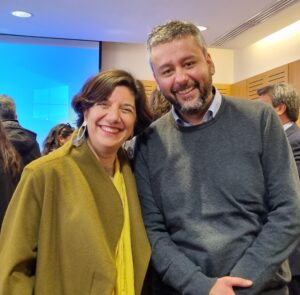
“With this, we are fulfilling one of the objectives we have had since the founding of our institute: using the knowledge we generate to contribute to advances that benefit society as a whole”, says Marcelo Arenas, director of the Millennium Institute for Foundational Research on Data. Vincula is a pioneering initiative, unique in Latin America, but there are other entities with which it collaborates and from which it draws best practices at an international level, such as Research Impact Canada, Universities Policy Engagement Network (United Kingdom), Advancing Research Impact in Society (United States), and Africa Research and Impact Network. These five initiatives are part of the Research Impact Network, with Vincula being the only representative at the Latin American level.
For Francisca Reyes, manager of the Vincula platform and academic at the Instituto para el Desarrollo Sustentable de la P. Universidad Católica de Chile, cross-institutional collaboration can be understood as a clock, which, to function properly, requires many interconnected gears: “In this way, science is mobilized for the benefit of society as a whole”.
“This is a first step toward recognizing the importance of science, but also understanding that academics and researchers must contribute to the changes needed in society and in public policy,” said at the presentation the Vice-Rector for Research and Development of the Universidad de Concepción, senior researcher at the Millennium Institute for Foundational Research on Data and co-director of Vincula, Andrea Rodríguez Tastet.
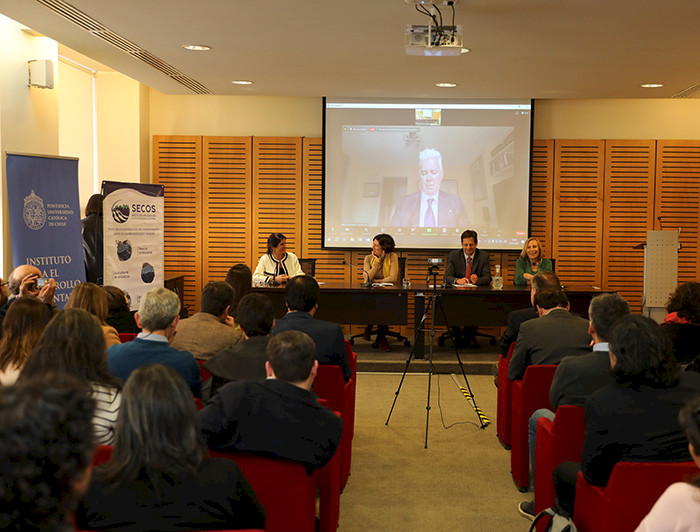
In the panel following the presentation of the platform, the Vice-Rector for Research at UC, Pedro Bouchon said that “it is very important for universities and our academics to understand how the legislative process and its timelines work. Otherwise they might arrive too early or too late,” while the Minister of Science, Technology, Knowledge and Innovation of Chile, Aisén Etcheverry, emphasized that the language and timelines of universities and politics often differ. “We must assess what type of scientific knowledge will be required for the design of public policy”.
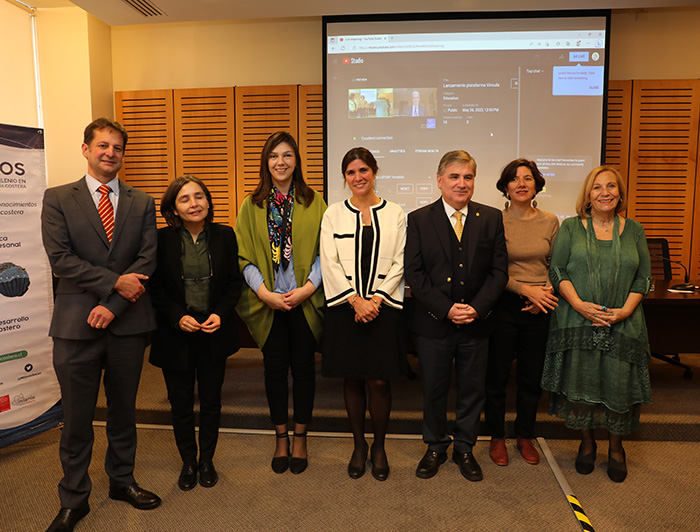
“Science must be connected to people and institutions. Sometimes universities are very insular,” said Deputy Helia Molina, who has worked as an academic at various universities, such as UC and Universidad de Santiago.
Source: Noticias UC