
Knowledge Graphs: An Integrated Vision of Knowledge Graphs
Knowledge Graphs aims to give a general introduction to a new area of knowledge management in the digital age called knowledge graphs. “This book provides an integrated view of knowledge graphs, both in the academic world and in industry. This is because there are several perspectives on what constitutes a knowledge graph, in which cases it is useful, etc.”, explains Aidan Hogan.
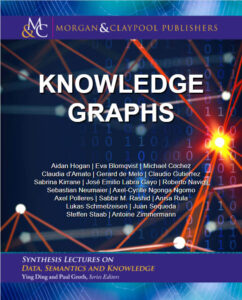
For his part, Claudio Gutiérrez points out that knowledge graphs are the counterpart of databases in the field of knowledge. “They integrate decades of research on ways to store and make knowledge available in digital format. In that sense they distill the experience of semantic networks, knowledge bases, expert systems, and, more recently, machine learning techniques, to offer user-friendly systems for managing knowledge at all levels.”

These systems are used in organizations to integrate, manage, and disseminate knowledge on a large scale, explains Aidan Hogan: “In 2012, Google announced the use of the Google Knowledge Graph to improve its Web search functionalities. Since then, several large companies -such as, for example, Airbnb, Amazon, eBay, Facebook, LinkedIn, Uber, etc.- have presented their own knowledge graphs in the context of various applications related to search, recommendations, advertising, chatbots, etc. Since as early as 2017 or 2018 there has been a lot of interest, not only in industry, but also in various academic communities”.

Hogan indicates that this book is aimed at any person and organization interested in knowledge graphs, but to be able to approach it, one needs to understand some general computing concepts such as databases, machine learning, programming, etc. “This book is very relevant for teachers and advanced undergraduate or graduate students, for researchers in the same field or in related fields, for professionals who want to apply this technology in their organizations, etc.”.
It is worth noting that Knowledge Graphs originated from an international seminar in Dagstuhl, Germany, involving a large group of researchers: Eva Blomqvist, Michael Cochez, Claudia d’Amato, Gerard de Melo, Sabrina Kirrane, José Emilio Labra Gayo, Roberto Navigli, Sebastian Neumaier, Axel-Cyrille Ngonga Ngomo, Axel Polleres, Sabbir M. Rashid, Anisa Rula, Lukas Schmelzeisen, Juan Sequeda, Steffen Staab, Antoine Zimmermann and DCC faculty members Aidan Hogan and Claudio Gutiérrez.
Aidan Hogan highlights that among the goals they have for this book is that it can be used in undergraduate and graduate courses. Also, that it be a reference book for researchers in the field and, lastly, that it bring together different communities interested in knowledge graphs. “The book places a lot of emphasis on demonstrating how the field of knowledge graphs also incorporates topics from the database, logic, knowledge representation, network analysis, machine learning, semantic web communities, etc. It is, in a way, a call to different communities to consider knowledge graphs as a unifying viewpoint in the field of knowledge management in the digital age”, he concludes.
Free online version of Knowledge Graphs
Source: Comunicaciones DCC U. Chile