
ICLR 2020 Conference: Learn About the Research Presented by Jorge Pérez
It is the most important conference in the field of deep learning, or deep neural networks, “which is the most effective artificial intelligence (AI) technique and the one achieving the best results today,” says Jorge Pérez, researcher at the Millennium Institute for Foundational Research on Data (IMFD) and faculty member of the Department of Computer Science (DCC) at Universidad de Chile. The researcher is referring to the scientific gathering ICLR 2020 (International Conference on Learning Representations). The conference was originally supposed to take place in Ethiopia, but it was held in an online format in late April.
“The conference is called Learning Representations, because that is what neural networks do: they learn representations of data, which then allow them to make very good decisions,” explains Pérez.
ICLR is a top-tier gathering held every year that is key for the fields of deep learning and AI. The reason? It is where the latest results from work by the world’s most important universities and research centers are presented.
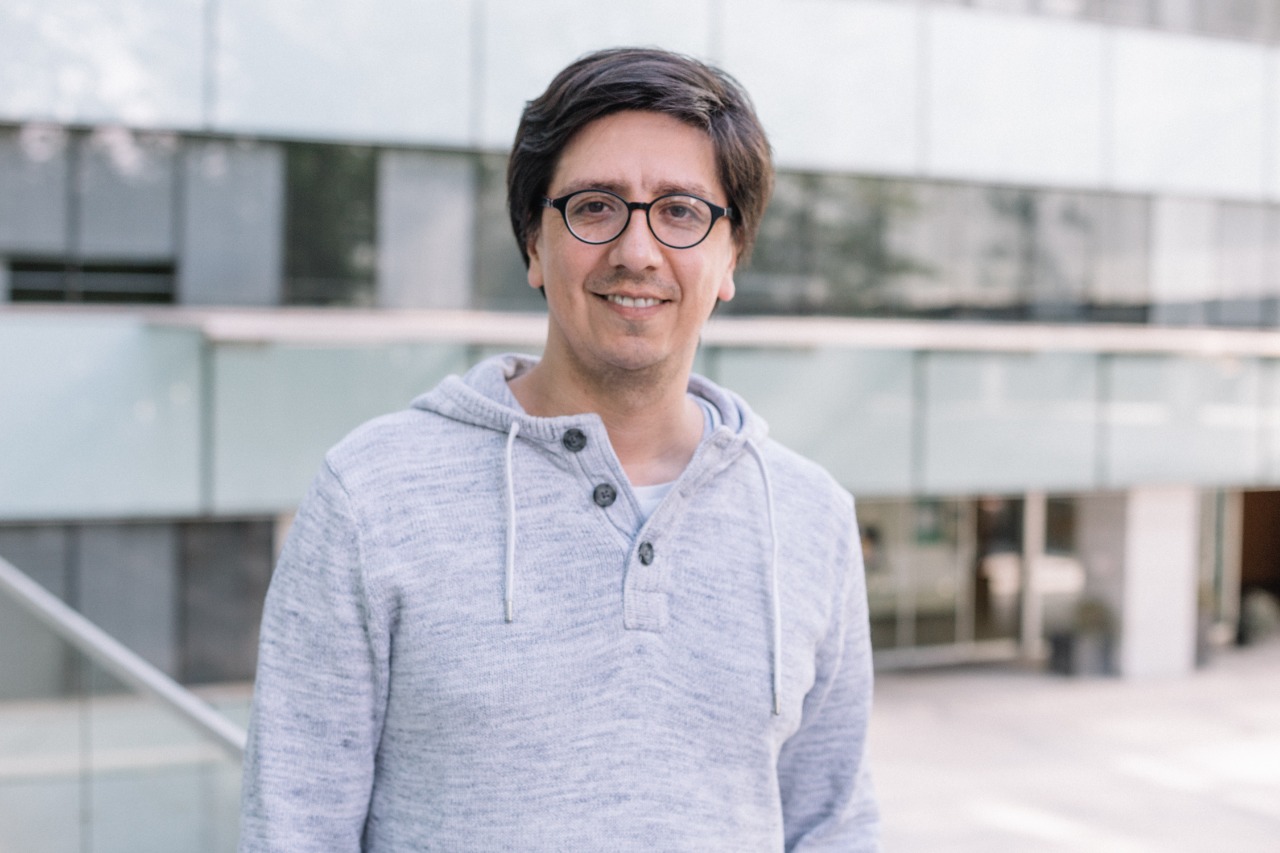
Along with several co-authors, the IMFD researcher presented three papers related to these topics. “At the ICLR main conference I presented a work I did with Pablo Barceló -deputy director of IMFD-, which is a specific research on deep neural network theory,” the academic details.
Titled “The Logical Expressiveness of Graph Neural Networks,” this article provides certain insights to understand the expressive power of Graph Neural Networks –neural networks that receive graphs as input–, that is, “what things they can do and learn, and which they cannot. And we do this from the point of view of classical computational logic,” says Pérez. One of the main results is that the most commonly used Graph Neural Networks, in practice, “are equivalent to what certain knowledge representation logics can express, thus joining two quite different areas of AI. This also opens up the possibility of being able to explain what these neural networks do more precisely, although that remains to be seen,” he adds.
Another of the papers the academic presented at an ICLR 2020 workshop has to do with medicine and an AI application he developed, together with his team, for Clínica Las Condes. “The work was published at the AI for Affordable Healthcare workshop. The idea is to predict when a patient will need to be re-hospitalized after being discharged. We showed how to achieve a prediction from unstructured data using Spanish-language text.”
That article -called “Predicting Unplanned Readmissions with Highly Unstructured Data“- was written together with Constanza Fierro, who currently works at Google, and Javier Mora, a cardiovascular surgeon.
His participation in the conference also included the presentation of the paper “Practical ML for Developing Countries,” which seeks to generate high-precision models for automatic natural language processing in Spanish, “in particular, models based on neural self-attention,” Pérez indicates.
The research behind that work is called “Spanish Pre-Trained BERT Model and Evaluation Data,” where they present a model also known by the name BETO. He worked on this together with José Cañete, Gabriel Chaperón, and Rodrigo Fuentes, from the DCC at Universidad de Chile, and Jou-Hui Ho and Hojin Kang, from the Department of Electrical Engineering at Universidad de Chile.
Pérez says the works were very well received and there were many questions. “Our paper at the main conference blended two quite different areas of AI, namely neural networks and knowledge representation. That drew a lot of attention, especially from young researchers. The most common question was ‘how did you come up with the idea of mixing these two things?’ You see the result of research, which is an article. But there is a lot of work over a long time that we had been doing with Pablo Barceló and other co-authors, to blend those two areas.”
BETO will have a big impact, the academic adds, because it is a resource that is available “for everyone to use, and there was not another one of that kind in Spanish. I really hope many people use it. Regarding the work we did in the field of medicine, there is a very interesting factor, which is that it could be applied in public hospitals. We are working to be able to move it in that direction.”
If you want to learn more about BETO, visit this link: https://imfd.cl/beto-la-red-neuronal-que-podria-ser-utilizada-durante-el-proximo-proceso-constituyente/