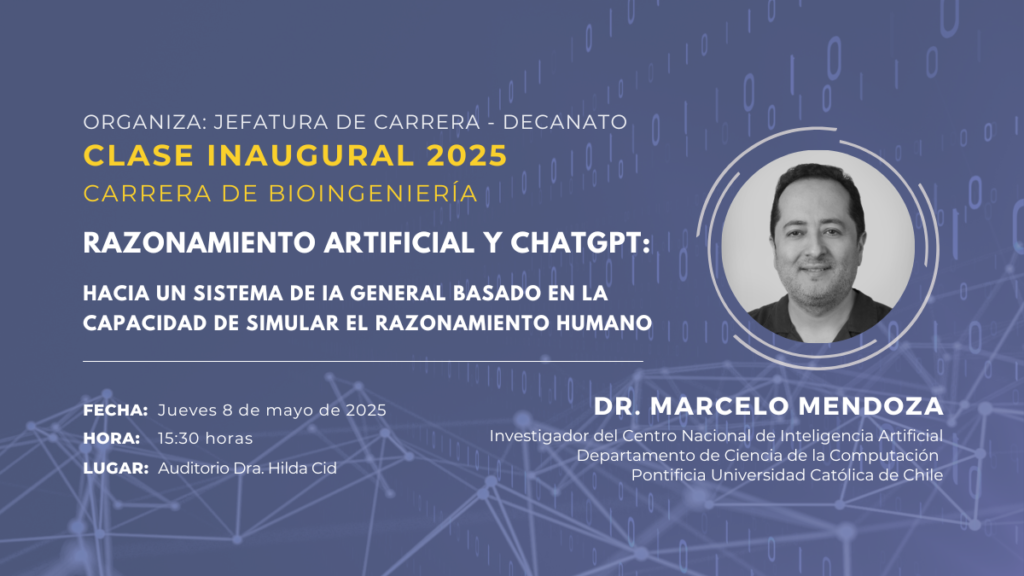
Inaugural Class of the Bioengineering Program at UdC: Artificial Reasoning and GPT | Marcelo Mendoza
📅 Thursday, May 8 | 3:30 PM
On this occasion, the inaugural lecture will be given by Dr. Marcelo Mendoza Rocha, faculty member of the Department of Computer Science at Pontificia Universidad Católica de Chile, who will deliver the talk titled “Artificial Reasoning and ChatGPT: Towards a General AI System Based on the Ability to Simulate Human Reasoning”.
The lecture will address the field of artificial reasoning, an area of AI that seeks to understand how inductive learning models, especially large language models, exhibit surprising emergent reasoning abilities across different types of problems.
The speaker will explore both the possibilities and current limitations of these models, as well as the key challenges that must be overcome to advance towards general artificial intelligence.
Dr. Marcelo Mendoza’s career and his contribution to the field of AI
Dr. Marcelo Mendoza is a principal researcher at the National Center for Artificial Intelligence (CENIA) and an associate researcher at the Millennium Institute for Foundational Research on Data (IMFD).
He holds a PhD in Computer Science from Universidad de Chile and completed a postdoctoral fellowship at Yahoo Research. His research has focused on developing artificial intelligence methods for measuring and predicting events and processes involving human beings.
The academic’s contributions have focused on advancing the understanding of the potential of artificial intelligence in addressing complex social challenges, especially those related to the dynamics of human behavior.
He has published more than 100 scientific articles and is co-author of the book “Ethics in Artificial Intelligence and Information Technologies,” published in 2025 by CRC Press.
In 2021, he received the Seoul Test of Time award for his co-authorship of the paper “Information Credibility on Twitter,” a pioneering study in the application of artificial intelligence to the analysis of disinformation.
Event open to the entire university community interested in the topic, no prior registration required.