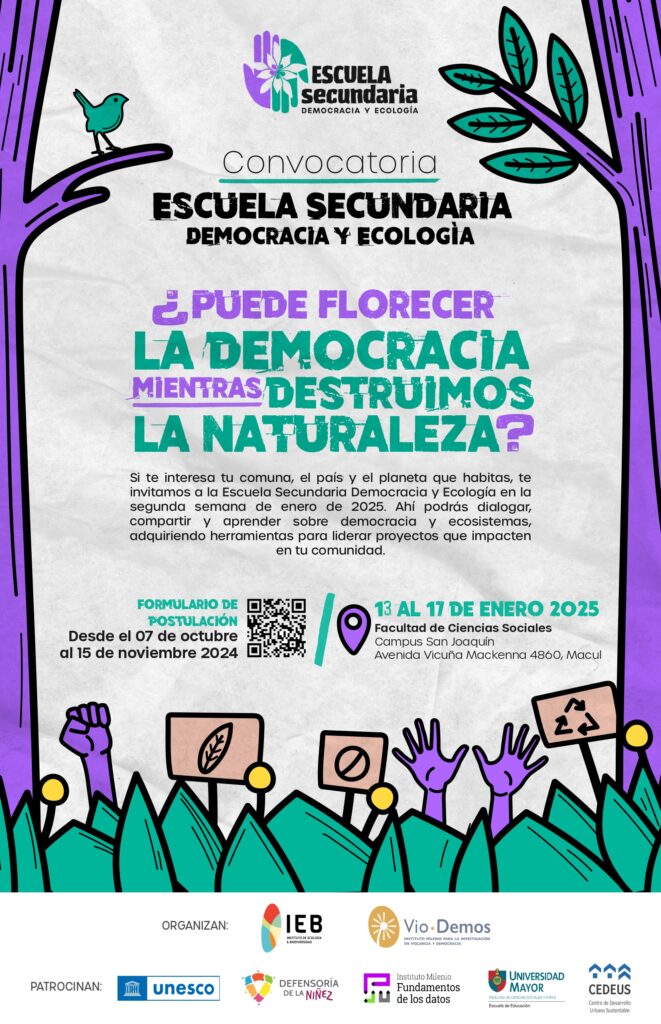
Democracy and Ecology High School
📆January 13 to 17, 2025
Can democracy flourish while we destroy nature? This is the question posed by the Millennium Institute for Research on Violence and Democracy (VioDemos) and the Institute of Ecology and Biodiversity (IEB) to foster dialogue and learning, and that is why we invite you to the first Democracy and Ecology Secondary School, to be held from January 13 to 17, 2025.
The purpose of the Democracy and Ecology Secondary School is to help train student leaders in democracy and ecology from the Metropolitan Region, so they can drive initiatives in their school communities, territories, or activist networks.
After taking part in the school, young people are expected to be able to collaborate with other secondary school students from the Metropolitan Region, have an informed and critical voice regarding their surroundings, put solidarity into practice to mobilize projects, and apply knowledge about local and national realities.
What is it about and where will it take place?
This is a free summer school held in person for high school students, in an intensive format with a strong emphasis on dialogue, hands-on workshops, and reflective sessions, structured around the participating students’ own projects.
The teaching team will be made up of researchers from the IEB and VioDemos centers, along with various professionals, artists, and activists specially trained for this initiative.
The School will run from Monday, January 13 to Friday, January 17, from 9:00 a.m. to 6:00 p.m., and will include breakfast and lunch for all participants, who must make their own way to Campus San Joaquín, located at Av. Vicuña Mackenna 4860, Macul.
During the week of the Secondary School, participants will work on their proposals, and at the end of the school, projects will be selected for funding and follow-up over six months.
Who can apply?
Applications for the Secondary School will be open until Friday, November 15 to students in grades 9 through 12 (1st to 4th year of Educación Media) from public and private schools in the Metropolitan Region who take part in student councils, environmental groups, feminist collectives or LGBTIQA+ rights groups, soccer or other sports teams, groups promoting access to ICTs, collectives for the rights of Indigenous peoples or people with disabilities, among others. It is also open to those who, without having taken part in collective initiatives, have an interest in joining or launching such initiatives in their communities.
How to apply?
Those wishing to take part in the Democracy and Ecology Secondary School must:
1) Submit a social, community, or activist project in writing, based on questions included in the registration form, and attach an explanatory video no longer than one minute.
2) Fill out the registration form.
3) Submit an authorization letter signed by one of their parents or legal guardians, following a specific format. AUTHORIZATION FOR PARTICIPATION IN THE DEMOCRACY AND ECOLOGY SECONDARY SCHOOL
4) Submit a letter of intent specifying why you are interested in taking part in the school, including your expectations, with a maximum length of 350 words, in the same application form.
Applications will be open from October 7 to November 15, 2024 at the following form: https://forms.gle/mivvzQ2iEfkbgrAR9
You can review the application guidelines at the following link: SECONDARY SCHOOL 2025 APPLICATION GUIDELINES
Questions will be accepted until November 14 at the email address escuelasecundaria@viodemos.cl
A virtual meeting will be held on Wednesday, October 23 with potential applicants to explain the details of the school and go over the application form. Those wishing to take part should write to escuelasecundaria@viodemos.cl
Selected applicants will be notified during the second week of December 2024.
This initiative is sponsored by the UNESCO Office in Santiago, the Ombudsperson’s Office for Children and Adolescents (Defensoría de la Niñez), the Millennium Institute for Foundational Research on Data (IMFD), the Faculty of Education of Universidad Mayor, and the Center for Sustainable Urban Development (CEDEUS).