
Artificial intelligence and archives: Jocelyn Dunstan presented the work of NuestramemorIA at an Ibero-American meeting in Mexico City
Jocelyn Dunstan, a researcher at the Millennium Institute for Foundational Research on Data (IMFD) and an academic at IMC UC and DCC UC, took part in the II Ibero-American Archives Meeting, dedicated to the uses and ethical implications of artificial intelligence in document preservation. In her presentation, she outlined four lines of work of the NuestramemorIA project, which applies artificial intelligence to the study of archives from the Chilean dictatorship.
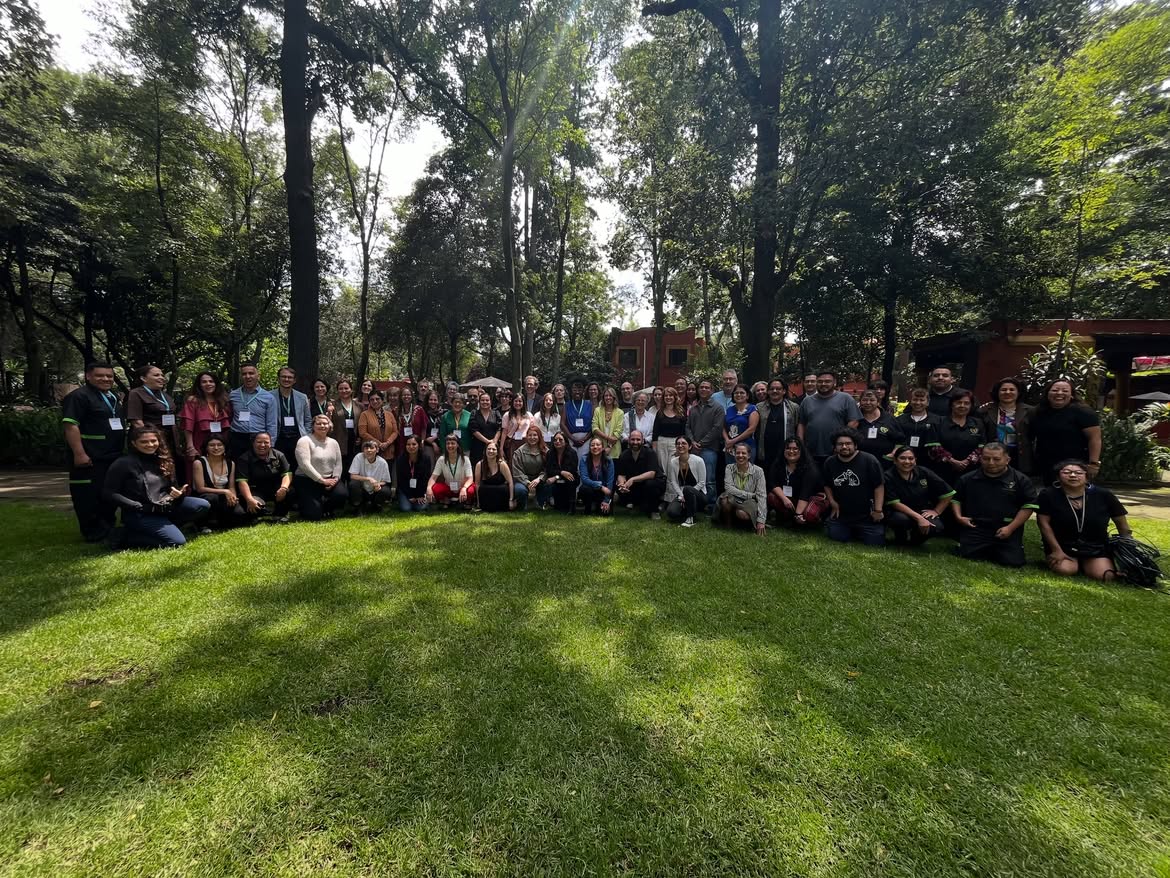
From September 7 to 9, the II Ibero-American Archives Meeting was held in Mexico City, titled “Artificial Intelligence in Document Preservation.” Organized by the Ibermemoria Sonora, Fotográfica y Audiovisual programs, Iberarchivos, and the Ibero-American Diplomatic Archives Network —together with UN Women, the Ibero-American General Secretariat, and Mexico’s National Phonotheque, among others—, the meeting brought together the region’s archival community to discuss the progress, challenges, and ethical implications of AI in the preservation of sound, photographic, audiovisual, and textual archives, from a gender, inclusion, and multicultural perspective.
Over the course of three days, specialists from ten countries took part in panel discussions, keynote lectures, workshops, and a poster exhibition on concrete experiences using AI in archives. The organizers also awarded six full scholarships for women professionals in the archival field residing in countries of the Ibero-American Conference.
NuestramemorIA:
In this context, Jocelyn Dunstan, researcher at the Millennium Institute for Foundational Research on Data —academic at the Institute of Mathematical and Computational Engineering (IMC UC) and the Department of Computer Science (DCC UC), and also a researcher at the Millennium Institute (iHEALTH)— spoke at the panel discussion “Artificial Intelligence in Archive Preservation: Assessment and Perspectives in Latin America,” alongside Juan Carlos Murillo Pavón (Señal Memoria, Colombia) and Aiala Rosá (University of the Republic, Uruguay).
Dunstan brought to the table the work of NuestramemorIA, a project originated at the Millennium Institute for Foundational Research on Data (IMFD) that studies the archives of the Chilean dictatorship using artificial intelligence tools, in direct collaboration with the civil society organizations that hold custody of these document collections. Citing the work of students and researchers from the team, she presented four ways in which AI contributes to preserving these archives:
- Optical character recognition, to read worn-out documents and manuscripts from the period.
- Knowledge graphs, which organize information around people, places, and dates, making it possible to gather information about the disappeared detainees.
- Audio transcription, through the training of a speech recognition model (Whisper). The goal is to reach 500 hours of transcribed Chilean speech from the seventies: “we want to reach 500, which is like the international standard for fine-tuning a speech recognition model,” Dunstan explained during the panel discussion. This line of work is being developed together with Radio Cooperativa, which holds sound archives that have not yet been cataloged.
- An image annotation platform, with models trained by people to generate linguistically and historically accurate descriptions of raw images from the dictatorship. The process takes place in stages: first specialized annotators intervene, followed by professionals from the field of history.
The UC academic emphasized in her presentation the concept of human-in-the-loop, suggesting that this should not be activated only when a model fails, but rather as an integral part of the design of a system that works with artificial intelligence for the preservation of archives.
When asked about the lessons learned and possible collaborations arising from the meeting, the researcher stated:
“On my own panel was Aiala Rosá, a professor from Uruguay with whom we are both part of a Uruguayan international fund called Ida Holz. I also found what Juan Carlos Murillo presented on the preservation of Colombian radio audio archives very interesting. I think it aligns very well with the collaboration we are building in NuestramemorIA with Radio Cooperativa.”
The link with Uruguay is part of “Memorias del Sur”, a project selected by the Ida Holz Fund of the National Agency for Research and Innovation (ANII), which seeks to create a digital infrastructure that functions as a repository for the archives produced during the 20th century dictatorships in the Southern Cone.
Watch the discussion: