
Organized crime, technological platforms, and AI: Juan Pablo Luna analyzes the challenges of the current political and social context in an interview with Radio Infinita
On the program Mirada Infinita, the academic from the Escuela de Gobierno UC and researcher at the Millennium Institute for Foundational Research on Data (IMFD) discussed changes in the forms of criminal organization, the impact of technological platforms, the challenges posed by artificial intelligence, and the need to bring academic research closer to public debate.
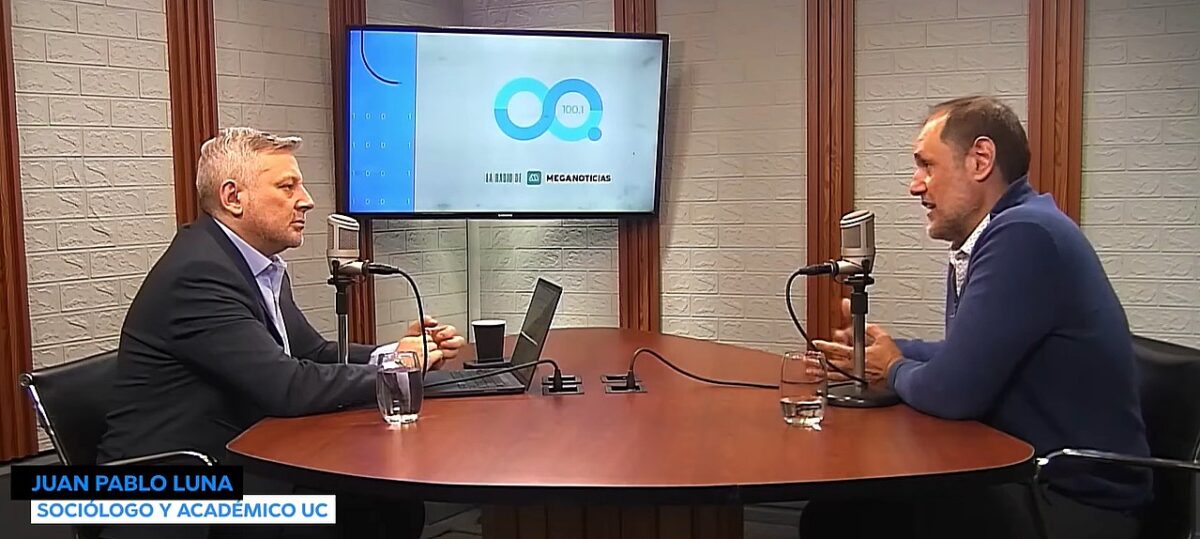
Professor Juan Pablo Luna, from Escuela de Gobierno UC and McGill University (Canada), held a wide-ranging and lengthy conversation with journalist Juan Manuel Astorga on the program Mirada Infinita, on radio Infinita, this past September 10. Luna, who is also a researcher at Millennium Institute for Foundational Research on Data (IMFD) and Millennium Institute for Research on Violence and Democracy (VioDemos), provided an overview of the current political and social context surrounding organized crime, technological advances, and how these are affecting the work of the State and education.
At the start of the conversation, Astorga cited the work “Criminal Politics and Botched Development in Contemporary Latin America” (Cambridge University Press, 2023), co-authored by Luna together with Andreas Feldmann, to explore the authors argument that the expansion of illegal markets should be understood as a development problem rather than merely a law enforcement one.
“On one hand there is the expansion of illegal markets, which obviously creates problems of security and criminality, but both its causes and its consequences involve development problems. […] One of the consequences that the expansion of illegal markets and organized crime has on a society is that it does not only generate problems of violence, but also institutional infiltration, institutional corruption, and institutional capture, which eventually distort the very institutions that are needed to grow,” Luna explained.
Regarding the causes, he added that today we have formal markets that are stalled, problems of economic growth, and difficulties for the formal economy to meet the needs and consumption aspirations of new generations, and this is the context in which illegal markets begin to grow. “From that perspective, we argue that this must be thought of much more as a development problem than as a purely criminal or delinquency problem, focused solely on rising homicide rates or the spirals of violence that arise from them,” he added.

Where attention should be focused: more fragmented organized crime and technological platforms
One of the central points of the conversation was the shift in the ways organized crime is structured. Luna noted that attention tends to focus on large structures, such as the Mexican and Colombian cartels, the Tren de Aragua (Venezuela), or the PCC (Primeiro Comando da Capital, Brazil). However, he pointed out that the current phenomenon has a different characteristic: the fragmentation and atomization of those large organizations. “What we are seeing today is a fragmentation of those large structures and a capacity to engage in illegal and informal businesses that evade the State and its regulatory capacity through technological platforms,” he said.
Building on this transformation, the researcher described what he called a “double shock”: on one hand, the expansion of illegal activities that are beginning to eat into the space of formal markets and the State; on the other, a technological shock that makes it possible to conduct different kinds of business outside traditional mechanisms of regulation. Among his examples, he mentioned Uber and online betting, which the State has been unable to regulate. Luna contrasted this scheme with the more widespread image of organized crime associated with territorial control.
“What we have here is a growing loss of the space regulated by the State and by the formal market. So, when we think about politics, and about a politician who promises us something, their scope of action, their ability to move the needle, is in reality becoming increasingly limited because illegal and informal markets are eating into the space of the State and the formal market. Today many of these activities operate in networks, in the cloud, in a multijurisdictional space, which neither the State nor the international system can regulate,” he added.
Who Are We Writing For? Artificial Intelligence and an Agraphic Society
The conversation also broadened its scope to artificial intelligence and its impact on writing and education, in light of the results of the 2025 PISA test, published by the Organisation for Economic Co-operation and Development (OECD), which assessed the performance of 760,000 15-year-old students in 91 countries. According to the report, between 2015 and 2025 the OECD country average fell 28 points in reading and 22 points in mathematics.
“The PISA test results have just come out, showing globally alarming outcomes in terms of reading comprehension, math skills, and so on, and at the same time we are at a moment when probably more text is being written than ever before, because it is being written with AI. So who are we writing for?” Luna asked. “We have an agraphic society, a society that does not read and does not write, and at the same time we have this enormous capacity to write with AI. So we are at a moment that is analytically very interesting but very difficult to live through if one thinks about what the consequences of this could be going forward,” he adds.
This scenario also poses challenges for universities. According to Luna, the emergence of AI is leading academics to rethink how to teach, how to hold students’ attention, and how to deliver knowledge and valuable experiences in this new context. He added insights from his fieldwork with young people in Chile and Uruguay, where, he noted, they have told him that university and education no longer hold value compared to the option of starting a business.
The challenge of translating research into public debate
Luna also argued that academia has a specific responsibility: to translate the knowledge produced through research into formats that allow for effective participation in public discussion.
“I believe academia has to make an effort to translate, and that part of our public role is to try to influence public debate, and to do so based on our research, based on evidence, but in a format and register that helps improve the quality of public discussion,” he stated.
“If we are funded with public funds, part of our role is to try to ensure that research has some kind of relevant impact on society,” he added.