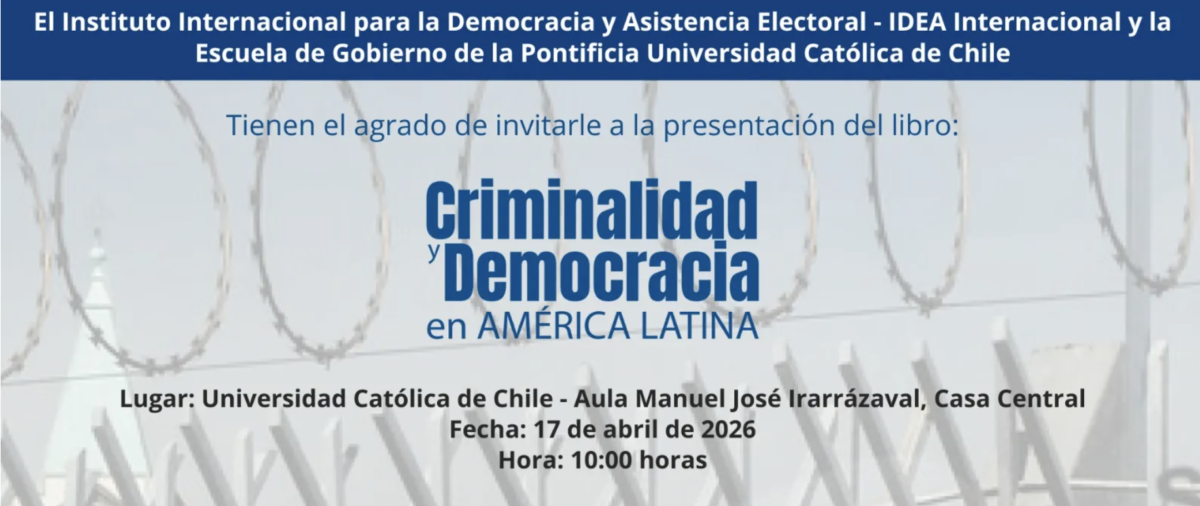
Crime and Democracy in Latin America
📅 Friday, April 17 | 10:00 am
Organized crime has become a structural factor that redefines political, economic, and social life in Latin America. Its expansion goes beyond drug trafficking to include flexible networks devoted to human and arms trafficking, illegal mining, corruption, and cybercrime. These networks compete with the State through economic and coercive power, directly affecting democratic institutions and the living conditions of more than 100 million people under criminal governance schemes in the region. This growing presence erodes the rule of law, weakens governability, and fuels citizen distrust. The interaction between criminal groups, state actors, and politicians results in vulnerable electoral processes, distorted public policies, and a climate conducive to authoritarian narratives that offer simplistic solutions based solely on punishment. The false dichotomy between security and democracy reinforces hardline discourses that, far from solving the problem, may deepen authoritarian tendencies. Even institutionally strong democracies show signs of vulnerability to these dynamics.
Faced with this scenario, it is urgent to strengthen state capacity in justice, security, transparency, and accountability, to protect political processes from illegal financing and violence, and to promote regional cooperation given the transnational nature of organized crime. Likewise, reliable evidence must be generated and new narratives built based on human rights, the rule of law, and democratic stability.
In Chile’s case, the expansion of organized crime shows that even consolidated democratic systems are not shielded. Although the phenomenon remains incipient and fragmented, the country is experiencing a rise in emerging illegal markets linked mainly to local institutions. Recent data show that drug trafficking continues to be the main illicit activity, while crimes such as kidnappings and extortion show the greatest growth. At the same time, the sustained decline in homicides, the growing involvement of vulnerable groups in criminal activities, and the use of prison systems to coordinate crimes underscore a complex and evolving trend. This landscape calls for comprehensive responses that strengthen democratic resilience before these dynamics deepen further.
Event Book launch: Criminalidad y Democracia en América Latina and high-level panel: How does crime affect democracy in Latin America? Implications for the Chilean case
Authors: Juan Pablo Luna (McGill University & Universidad Católica de Chile, VioDemos and IMFD researcher) and Andreas Feldmann (University of Chicago).
Date: Friday, April 17, 2026 Time: 10:00 a.m. to 12:00 p.m. Location: Pontificia Universidad Católica de Chile, Aula Manuel José Irarrázaval, Casa Central UC.