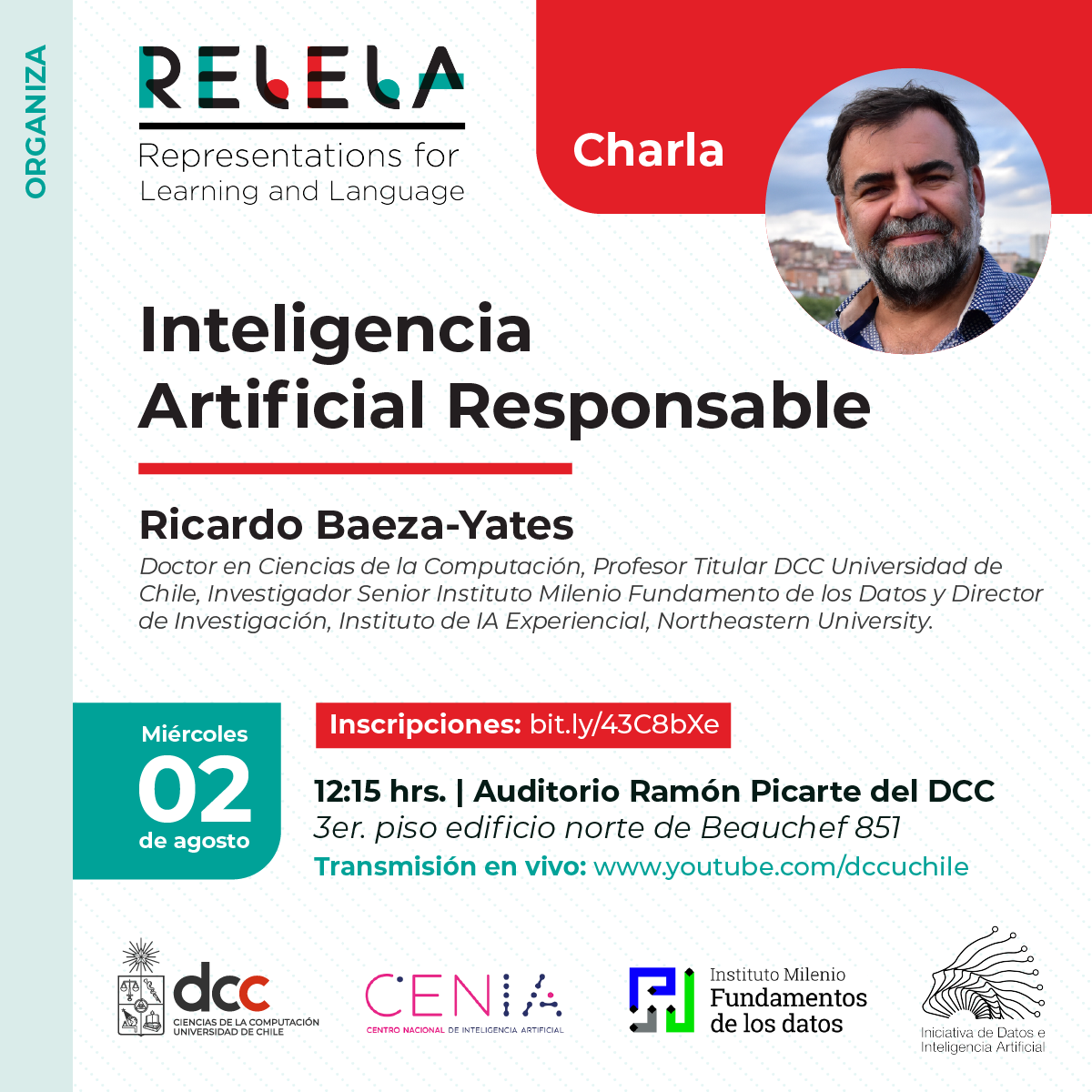
Responsible Artificial Intelligence Talk, with Ricardo Baeza-Yates
We invite you to the talk “Responsible Artificial Intelligence”, given by Ricardo Baeza-Yates, academic at the Institute for Experiential AI at Northeastern University, USA, Full Professor at the Department of Computer Science of the Universidad de Chile and Senior Researcher at the Millennium Institute for Foundational Research on Data (IMFD). This talk is part of the RELELA series, Representations for Learning and Language.
WHEN: Wednesday, August 2, 2023, at 12:15 pm (welcome coffee)
WHERE: Auditorium of the Department of Computer Science, Universidad de Chile (Beauchef 851, Edificio Norte, 3rd floor, Santiago, Chile)
ORGANIZED BY: Department of Computer Science, Universidad de Chile
REGISTRATION: bit.ly/43C8bXe
SUMMARY:
In the first part, to set the stage, we will address irresponsible AI: (1) discrimination (e.g., facial recognition, justice); (2) phrenology (e.g., biometric based predictions); (3) limitations (e.g., lack of human competence, minimal adversarial AI) and (4) indiscriminate use of computing resources (e.g., large language models). These examples have a personal bias, but they set the context for the second part, where we will address three challenges: (1) principles and governance, (2) regulation and (3) our cognitive biases. We will finish by discussing our responsible AI initiatives and what is coming in the near future.
ABSTRACT:
In the first part, to set the stage, we cover irresponsible AI: (1) discrimination (e.g., facial recognition, justice); (2) phrenology (e.g., biometric based predictions); (3) limitations (e.g., human incompetence, minimal adversarial AI) and (4) indiscriminate use of computing resources (e.g., large language models). These examples do have a personal bias but set the context for the second part where we address three challenges: (1) principles & governance, (2) regulation and (3) our cognitive biases. We finish discussing our responsible AI initiatives and the near future.
Short bio:BIO:
Ricardo Baeza-Yates is Director of Research at the Institute for Experiential AI of Northeastern University. Before, he was VP of Research at Yahoo Labs, based in Barcelona, Spain, and later in Sunnyvale, California, from 2006 to 2016. He is co-author of the best-seller Modern Information Retrieval textbook published by Addison-Wesley in 1999 and 2011 (2nd ed), that won the ASIST 2012 Book of the Year award. From 2002 to 2004 he was elected to the Board of Governors of the IEEE Computer Society and between 2012 and 2016 was elected for the ACM Council. In 2009 he was named ACM Fellow and in 2011 IEEE Fellow, among other awards and distinctions. He obtained a Ph.D. in CS from the University of Waterloo, Canada, in 1989, and his areas of expertise are web search and data mining, information retrieval, bias on AI, data science and algorithms in general.