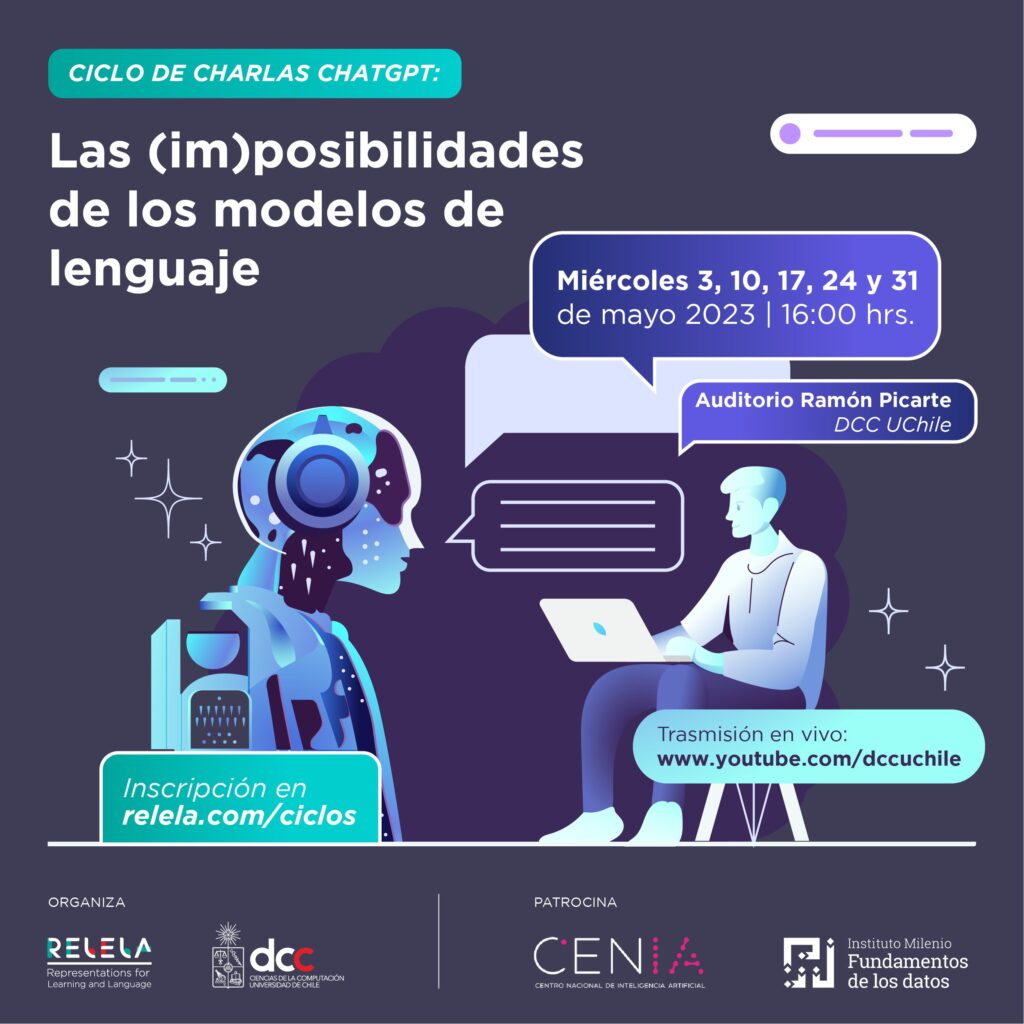
Ciclo de Charlas ReLeLa: The (Im)possibilities of Language Models
SUMMARY
The growing importance and popularity that language models such as ChatGPT have recently gained has raised concerns among the public about their conditions of possibility and their limitations. Due to the multidisciplinary nature of the issue, spaces for dialogue, dissemination, and collaboration between experts from different areas are needed.
The goal of this series is to provide a broad and critical view of the development and possibilities of language models, specifically in relation to the latest technological advances in the field of artificial intelligence. The aim is to explain the technical foundations of these technologies and to foster reflection and debate on the role these models play in today’s society, their limitations and possible risks, and the ethical and social implications they raise.
SCHEDULE
- Wednesday, May 3, 4PM
- Can ChatGPT conquer the world? Human language vs. machine language Presented by: Jorge Ortiz, DCC UChile, IMFD, Awto.
- Wednesday, May 10, 4PM
- A journey through Language Models: from Shannon to GPT-4. Presented by: Felipe Bravo-Marquez, DCC UChile, IMFD, CENIA.
- Wednesday, May 17, 4PM
- Current ethical challenges in light of the socio-technological revolution of GPT-3 and 4. Presented by: Gabriela Arriagada, IEA, IMC, UC, CENIA.
- Wednesday, May 24, 4PM
- ChatGPT in industry: possibilities and projections.
– Talk 1: “AI without the hype” by Jorge Pérez (CERO).
– Talk 2: “GPT and Agents: How to Talk to Your App” by Manuel Peña (Fintual).
- ChatGPT in industry: possibilities and projections.
- Wednesday, May 31, 4PM
- Discussion Panel – Scope and limits of language models
– Panelists: Cristian Buc (CENIA), Magdalena Saldaña (UC, IMFD), Martín Cáceres (MINEDUC), and Felipe Tobar (IDIA UChile, CMM).
– Moderator: Claudio Gutierrez (DCC UChile, IMFD).
- Discussion Panel – Scope and limits of language models
SPEAKERS
Felipe Bravo-Márquez: Assistant Professor at the Department of Computer Science of the Universidad de Chile, Associate Researcher at the National Center for Artificial Intelligence (CENIA), and Young Researcher at the Millennium Institute for Foundational Research on Data (IMFD).
Jorge Ortiz Fuentes: Data Scientist and Linguist. Bachelor’s degree in Hispanic Literature from the Pontificia Universidad Católica, Master’s candidate in Computer Science at the Universidad de Chile, and IMFD Student.
Magdalena Saldaña: Assistant Professor at the Faculty of Communications of the Pontificia Universidad Católica de Chile and Researcher at the Millennium Institute for Foundational Research on Data.
Gabriela Arriagada: Assistant Professor, Institute of Applied Ethics (IEA) & Institute of Mathematical and Computational Engineering (IMC), UC, CENIA Researcher. PhD Candidate in Philosophy and Applied Ethics at the University of Leeds, England.
Jorge Pérez: Co-Founder of Cero.ai. He was an academic and university researcher for more than 15 years (DCC UChile), holds a PhD in Computer Science (UC). His main research area is Natural Language Processing and Deep Neural Networks.
José Manuel Peña: Senior Portfolio Manager at Fintual, Industrial Civil Engineer from the Universidad de Chile, Chartered Financial Analyst (CFA), and Master’s in Applied Analytics from Columbia University in New York.
Cristián Buc: CENIA Researcher, Head of the CENIA scientific group. PhD in Cognitive Computational Neuroscience from the Université Libre de Bruxelles, postdoctoral fellowships at Ghent University and Brown University.
Felipe Tobar: Associate Professor, Universidad de Chile, Director, Data and Artificial Intelligence Initiative, UChile, Researcher, CMM & AC3E.
Martín Cáceres: Director of the MINEDUC Innovation Center. Bachelor’s degree in Physics and PhD in Engineering Sciences from the Pontificia Universidad Católica de Chile.