
The Department of Computer Science at the University of Chile celebrated 50 years of history and contributions to the country's digital development.
Looking back on its history and the milestones that have defined its contribution to the country, the Faculty of Physical and Mathematical Sciences at the University of Chile commemorated half a century since the creation of the Department of Computer Science (DCC), a pioneering unit in training, research, and technological development that has driven digital transformation in Chile.
Under the slogan "We celebrate our history and build the future," the Department of Computer Science (DCC) held its five-decade anniversary ceremony on October 10 at the Beauchef Campus, bringing together university authorities, the academic community, staff, students, and graduates of the DCC, as well as the founders of the unit: Fernando Silva, José Pino, Alfredo Piquer, and Patricio Poblete. The event was attended by the Rector of the University of Chile, Rosa Devés; the Dean of the Faculty of Physical and Mathematical Sciences (FCFM), Francisco Martínez; and the Director of the DCC and Alternate Director of Millennium Institute Foundational Research on Data, Aidan Hogan, along with special guests who were part of the department's historical journey.
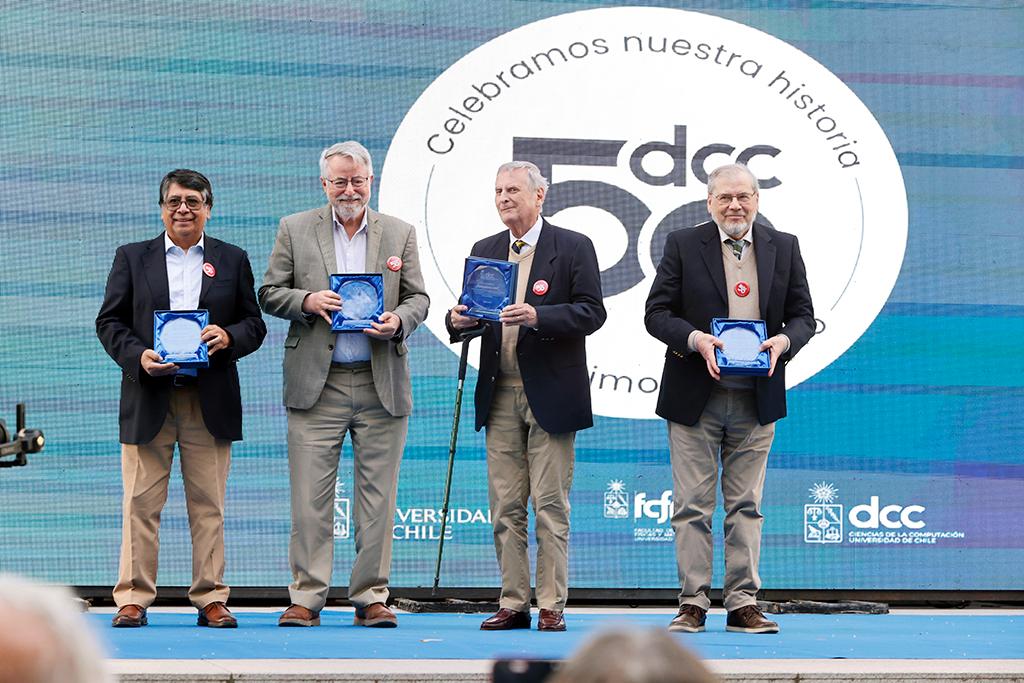
In addition to the main ceremony, the event included exhibitions on the DCC's major milestones and presentations of current projects led by its researchers. Associated centers and units—such as the Millennium Institute Foundational Research on Data (IMFD), the National Center for Artificial Intelligence ( CENIA), the FCFM's Data and Artificial Intelligence Initiative (IDIA), and the Niñas Pro Corporation—participated with stands that showcased the Department's current dynamism and scope.
On this occasion, Rector Rosa Devés highlighted the importance of the DCC in the history of the institution and in the digital transformation of the country: "It has been an exciting day, where we have seen the full force of intelligence, but also the full force of the will to do something new and important that starts with young people, who at that time were completely visionary, revolutionary, and who managed to build this great department that today serves Chile so well."
A strong, young tree
DCC Director Aidan Hogan began his speech with a metaphor that set the tone for the day: "Today, the DCC is a strong, young tree, ready to bear more fruit and continue growing."
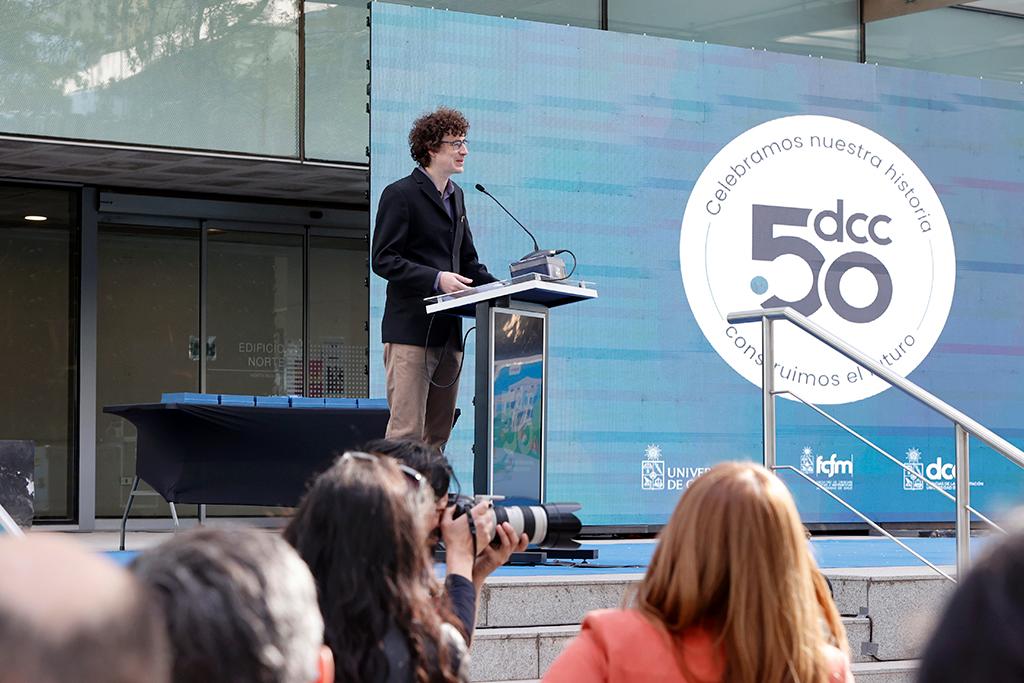
In his speech, he paid tribute to the founders and the entire community that has been part of the department's history. He also reflected on the role of the DCC—together with colleagues from the NIC, the university, and the public and private sectors—in the adoption and development of technologies that are now part of everyday life: "The DCC has been a key player in the development and national adoption of technologies so significant that we now take them for granted."
However, he said that "there are no roses without thorns," referring to the fact that, in the global context, computing today is marked by contradictions. For example, he said: "Social media connects us in an unprecedented way, but through misinformation, bubbles, polarization, and bots, it also divides us in an unprecedented way."
In his speech, he highlighted the DCC's contributions to national issues, such as the participation of academics in discussions on new cybersecurity and personal data protection laws.
At the end of his speech, he stated that "computing has transformed the world, and will continue to transform it. We are still in its infancy." In this vein, he stressed the importance of Chile forging its own technological path: "The challenge is for the country to define its future with computing, and not always lag behind the major technologies coming from the northern hemisphere. Although there is still much to be done, I am optimistic about the future of computing in Chile and the future of Chile with computing."
Challenges for the future
For his part, the dean of the FCFM, Francisco Martínez, linked the history of the DCC with the university's mission to contribute to national development. "The history of the DCC is a version of the history of the University of Chile, because it sowed the first seed from which fruits have sprung throughout the country," he said.
The dean also reflected on the challenges facing humanity in the face of rapid technological change: "We live in an age where advances are outpacing us. We have to rethink ourselves in order to face this tremendous challenge. But where there are challenges, there is life and there is construction. And the DCC, with its innovative spirit and courage, will continue to be key in that journey."
Source: DCC Communications