
XIII ChileWiC 2025 Women in Computing Meeting: “Computing is too important to be left only in the hands of men”
Inspired by Karen Sparck Jones, the distinguished British programmer and computer scientist, the 13th Women in Computing Chile Meeting WiC 2025 will take place on Friday, November 28, 2025, at the Enrique d’Etigny auditorium of the Universidad de Chile.
“Even though women have always been a fundamental part of computing since its origins and throughout its historical development, the gender gap in this field remains enormous,” notes Valeria Herskovic, director of the Department of Computer Science at Universidad Católica and one of the event’s organizers. This is confirmed by studies conducted in Chile: according to data from the 2025 Gender Report from the Ministry of Science, only 35.8% of the country’s total researchers, across all fields, are women. The share of women graduating from STEM programs reaches 7.8% of all graduates, and only 12.5% of undergraduate students in Computer Engineering are women.
“These figures speak to something deeply concerning, as they show that the efforts made to increase women’s entry into and retention in these fields remain insufficient, causing us to miss out on the opportunity for greater diversity of experiences and perspectives when doing science and technology,” says Claudia López, faculty member at Universidad Federico Santa María and event organizer.
ChileWiC 2025 will feature a student competition, showcasing participants’ work through mini presentations and academic posters, along with hands-on workshops and plenary talks.
The event is supported by Pontificia Universidad Católica de Chile, Universidad Técnica Federico Santa María, Universidad de Chile, Universidad de Santiago de Chile, Universidad de La Frontera, the National Center for Artificial Intelligence (Cenia), and the Millennium Institute for Foundational Research on Data (IMFD).
From 35 to two hundred people in 13 years
ChileWiC is organized every year by a volunteer group of computing and computer science academics from different universities across the country. The first edition of ChileWiC brought together around 35 academics, researchers, and students, some of whom simply peeked in at the door out of curiosity. “For us, in 2024, it was quite an achievement to see the room full of students, and both women and men professors interested in breaking down this gender gap,” says Claudia López. The XII edition was held in the Manuel Montt auditorium at Universidad Mayor, with more than 200 participants. The previous edition had been held at Universidad de Santiago, with more than 150 participants.
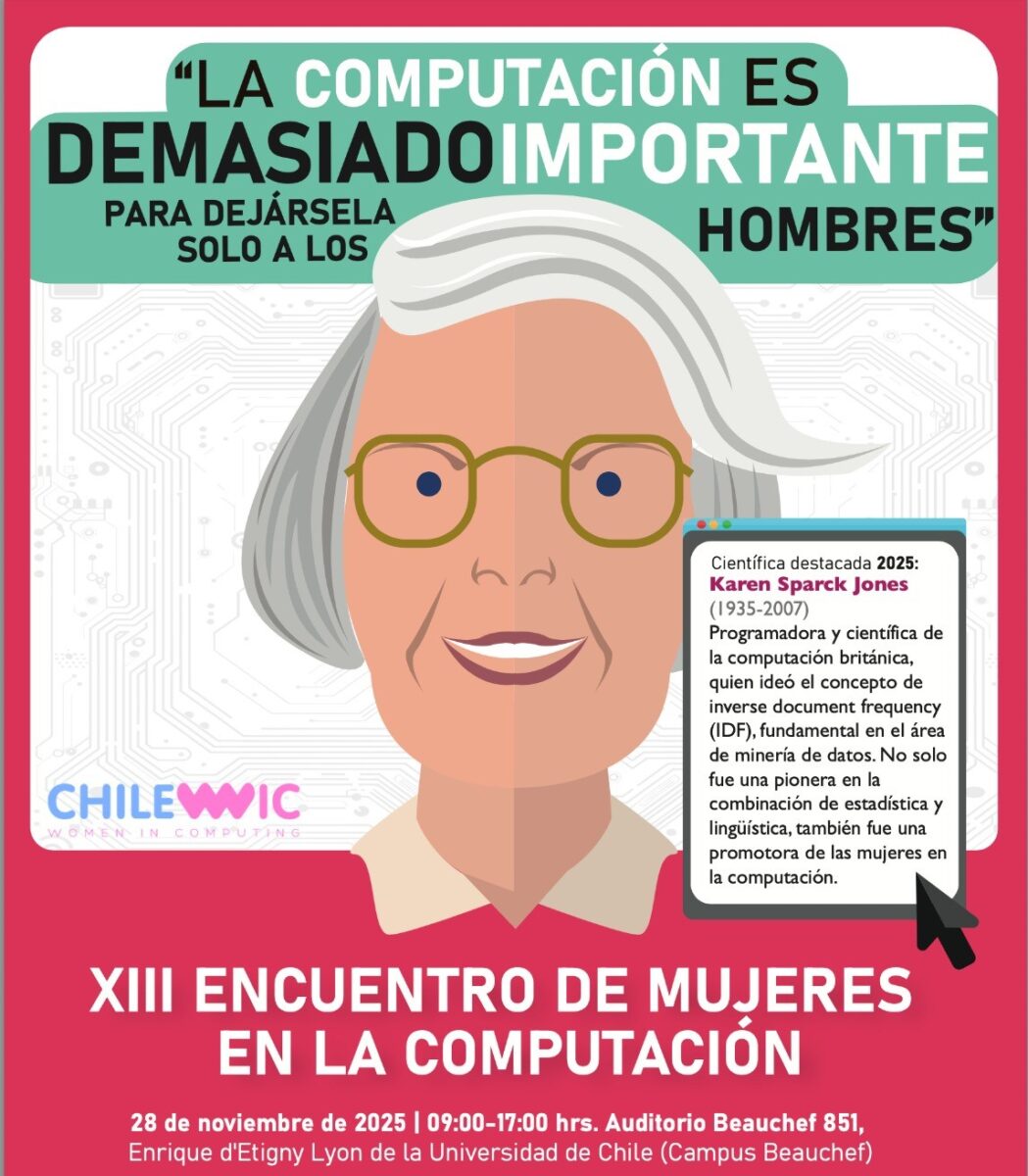
Karen Sparck Jones: the pioneer who taught computers to understand human language
Every year, ChileWiC chooses a renowned woman from global computing to honor and showcase her work: in the XIII edition, tribute is paid to Karen Sparck Jones (1935-2007), British programmer and computer scientist, who devised the concept of inverse document frequency (IDF), fundamental to the field of data mining. She was not only a pioneer in combining statistics and linguistics, but also a champion for women in computing.
Born in 1935 in Huddersfield, England, Spärck Jones studied philosophy and history, but soon found herself drawn to a new and challenging field: the interaction between language and machines. At a time when computers were just beginning to be used as research tools, she already imagined they could become powerful allies for processing and organizing knowledge.
Her most revolutionary contribution came in 1972, when she introduced the concept of IDF (inverse document frequency), a key part of the TF-IDF metric, whose goal is to measure how important a word is within a document in relation to other documents in the same collection. This metric is fundamental to information retrieval, including the search engines we use every day. Every time we get relevant results on Google, there is a bit of Karen Spärck Jones’ ingenuity working behind the scenes.
Beyond her brilliant scientific career, Spärck Jones became an essential voice for gender equality in computing. In a male-dominated world, she firmly advocated for the need for more women to join the discipline. Her famous quote, “computing is too important to be left to men,” remains a relevant call to break down barriers and open new paths.
Throughout her career she received numerous accolades: she was elected a Fellow of the British Academy and the Royal Society, received the BCS Lovelace Medal, and in 2007, the prestigious ACM-AAAI Allen Newell Award, which recognizes outstanding contributions in computer science.
Karen Spärck Jones passed away in 2007, but her legacy lives on in thousands of applications through which we retrieve information. Her life reminds us that technological innovation requires not only formulas and algorithms, but also an inclusive vision that inspires future generations.