
IMFD researcher Gonzalo Navarro has been named an ISCB Fellow
Gonzalo Navarro, a professor in the Department of Computer Science at the University of Chile and a researcher at Millennium Institute Foundational Research on Data , has been named a Fellow of the International Society for Computational Biology (ISCB), one of the most prestigious international honors in computational biology and bioinformatics. The distinction is part of the ISCB Fellows program, created in 2009 to honor members who have distinguished themselves through their outstanding contributions to these fields, as well as through their leadership, service, and contributions to the scientific community.
The ISBC, founded in 1997, is the only organization representing computational biology and bioinformatics on a global scale. It currently brings together a global community of more than 4,000 researchers, professionals, technicians, students, and industry representatives, all dedicated to advancing the scientific understanding of living systems through computation.
“ISCB Fellows have played a pivotal role in advancing bioinformatics and computational biology, shaping the field through innovation and collaboration. This prestigious distinction reflects a track record of significant impact and a dedication to the scientific community, ”state the program guidelines.
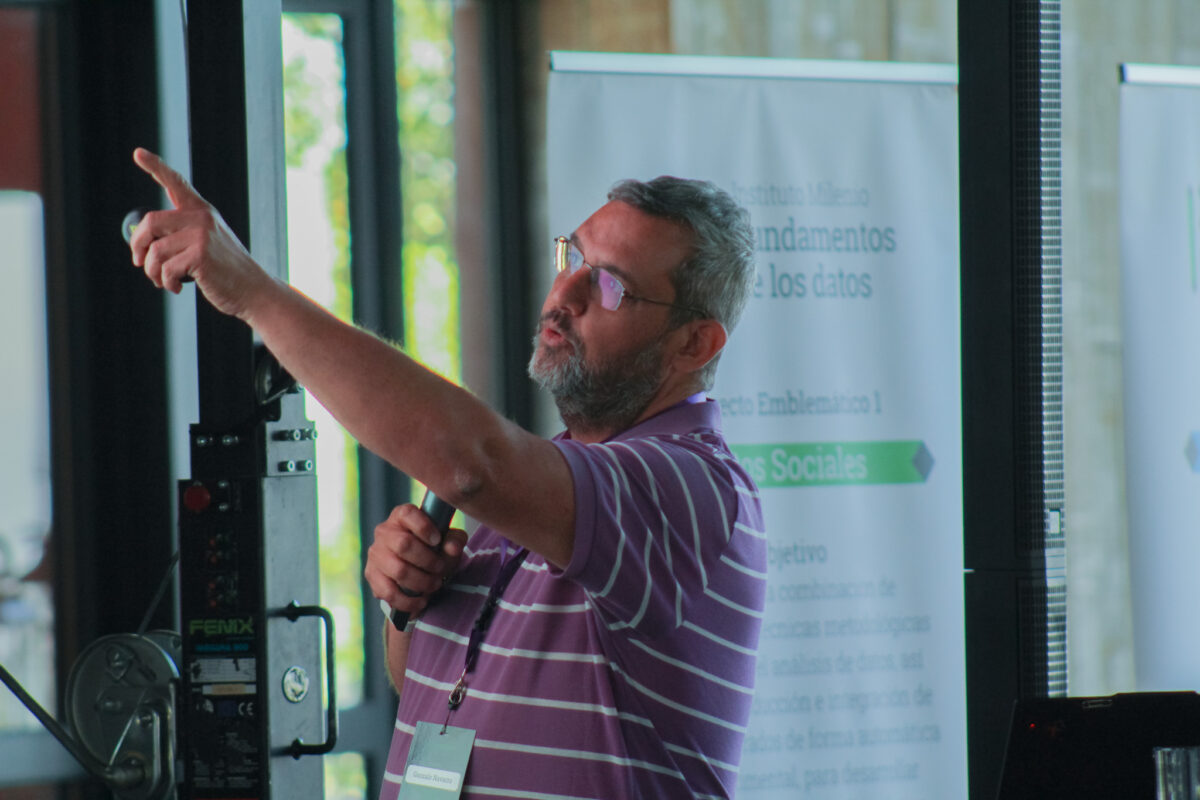
For the scholar, this recognition marks a milestone in a career dedicated to a field that has gained significant prominence in recent decades. He recalls that in 1998, when he was planning to spend part of his postdoctoral training in Arizona with researcher Gene Myers, his plans changed because Myers joined Celera Genomics, one of the companies involved in sequencing the first human genome.
“That happened around the year 2000 and marked the beginning of an ongoing effort to sequence entire populations, understand the contents of the genome, and use that knowledge to understand and cure diseases. “You could say that big data bioinformatics was born at that point, bringing with it enormous algorithmic challenges related to complex sequence searches and the efficient storage of large volumes of information,” he says.
The scholar notes that, although his approach has been primarily algorithmic rather than biological, “several of the things we’ve done over the past two decades have ended up being used in bioinformatics research and even in widely used products.”
Contributions from the field of computer science
The researcher explains that his work in bioinformatics has focused on three main areas. First, approximate text search, which focuses on efficiently identifying patterns even when errors are present—errors that, in bioinformatics, stem from mutations and sequencing errors, among other sources. Second, compressed self-indexes, which allow sequences such as genomes or proteins to be stored using almost minimal space while simultaneously enabling efficient searches. Finally, his most recent line of work addresses the indexing of large collections of repetitive sequences, a key challenge when working with many genomes that are very similar to one another.
In this context, he explains that the representation should occupy a space close to the one needed to represent one of the sequences, plus the few changes required to obtain each of the others. “That isn’t difficult in itself, but it is difficult to perform complex searches for patterns within that space,” he asserted. He began this work a couple of decades ago with researchers from Finland whom he met during his postdoc, in what he describes as “a time when no one really paid much attention to the problem, but today it is crucial and many people are working on it.”
After receiving this award, Professor Navarro expressed his gratitude for the support of the UCH Department of Computer Science and the Center for Biotechnology and Bioengineering (CeBiB), noting that the latter has played a key role over the past decade in advancing his research in this field.
This appointment reflects the impact and track record of the researcher’s work, as well as his contribution to the development of a discipline that integrates computing, data, and biology. For the IMFD, this distinction reaffirms the international standing of one of its researchers and the value of his contribution to data science from an interdisciplinary perspective.

—
Sources: DCC Communications, International Society for Computational Biology (ISCB).