
IMFD Researchers Awarded 2026 Fondecyt Regular Grants
IMFD researchers and academics from the Departamento de Ciencias de la Computación de la Universidad de Chile, Benjamin Bustos and Gonzalo Navarro, each were awarded a Fondecyt Regular project in the 2026 call. These works address time- and space-efficient techniques to extend worst-case optimal algorithms to complex graph and relational databases, and a multi-modal similarity model that integrates text, images, and 3D models to improve the search of ancient pottery in digital collections.
The Fondecyt project, administered by the Agencia Nacional de Investigación y Desarrollo (ANID), aims to promote scientific-technological research across various fields of knowledge, by funding excellence-driven individual research projects oriented towards knowledge production.
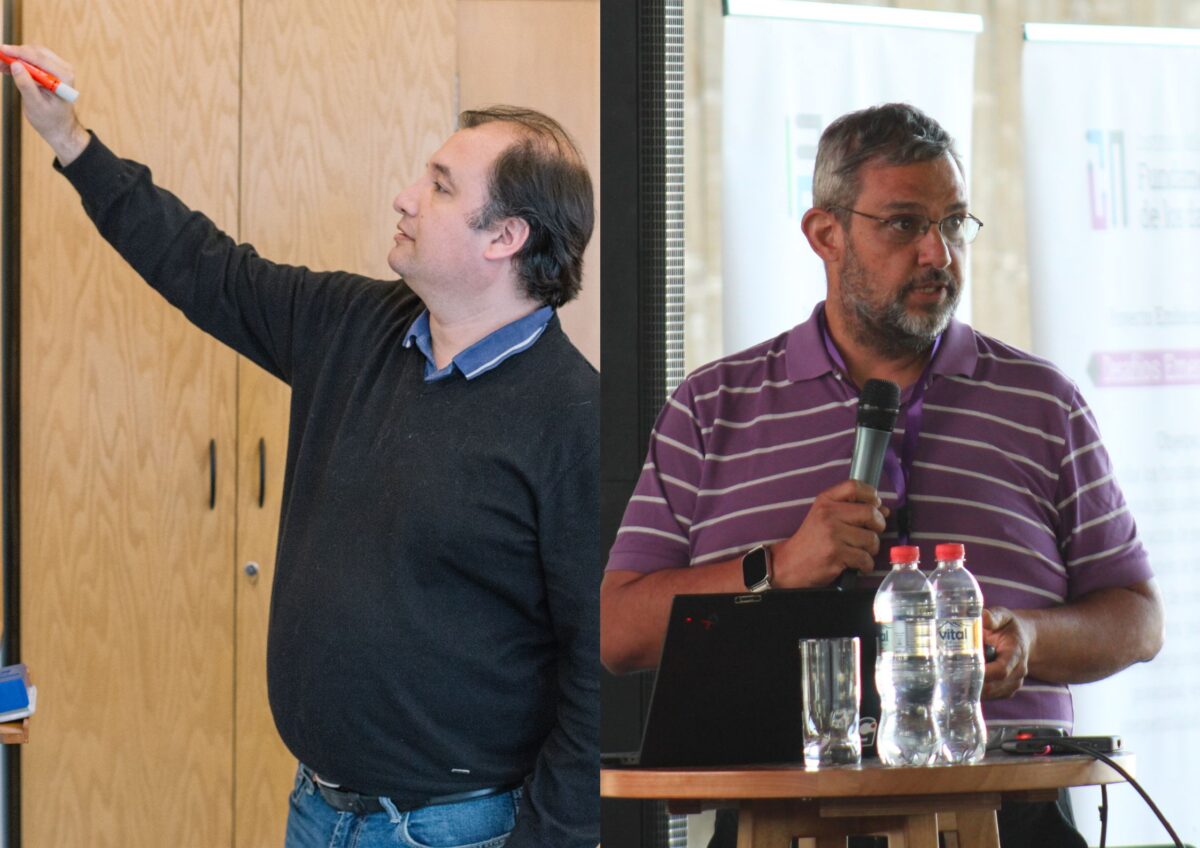
The awarded projects
Researcher Gonzalo Navarro was awarded the project Space/Time Efficient Solutions to Extend Graph Databases, which seeks to develop new techniques for relational and graph databases that improve solutions based on worst-case optimal (WCO) algorithms, extending them to practical scenarios in order to increase their usefulness and accessibility.
The research will focus, on one hand, on optimizing fundamental queries through better data structures, such as hashing and factorized representations, and on the other, on expanding these algorithms to support more complex models, including Property Graphs and temporal or spatial data, thereby narrowing the gap between research prototypes and professional use. It will also seek to generalize these results to the relational model, integrating WCO algorithms with classic join techniques to improve space efficiency. By extending the solutions to tables with more attributes and combining compact solutions with binary joins and factorization, we expect that the use of WCO algorithms will become more frequent and convenient in practice.
On the other hand, Benjamín Bustos will work on the research project Multi-Modal Retrieval for Ancient Pottery. The project focuses on the task of searching within collections of ancient pottery. The challenges in solving this problem stem from the context of the data: sources of this type of data are scarce; objects can be incomplete, with eroded parts, or present noise or errors generated during the digitization process; these objects can be described through a combination of textual information, images, and 3D geometry.
The problem is how to characterize ancient pottery in a way that simultaneously represents all modalities (text, image, 3D model) and allows searching for similar objects. “In this project, we propose to design a multi-modal similarity model in the context of ancient pottery, which will allow us to implement search algorithms for multi-modal queries. The idea is that, using our multi-modal similarity model, one can pose queries that combine the different modalities, for example, searching for objects in the collection that best match a given reference text and image” states the researcher.

The National Fund for Scientific and Technological Development (Fondecyt) stimulates and promotes the development of basic scientific and technological research every year. It has funded more than 16,000 research projects whose impacts have benefited both the scientific community and society at large.
Sources: DCC U. Chile