
Pablo Barceló will lead the organization of LICS 2027
Next year will see the 42nd edition of the Logic in Computer Science (LICS) forum, organized by the Association for Computing Machinery (ACM) and the Institute of Electrical and Electronics Engineers (IEEE). This is the world's most important symposium on logic and computer science, which will be held in Montreal (Canada) and will be co-chaired by Pablo Barceló, an academic at the UC Institute of Mathematical and Computational Engineering who is also currently in charge of the AI Department of the Vice-Rectorate for Digital Intelligence (VRID); He is also a researcher at Millennium Institute Foundational Research on Data CENIA.
LICS is an annual international forum that explores various theoretical and practical aspects in the field of computer science. The topics covered range from automata theory, categorical models and logics, database theory, knowledge representation and reasoning, logical aspects of artificial intelligence and quantum computing, bioinformatics, and programming language semantics, among other areas.
The academic will fulfill his role as co-chair alongside Alexandra Silva (Cornell University, USA). Both will be responsible for selecting the symposium's program committee, made up of various scientists who in turn are responsible for selecting the articles to be accepted at the symposium and designing the final program for the event. The task of each co-chair is to lead this group, as well as having the final say on the papers that will be included: normally around 300 papers are submitted and between 50 and 60 are selected.
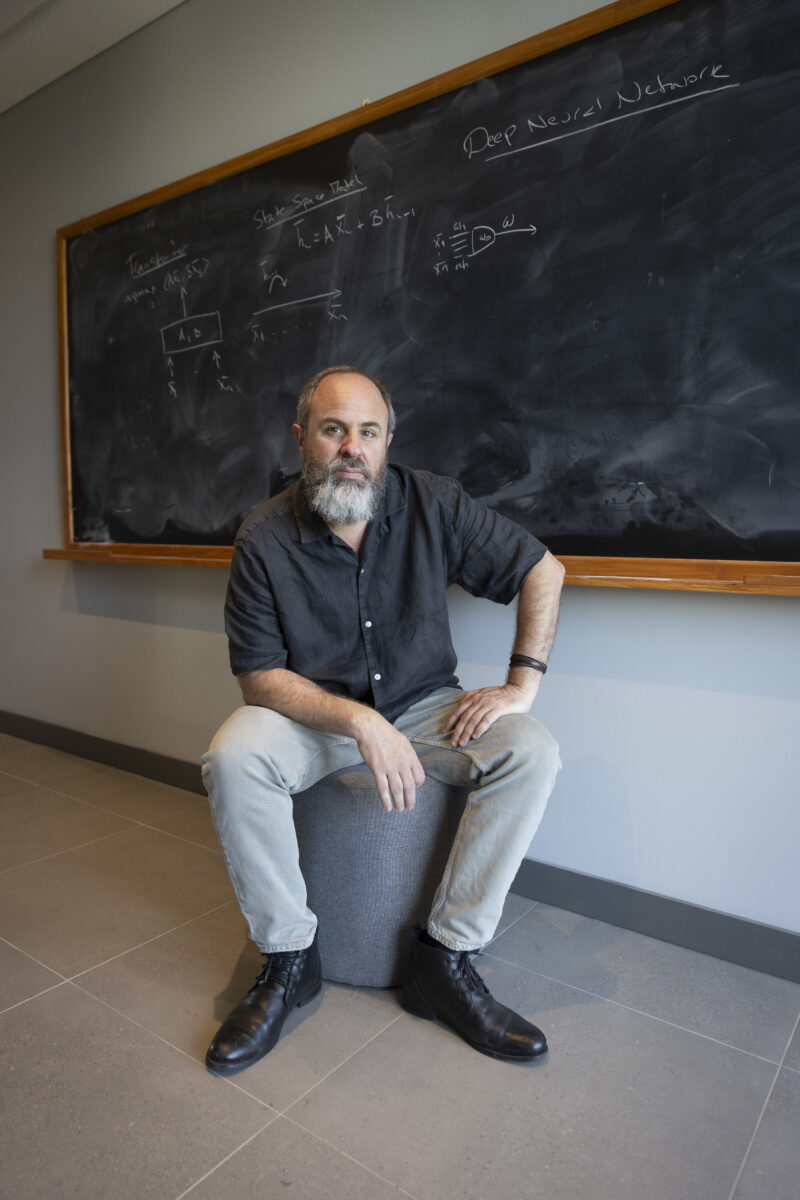
Given the responsibility involved, Pablo Barceló points out that being appointed chair of this type of conference is a major achievement. In fact, those who have held this role are usually leaders in their fields of research and not only have scientific visibility due to their work, but have also helped to build community in the field through networking. Furthermore, the academic will be the first Latin American to take on this role.
"LICS is one of the leading conferences in the field of logic and theoretical computer science and a central forum for fundamental work on the mathematics of computing. It is a great honor for me. I have admired the LICS community for many years and feel truly privileged to be able to serve it in this role. I will do my utmost to help organize an inspiring program for the conference," says Barceló.
The role of logic
The University of Toronto computer science PhD points out that "logic is not only an area of interest in itself in computing, but it is also the basis for many areas within this field. This is the case with databases, formal verification, artificial intelligence, and programming languages." That is why Barceló explains that it is often said that "while for engineers the most important thing in mathematics is differential and integral calculus, for computer scientists the fundamentals of this field lie in logic."
Barceló comments that the most important theoretical developments in the field of logic, which cut across many areas of computing, are commonly published in LICS: "It is an extremely broad conference, because it is not only interested in logic itself, but also its uses in different areas of computing. It always focuses on very fundamental applications and very profound mathematical developments that generate new perspectives or show extremely robust results."
It is worth mentioning that, as every year, LICS will present the "Test of Time Award" to a select group of papers that have had a significant impact since their inclusion in the collections of papers accepted at the conference 20 years ago. In addition, the most outstanding publication by a student will receive the Stephen C. Kleene Award, named in honor of the late American mathematician who helped found the branch of mathematical logic known as recursion theory. That idea, among others, helped lay the foundations of computer theory.
Source: IMC UC