
Juan and Aidan Hogan take over as new directors of the IMFD
December, 2023.- Scientific research, when accompanied by a significant component of self-reflection, and when its leaders embrace the vision of younger researchers, has a greater chance not only of renewing its perspective, but also of being more in tune with what society requires.
This is the vision of Marcelo Arenas, professor and academic of Computer Science at the Pontifical Catholic University of Chile, on the change of directors at Millennium Institute Foundational Research on Data IMFD) for the second five-year period (2023-2028) of this research center. In this process of progressive change in 2022 Pablo Barceló, director of the UC Institute of Mathematical and Computational Engineering, had stepped down from his position as deputy director.
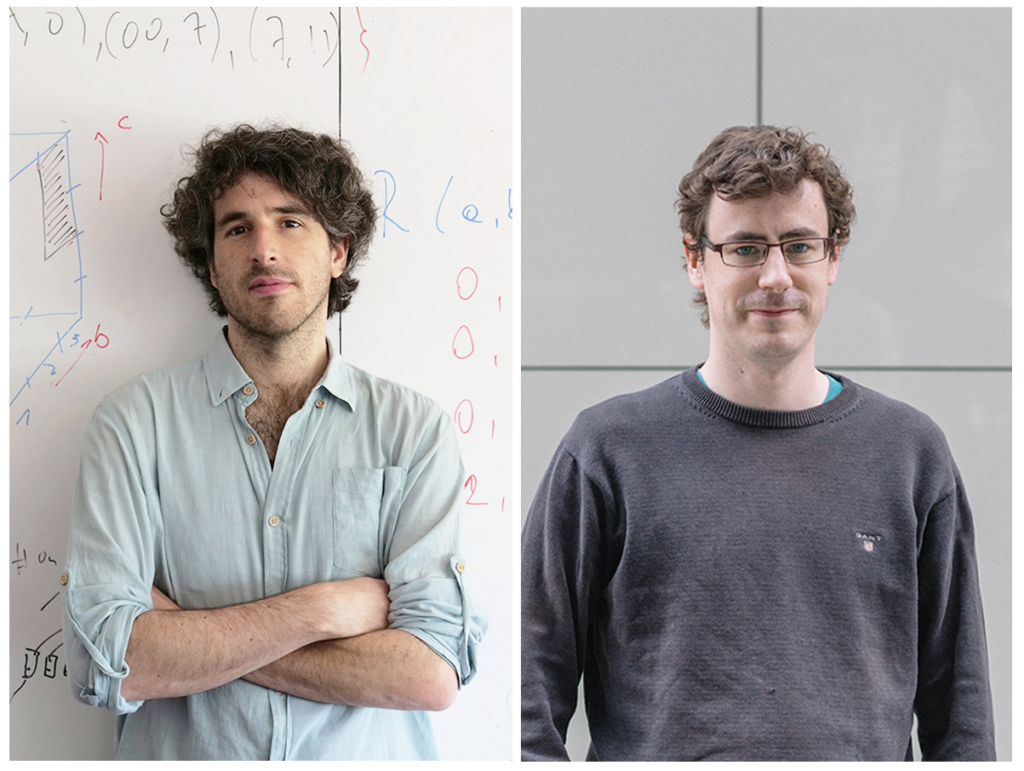
As of December 2023, Juan de la Maza will officially take over as principal director and Aidan Hogan as alternate director of the IMFD, roles they have been performing since June 2023, the start of the sixth year of operations of this research center, which is funded by the Millennium Science Initiative, under the National Research and Development Agency (ANID).
Juan Reutter de la Maza is an associate professor and head of postgraduate studies in the Department of Computer Science at the at the Catholic University of Chile (DCC UC). He is also a faculty member at the Institute of Mathematical and Computational Engineering at the Catholic University (IMC UC).
"One of my goals for the IMFD's new five-year period is to promote the science-based innovation that the IMFD has been creating in recent years. We have experience in health with the KoR Test platform that we developed during the pandemic and with the use of thick-data methodology to study complex social phenomena, such as Plataforma Telar our studies of sacrifice zones," says Juan .
In addition to these experiences, there are new projects, among which the following stand out MillenniumDB, a powerful search engine for graph databases, whose promising applications show that it is competitive with others on the market.
"The IMFD has been known until now for having leading scientists in their fields, who generate knowledge that is at the forefront of research. We now want to be known also for being creators of innovation, for our developments that can be applied to substantial improvements in different fields," adds the new director of the IMFD.
Focus on innovation and strengthening the student community
Aidan Hogan, Ph.D. in Computer Science from the National University of Ireland, Galway, is an associate professor in the Department of Computer Science at the University of Chile, which awarded him the prize for Best UNDERGRADUATE Teacher UNDERGRADUATE 2016 and 2020. Hogan has been an important driving force behind the connection between the different areas of computer science addressed at the IMFD, such as database systems with query languages for graphs.
The academic indicates that one of his first goals would be to increase the IMFD's participation and visibility in the universities associated with the institute, beginning this work at his own university, the University of Chile. "In addition, I would like to strengthen the IMFD student community by creating spaces where they can share experiences and perspectives and provide them with support. This goal is a top priority for me, considering that students are emerging from the isolation associated with the pandemic and its impact is still being felt in different ways."
Both researchers also share the IMFD's main objectives: to promote high-impact research for the benefit of society, to increase the IMFD's international visibility as a center of excellence, to foster new collaborations between People have not worked together before, and to train the next generation of experts to address the challenges of a society that increasingly relies on data.
In the footsteps of promoting interdisciplinarity
For both Reutter and Hogan, following in the footsteps of Marcelo Arenas and Pablo Barceló represents a great challenge, but also an opportunity to build on the work done by these academics. "Forming collaborations between People experience in areas as diverse as statistics, political science, communications, and computer science is a huge challenge, and requires leadership not only in scientific terms, but also in human terms. It also requires openness and creativity in terms of how to bring the different disciplines together. That is something that Marcelo and Pablo achieved in a remarkable way, and they will be an example to follow," says Aidan Hogan.
For Reutter, the outstanding evaluation at the end of the IMFD's first five years is evidence of the leadership and capabilities of Arenas and Barceló, who founded and promoted the institute. "They left us a legacy that today allows us to look to the future with solid foundations, with interdisciplinary scientific research that puts us at the forefront in Latin America. Their management is also marked by the creation of an environment at the IMFD that is not only one of excellence and professionalism, but also one that is open to new ideas, pluralistic, and friendly. Their achievements form a solid foundation for continued progress over the next five years," concludes Reutter.