
Magdalena Saldaña takes over as head of the UC Department of Journalism
“We need to train journalists who are capable of understanding an increasingly complex news landscape”: In March of this year, UC professor and IMFD researcher Magdalena Saldaña took over as head of the UC Department of Journalism. Her arrival marks a new chapter for the school at a particularly challenging time for the profession: rising misinformation, audiences avoiding the news, the rapid rise of artificial intelligence, and new ethical demands on future journalists.
The researcher acknowledges that this appointment is, above all, a vote of confidence: “I’ve built my career primarily through research and teaching. I’ve never held a management position before, so I see this as a huge endorsement: a belief that I can do something I’ve never done before and still do it well,” she says of this role, which was entrusted to her by the dean of the School of Communications, Paulina Gómez.
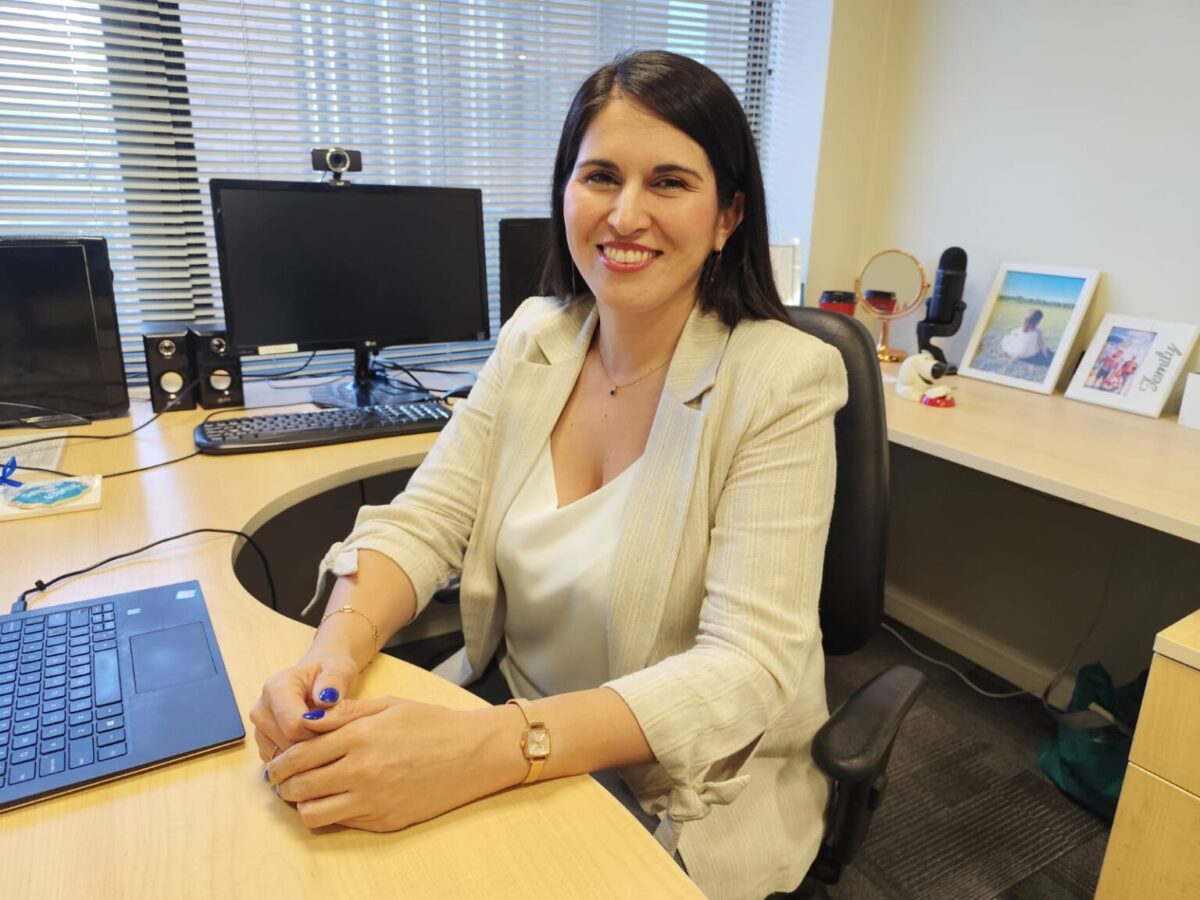
Magdalena is a journalist with a master’s degree in Social Research and Development from the University of Concepción and a Ph.D. in Journalism and Mass Communication from the University of Texas at Austin. Her research focuses on digital media, public opinion, political communication, and Latin American studies, with a particular emphasis on topics such as disinformation, audience behavior, and information ecosystems.
Throughout her career as a researcher, Magdalena has held various academic, editorial, and leadership roles in organizations such as the International Communication Association (ICA). In addition, she is currently a researcher at the Millennium Institute for Data Millennium Institute (IMFD) and an associate director at the Millennium Nucleus for the Study of Politics, Public Opinion, and the Media in Chile (MEPOP).
At the UC School of Communications, Professor Saldaña has taught courses in Social Media Journalism, Data Journalism, Research Seminar, and Advanced Methodology for Communications I, and has served as an advisor for several doctoral dissertations.
The Major Challenges: News Avoidance and Media Literacy
When discussing the current state of journalism, Magdalena does not hesitate to point out two critical issues affecting audiences: news avoidance and a lack of media literacy.
The first occurs when People or not—turn away from the news due to information overload, fatigue, mistrust, or negativity. “If I switch to social media, where the algorithm shows me only what I like, the news may stop appearing altogether. And without information, people cannot make decisions—neither in their daily lives nor as citizens,” he explains.
The second challenge runs even deeper: not knowing how to distinguish between what is news and what isn’t. And in the age of artificial intelligence, that challenge becomes even more complex: “Today, anyone can create fake news that sounds perfectly real. If someone doesn’t know how journalists write, they lack the tools to tell the difference,” she warns. For her, this is an issue that needs to be addressed not only in journalism schools but at the national level. “It’s something we should tackle starting in elementary school. How do we empower children to become informed citizens capable of understanding the ecosystem in which they live?”
Artificial Intelligence: Integrating It the Right Way
Far from banning the use of tools like ChatGPT, Magdalena Saldaña advocates for their critical and transparent integration: “Saying we shouldn’t use artificial intelligence is like saying we shouldn’t use Google. It’s absurd. What we need to teach is when its use is ethical, necessary, and appropriate,” she explains, though she acknowledges a significant risk in the context of journalism: “If I’m teaching writing, I need to evaluate the student’s writing, not that of a tool. But if I ask them to identify potential sources for a story, I see nothing wrong with using AI as a starting point.”
Training the best: a tradition that continues
Regarding the mark she hopes to leave on her role as director, Professor Saldaña explains: “We have always sought to train the best journalists—the best in terms of professionalism, ethics, and practical skills. That doesn’t change, even as technologies evolve.” However, she is emphatic about the importance of understanding and integrating technologies: “Technologies cannot outpace us. We must integrate them, but always in service of the same goal: telling good stories that help People decisions and understand democracy.”
He also points out that younger generations face more ethical temptations than ever before: “In the past, we didn’t have as many opportunities to do unethical things that actually worked. Today we do. That’s why we must strengthen ethical training at every step.”
The UC School of Communications is working on redesigning its curriculum, with a focus on incorporating up-to-date content while maintaining core elements such as practical training workshops. Professor Saldaña adds that it is essential to provide exposure to journalism from the early stages, something she also aims to promote.
Research as a driving force for more robust teaching
As a researcher, Magdalena sees enormous potential for the research conducted at the School to directly inform UNDERGRADUATE education. “We have a wealth of evidence on various effects—for example, in fact-checking, information retention, or news perception. That research doesn’t always feed into teaching, and it really should,” she reflects. In her view, incorporating studies on how People and process information could significantly strengthen professional training.
Regarding the benefits that the existence of the Doctorate in Communication Sciences can bring to UNDERGRADUATE, the professor believes there are many: “It’s valuable for students to know that there is a world of research right at their doorstep, exploring the very same topics they are learning. There is a lot of potential for synergy.”
Leadership for Challenging Times
With an approach that combines academic rigor, a concern for the information ecosystem, and a strong ethical commitment, Magdalena Saldaña takes the helm of the UC Department of Journalism with a clear conviction: “Training journalists today means teaching them to understand a much more complex information landscape. And equipping them with the tools to navigate it responsibly, with discernment, and in the public interest.”
Source: UC Communications