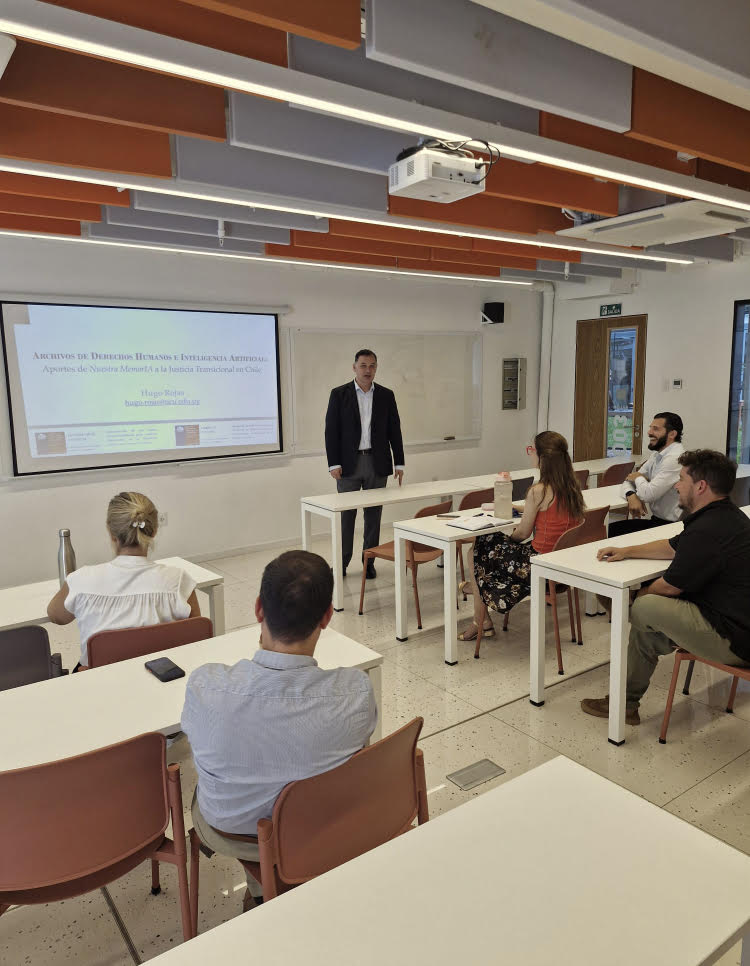
Hugo Rojas gives a lecture on memory archives and artificial intelligence in Uruguay
On March 17, Hugo Rojas, a research associate at Alberto Hurtado University, a member of the Nuestra MemorIA project, a faculty member at the School of Law and Liberal Arts at the Catholic University of Uruguay, and an IMFD researcher, delivered a lecture titled “Human Rights Archives and Artificial Intelligence: Contributions of Nuestra MemorIA to Transitional Justice in Chile,” as part of the Permanent Seminar of the Law Department at that university.
In his presentation, Professor Rojas outlined the rationale, scope, and progress of the interdisciplinary project Nuestra MemorIA, an initiative that, since September 2023, has brought together researchers from the fields of engineering, the social sciences, law, and history to analyze documentation related to human rights violations that occurred during the dictatorship in Chile.
The project—hosted by Alberto Hurtado University and the Pontifical Catholic University of Chile—aims to integrate scattered and fragmented information, thereby contributing to the reconstruction of historical knowledge. To this end, it combines the methodological expertise of specialists in human rights and the humanities with advanced tools from engineering and data science, in a genuinely transdisciplinary approach.
Our MemorIA project is supported by leading institutions, including the Museum of Memory and Human Rights, the National Institute of Human Rights (INDH), the Vicaría de la Solidaridad, the Committee for the Prevention of Torture, the Undersecretariat for Human Rights, and the Millennium Institute Foundational Research on Data IMFD).
During the conference, Dr. Rojas also presented updates on the Fondecyt Exploration project , “Developing a Transdisciplinary Framework for Analyzing Documents from the Chilean Dictatorship Using New Technologies,” and the Fondecyt Regular project, “Artificial Intelligence-Based Search in Multimodal Historical Archives from the Era of the Chilean Dictatorship.”
He also highlighted the project’s growing international reach: “Our research originally focused on Chile’s transitional justice process; however, various institutions and countries have requested our assistance in reviewing archives. “We have worked with entities as diverse as the International Criminal Court, the Office of the United Nations High Commissioner for Human Rights (OHCHR), the International Committee of the Red Cross, the International Organization for Migration (IOM), Impunity Watch, the Search Unit for People Missing in Colombia, and the Ukrainian government,” he noted.
Finally, the scholar highlighted the project’s future challenges, which are aimed at furthering the study of archives documenting repression in the Southern Cone—in collaboration with teams from Uruguay and Argentina—as well as strengthening dialogue with European academic communities, thereby expanding the comparative and interdisciplinary scope of the research.