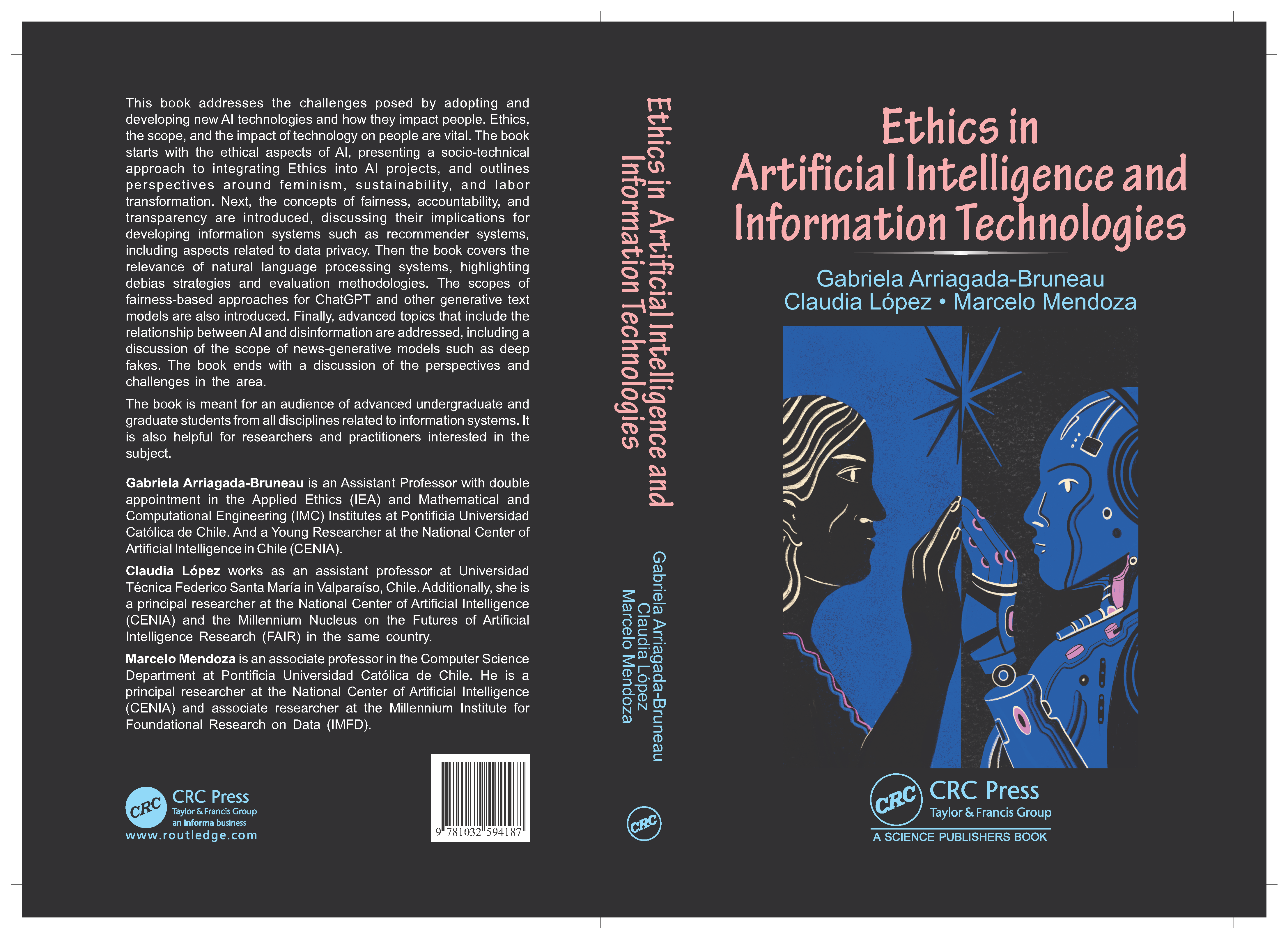
Marcelo Mendoza launches book in collaboration with Gabriela Arriagada and Claudia López on Ethics in AI and Information Technology
Gabriela Arriagada Bruneau is an assistant professor with dual affiliation at the Institutes of Applied Ethics (IEA) and Mathematical and Computational Engineering (IMC) at the Pontifical Catholic University of Chile and a young researcher at the National Center for Artificial Intelligence (CENIA).
Claudia López works as an assistant professor at the Federico Santa María Technical University in Valparaíso, Chile. She is also a principal investigator at CENIA and at the Millennium Nucleus on the Futures of Artificial Intelligence Research (FAIR).
Marcelo Mendoza is an associate professor in the Department of Computer Science at the Pontifical Catholic University of Chile. He is a principal investigator at CENIA and an associate researcher at the Millennium Institute Foundational Research on Data IMFD).
The book entitled: Ethics in Artificial Intelligence and Information Technologies
Authors: Gabriela Arriagada-Bruneau • Claudia López • Marcelo Mendoza
According to the description published on the back of the book, this text addresses the challenges posed by the adoption and development of new artificial intelligence (AI) technologies and how they impact People. The ethics, scope, and impact of technology on People fundamental aspects. The book begins with the ethical aspects of AI, presenting a socio-technical approach to integrating ethics into AI projects, and describes perspectives on feminism, sustainability, and labor transformation.
Next, the concepts of fairness, accountability, and transparency are introduced, discussing their implications for the development of information systems such as recommendation systems, including aspects related to data privacy. The book then covers the relevance of natural language processing systems, highlighting strategies for reducing bias and evaluation methodologies.
The scope of equity-based approaches for ChatGPT and other generative text models is also presented. Finally, advanced topics are addressed, including the relationship between AI and misinformation, with a discussion on the scope of generative news models such as deepfakes. The book concludes with a discussion on the prospects and challenges in this area.
This book is intended for advanced UNDERGRADUATE graduate students in all disciplines related to information systems. It is also useful for researchers and professionals interested in the subject.
Invitation from the authors
Marcelo Mendoza: "This book takes an interdisciplinary approach to ethics and artificial intelligence. It proposes a conceptual framework for addressing AI development by integrating ethics, conceptualizes AI systems as socio-technical systems, and defines the main threats associated with AI. In this regard, it addresses methodological aspects that enable the development of secure AI and reviews the progress of normative and regulatory approaches to AI at the global level. It is a book written from Chile but with a global perspective, ideal for researchers, students, and developers of AI solutions."
From Gabriela Arriagada: "What kind of future do we want to build with artificial intelligence?"
Ethics in Artificial Intelligence and Information Technology is an essential work for anyone who wants to understand, anticipate, and respond to the ethical dilemmas that arise in a world increasingly mediated by algorithms. With a rigorous but accessible approach, this book examines how AI is transforming areas such as education, justice, communication, work, privacy, and automated decision-making.
This work offers a critical overview of the contemporary challenges posed by the use of AI in society. From a socio-technical and interdisciplinary perspective, it addresses key concepts such as equity, transparency, accountability, sustainability, data governance, misinformation, and algorithmic bias. It also explores emerging approaches such as data feminism, design justice, and explainable AI (XAI), applied to real-world systems such as ChatGPT, generative image models, and recommendation systems.
This book is intended for UNDERGRADUATE students as well as professionals in law, engineering, philosophy, social sciences, and computer science. It is also a valuable tool for teachers, researchers, and policymakers seeking to integrate ethical principles into the research, development, and implementation of digital technologies.
Because it is not enough to know what AI can do; we need to discuss what it should do.
This book provides the frameworks, tools, and examples necessary to critically rethink the role of artificial intelligence in our lives and collectively decide where we want to go.
Where can you buy it? Click on the following link: https://www.routledge.com/Ethics-in-Artificial-Intelligence-and-Information-Technologies/Arriagada-Bruneau-Lopez-Mendoza/p/book/9781032594187
Source: Department of Computer Science, Catholic University of Chile