
IMFD among the first centers in the world to access unpublished Facebook data to study its role in elections
It can all start with a simple “Like” on a Facebook comment, so that this first approval, given freely and autonomously by a user to a message that matches their interests, becomes part of a chain of events that ends with that person marking a line on one of the millions of ballots that will determine who will be the next president of a country.
How much social media influences that final act —voting— is the big question that 12 teams of researchers in eight countries are seeking to answer, including Chile, as part of an unprecedented academic initiative: Facebook, the social media giant, has decided to share its data with the scientific community in a complete, anonymous, and transparent manner, so that researchers can adequately measure its influence on democratic processes.
The 12 projects —involving 60 researchers from 30 different universities— were accepted after going through a competitive peer review process organized by the U.S. Social Science Research Council (SSRC) together with Social Science One, a community of academics led by Harvard and Stanford universities, and Facebook.
“These projects position researchers from the Millennium Scientific Initiative at the forefront of studying new influences on social phenomena. It is essential to analyze and understand what happens in the digital universe, in order to grasp dynamics that we are just beginning to size up in fields as vital as democratic processes,” said Marcelo Arenas, director of IMFD and Full Professor at the Department of Computer Science of Universidad Católica.
The novelty of this competition is twofold. First, a specific infrastructure is created that will allow researchers to access information, such as the reactions a link shared on Facebook received, while safeguarding user privacy by removing identifiable information from the data. Second, to guarantee the independence of the research, Facebook does not participate in the selection of the projects and cannot limit or direct their results.
Fake news in the 2017 Presidential Elections
IMFD researchers and professors at the Faculty of Communications of Pontificia Universidad Católica de Chile, Sebastián Valenzuela and Magdalena Saldaña, lead the project “Fake News on Facebook in the 2017 Chilean Elections: Analysis of Its Content, Diffusion, and Audience Characteristics”. Their team also includes researcher Juan Pablo Luna, from the Institute of Political Science UC, along with Bárbara Poblete, Benjamín Bustos, and Jorge Pérez, professors at the Department of Computer Science of Universidad de Chile.
According to Valenzuela, “Chile shows a high level of social media use and political participation online, but people deeply distrust politicians and are participating less and less in elections. For this reason, our country is particularly at risk of the spread of misinformation and disinformation during electoral processes.”
The researcher adds that, although there is little scientific evidence on these phenomena in Chile, the data they have gathered so far confirms that exposure to rumors, conspiracies, and fake news among social media users is high.
For example, during the last presidential election, 66% of those surveyed by the think tank TrenDigital, from the UC Faculty of Communications, knew about the fake news claiming that Venezuelan president Nicolás Maduro called for people to vote for Alejandro Guillier. Meanwhile, 84% of those surveyed knew about the false accusation made by Sebastián Piñera, that in the first round there were ballots marked in favor of candidates Guillier or Beatriz Sánchez.
“This does not mean that most Chileans believe that this false information is true. The same survey showed that those who believe this information is true are less than half. However, it has been shown that the greater the familiarity with a piece of content, the more it tends to be perceived as credible,” Valenzuela states.
As an example, the researcher cites what has happened with the false link between vaccine use and health damage, especially promoted on social media. “The more people hear that vaccines can be harmful to health, the more they tend to doubt the scientific consensus that they are beneficial,” Valenzuela notes.
A long and narrow strip of disinformation
Through two studies that will soon be published in scientific journals, based on TrenDigital surveys, Valenzuela and his UC colleagues, Daniel Halpern, Juan Pablo Miranda, and James Katz, from Boston University (USA), established that Chile has become fertile ground for social media to foster disinformation.
In this context, the new IMFD research project that will use data provided by Facebook will examine the breadth, sharing, and consumption of misinformation among users of that social network during the 2017 electoral campaign in Chile.
The work will focus on four objectives. The first is to measure exposure to and sharing of fake news in relation to verified news. Then, the attributes of content that predict the sharing of misinformation will be determined. The emotional reactions of users to fake news compared to verified news will be analyzed, and finally, a sociodemographic profile of exposure to misinformation will be created to analyze whether voters were more exposed than non-voters to fake news.
Facebook’s influence on the 2017 Parliamentary Elections
Meanwhile, the team led by Juan Pablo Luna, IMFD associate researcher and academic at the Institute of Political Science and the School of Government of Universidad Católica, will analyze the role of Facebook in the 2017 legislative electoral campaigns in Chile.
This project also includes IMFD researchers Cristián Pérez-Muñoz, from the Institute of Political Science UC; Fernando Rosenblatt, director of the Department of Political Science at Universidad Diego Portales; Sergio Toro, from the Political Science department at Universidad de Concepción and director of DemoData UdeC; Bárbara Poblete, from Universidad de Chile, and Sebastián Valenzuela, from the UC Faculty of Communications.
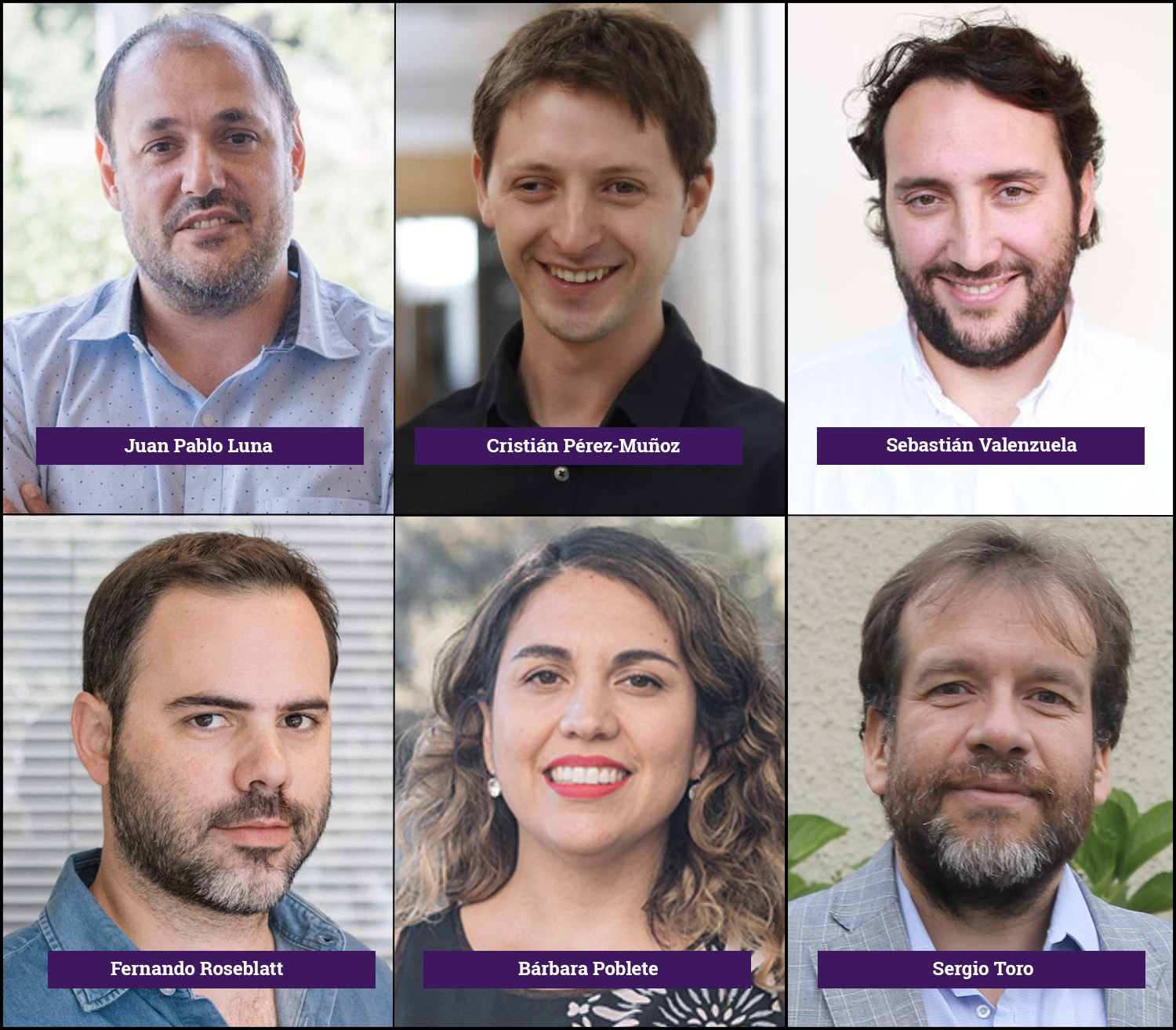
This project seeks to understand Facebook’s role in electoral campaigns in relation to other parameters, such as audiences: “This has not been possible until now, because –generally speaking, those who analyze electoral campaigns and the logic behind them can only look at a single dimension: either social media alone or offline campaigns alone. Our project will be the first, as far as we know, to study in Chile, in combined form, both types of campaigns, online and offline.”
Relationship between tweets and votes
The researcher explains that in 2017 his group tracked the legislative campaigns on the ground, on Twitter and Facebook, of 17 candidates for deputy in various districts of the Metropolitana and Biobío regions, which already allows them to have some tentative notions.
“For example, we saw two candidates with completely different levels of effectiveness: both came from challenger parties, tied to social movements; both ran very strong campaigns on Twitter and Facebook, but one had a very high rate of votes per tweet, while the other had a very low one. The difference would be explained by what each of them did on the ground, which would mean that there is indeed a connection between the online and the offline, which is what we hope to confirm with this project,” says Luna.
He also notes that they expect to analyze the impact of message segmentation: “We think —and what we have seen so far suggests— that audience-based segmentation, given social media algorithms, works for campaigns in the same way it does for brands or companies. Candidates may have delivered —seemingly opposing— messages to different groups through this segmentation, thereby expanding their sphere of influence.”
The awarding of these projects marks a milestone in research in this field: “Facebook’s data will allow us to carry out more sophisticated analyses, and Chile will be part of a community that will access this data for the first time to analyze the impact of social media on contemporary democracies,” concludes Juan Pablo Luna.