
Over 100 people attended the first edition of Data, Beer & Pizza by the IMFD
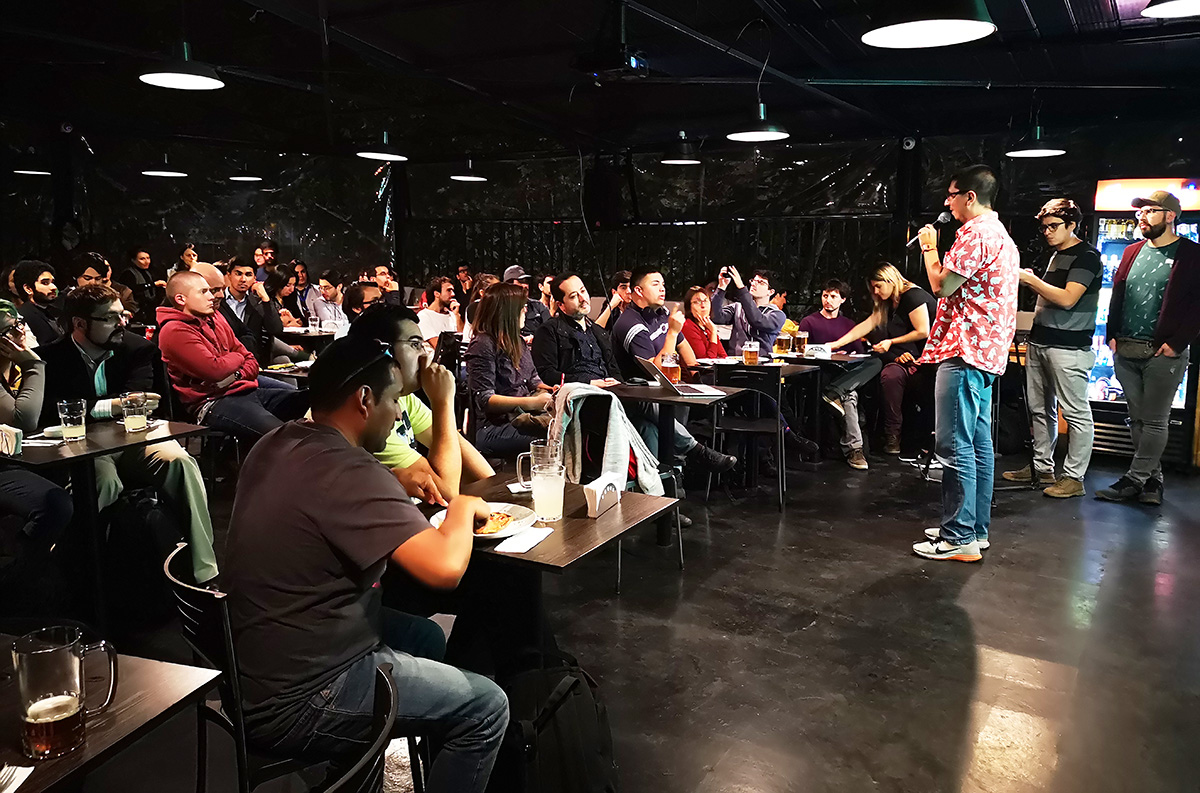
Data (lots of data), pizza, and beer were the essential ingredients of the first Data, Beer & Pizza, a gathering that seeks —in a relaxed, friendly atmosphere— to spread awareness about the reach of data science across its most diverse fields of application. The event, attended by more than 100 people, was organized by the Millennium Institute for Foundational Research on Data (IMFD) with support from the Outreach to the External Community program of the Millennium Scientific Initiative, and took place at Galería Mackenna, in downtown Santiago.
How do computers understand human beings? How does trolling manifest itself on social media, and with what kinds of topics does it arise most often? Are computers all-powerful? These were the three topics addressed in the talks given by IMFD researchers Jorge Pérez, Magdalena Saldaña, and Marcelo Arenas, respectively, at the first edition of this event held on April 16, 2019.
How do computers understand us?
Jorge Pérez, associate researcher at IMFD and faculty member at the Department of Computer Science (DCC) of the Universidad de Chile, was in charge of opening the session with a playful talk explaining how a computer system is trained to learn to link concepts and build sentences like the ones we use every day in society, using what we believe to be unique and distinctive of human beings: natural language.
Through examples, the researcher explained how computers, by learning to construct sentences using information generated by human beings, reproduce —without understanding their meaning— the same biases that society holds around various concepts. As reported by the news outlet Emol, Pérez showed the training of an artificial intelligence “through work with vectors and word analysis that were taught to a system, extracted from articles published on Wikipedia,” the publication states.
During the exercise, in which Jorge Pérez programmed “live” in front of the attendees, it became clear how the computer associated words related to gender or politics, for example, with certain adjectives, reflecting a possible bias acquired by the machine during its learning process. “One mission for scientists is to avoid teaching machines these biases,” said Jorge Pérez during the talk, “after showing, with examples, how some words took on context depending on the texts in which they appeared, resulting in relationships that clearly had problems of discrimination,” Emol notes.
Chileans and trolling on social media
Magdalena Saldaña, faculty member at the School of Communications of the UC and IMFD researcher, addressed incivility on social media —the academic concept used to refer to trolling— in her talk “Haters gonna hate.”
The researcher noted that, internationally, it is estimated that one in five comments (that is, 20%) falls into the category of incivility. Now, the situation changes when looking at the opinions posted on the social media accounts of media outlets in Chile: on average, in our country one in four comments falls into the category of incivility, and during election periods, 30% of posts correspond to what is clearly identified as “trolling.”
“The importance lies in the fact that uncivil comments have an effect on audiences: people become more intolerant, media credibility declines, and it even affects how news is perceived,” adds the IMFD researcher. With this, she pointed out that the more uncivil comments there are on a news story, the more people tend to rate the information as negative, without having read it.
Are computers all-powerful?
Closing out the session was Marcelo Arenas, director of IMFD. With his talk titled “Are computers all-powerful?”, the Full Professor at the Department of Computer Science (DCC) of the Universidad Católica challenged the belief that computers have reached a processing capacity for which there are no longer any limits.
The researcher explained that, while computers may be surpassing human beings in some respects, that does not make them all-powerful or infallible. In his presentation, he stated that there are physical limits to computers’ capabilities, imposed by hardware.
To demonstrate this, he used some examples of computational logic problems whose solution, if processed by the most powerful computers we could imagine, would take longer to solve than the universe has existed. “And that is something we should be thankful for, because if a computer could solve some of these problems, everything that science has developed in the field of cryptography — which is key to the security of online financial transactions — would become useless,” Arenas concluded.
Data, Beer & Pizza is part of a series of science outreach talks aimed at the general public, which will be held throughout 2019 and announced through the IMFD website and its social media channels.