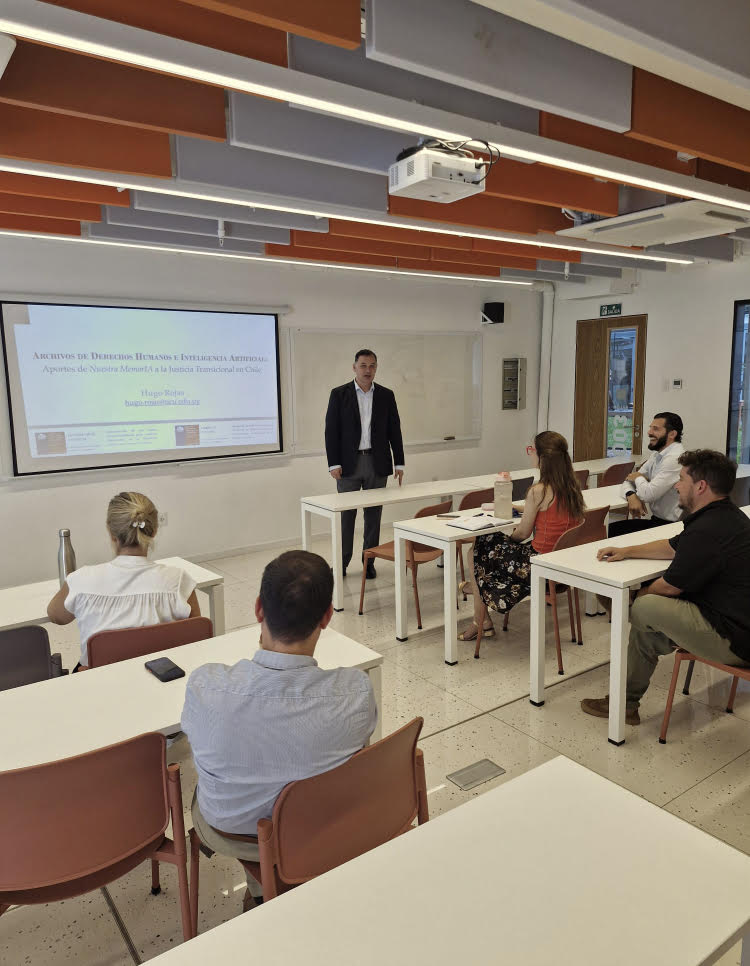
Hugo Rojas gives lecture on Memory archives and artificial intelligence in Uruguay
On March 17, Hugo Rojas, associate researcher at Universidad Alberto Hurtado, member of the Nuestra MemorIA project, as well as faculty member of the School of Law and Liberal Arts of the Universidad Católica del Uruguay and IMFD researcher, delivered a talk titled “Human Rights Archives and Artificial Intelligence: Contributions of Nuestra MemorIA to Transitional Justice in Chile”, as part of the Permanent Seminar of the Department of Law at that institution.
In his presentation, Professor Rojas discussed the foundations, scope, and developments of the interdisciplinary project Nuestra MemorIA, an initiative that, since September 2023, has brought together the work of researchers from engineering, social sciences, law, and history, with the aim of analyzing documentation related to human rights violations that occurred during the dictatorship in Chile.
The project –hosted at Universidad Alberto Hurtado and the Pontificia Universidad Católica de Chile– aims to integrate scattered and fragmented information, thereby contributing to the reconstruction of historical knowledge. To achieve this, it combines the methodological expertise of specialists in human rights and the humanities with advanced engineering and data science tools, in a genuinely transdisciplinary approach.
Nuestra MemorIA is supported by prominent institutions, including the Museum of Memory and Human Rights, the National Institute of Human Rights (INDH), the Vicaría de la Solidaridad, the Committee for the Prevention of Torture, the Undersecretariat of Human Rights, and the Millennium Institute for Foundational Research on Data (IMFD).
During the talk, Dr. Rojas also presented progress on the Fondecyt Exploración project “Building a transdisciplinary framework to analyze documents from the Chilean dictatorship using new technologies” and the Fondecyt Regular project “Artificial Intelligence-based search in multimodal historical archives from the era of the Chilean dictatorship.”
He also highlighted the project’s growing international reach: “Our research was originally situated within the Chilean process of transitional justice; however, various institutions and countries have requested our collaboration in reviewing archives. We have worked with entities as diverse as the International Criminal Court, the Office of the United Nations High Commissioner for Human Rights (OHCHR), the International Committee of the Red Cross, the International Organization for Migration (IOM), Impunity Watch, the Missing Persons Search Unit in Colombia, and the Ukrainian government,” he stated.
Finally, the academic underscored the project’s future challenges, aimed at deepening the study of repression archives in the Southern Cone –in collaboration with teams from Uruguay and Argentina– as well as strengthening dialogue with European academic communities, expanding the comparative and interdisciplinary scope of the research.