
Critical Gap: Vulnerabilities Revealed in Public Data Anonymization Ahead of New Data Protection Law
Knowing how many we are, how we are doing in health, in education, how we vote, what our origins are: There is a general consensus that this data should be accessible to those seeking to create public policy, innovate, research, study, and much more. But, how do we safeguard the privacy of individual data in a world where it is increasingly easy to handle enormous amounts of data?
“The privacy and security of our data are areas that are increasingly affected by advances in the field of computer science,” highlights Federico Olmedo, an academic at DCC U. Chile and researcher at the Millennium Institute for Foundational Research on Data (IMFD). The paper “A Study of Data Anonymization in Chile’s Public Sector”, carried out by researchers from the Computer Science Department (DCC) of Universidad de Chile and the Millennium Institute for Foundational Research on Data (IMFD), was recently presented at the Jornadas Chilenas de Computación 2025, held at the Pontificia Universidad Católica de Valparaíso.
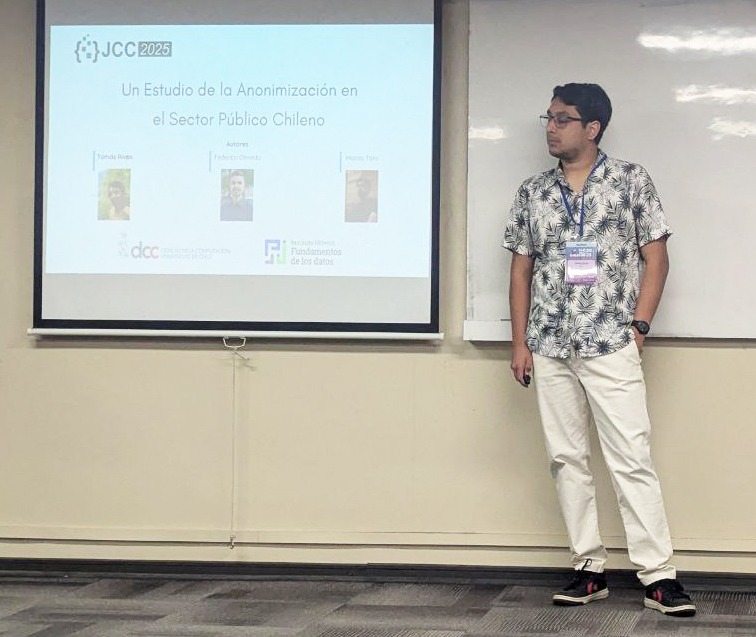
This work exposes significant flaws in the anonymization practices for microdata released by Chilean public institutions, and the enormous challenge that all organizations will face as the new Data Protection Law (Law No. 21,719) comes into effect.
Researchers Tomás Rivas, Federico Olmedo, and Matías Toro, all from the Computer Science Department of Universidad de Chile, carried out a systematic evaluation of the effectiveness of anonymization techniques applied to public datasets in sensitive areas such as health, education, migration, and electoral processes.
The research is based on an exhaustive analysis of the structural privacy properties of different databases from Chilean public institutions that are available to the general public. “In this analysis, we selected five databases, which should provide us with statistical and anonymous information on health, education, migration, and elections. Each of these datasets was selected based on criteria of sensitivity, microdata granularity, and public availability,” highlights Matías Toro Ipinza, also an IMFD researcher and DCC U. Chile academic.
The techniques used seek to test and stress the privacy of these datasets, using structural methods, which made it possible to demonstrate that most of these databases have structural weaknesses: “In particular, we found that a large portion of the data in these databases can be individually identified, and we showed that these vulnerabilities are not merely theoretical,” notes Tomás Rivas, DCC U. Chile and lead author of the research.
To this end, the researchers formulated realistic attacks under the “motivated intruder” concept: a model used for this type of testing that considers an ordinary user with intentions to obtain information. Through this test, they were able to confirm that the personal information of individuals in these databases can be recovered, and that, therefore, it is possible to individually identify the people whose data is in these supposedly anonymized databases.
These attacks confirmed that sensitive personal information —such as household income decile, voting behavior, or the outcome of a residency application— can be inferred and recovered in practice with moderate effort. The study successfully de-anonymized individuals in four of the five datasets evaluated.
New national regulation
The findings of this study take on critical relevance in the context of Chile’s new Personal Data Protection Law (Law No. 21,719). The research underscores a critical gap between legal compliance and effective privacy protection. “This law allows Chile to move toward a modernized data governance framework, bringing it closer to international standards such as the European Union’s GDPR,” highlights Olmedo.
However, the law establishes a strict requirement: anonymized data is that whose individual identification is irreversibly excluded. The study demonstrates that the current anonymization practices applied by Chilean public institutions do not meet this standard. “We also see that there is interest from the authorities and public organizations, since as part of this work, we contacted the institutions, and several of them are already taking action,” highlights Federico Olmedo.
The researchers emphasize that, although the law will be fully implemented by December 2026, it currently does not provide concrete technical standards for anonymization. Their results expose the urgent need for clear, robust technical guidance, ideally issued by the recently created Personal Data Protection Agency, to ensure that public institutions can safeguard individual privacy and achieve regulatory compliance.
Local solutions for our own problems
Regarding future work, Olmedo highlights that it would be interesting to expand the analysis to other datasets, as well as to track how changes in databases can modify re-identification risks. In addition, the researchers propose working on automated tools that public agencies could use to assess re-identification risks before publishing data. “We need to have the local capacity, as a country, to develop automated tools: it is very unlikely that a solution designed for another reality, such as that of Global North countries where these challenges have already been addressed, can be directly applied to the reality of our national databases. That is why promoting research, innovation, and study of these issues is vital for our academic and development communities alike.”