
Marcelo Arenas Takes Office as Director of Artificial Intelligence at the Vice-Presidency for Digital Intelligence of Pontificia Universidad Católica
The associate researcher and former director of the Millennium Institute for Foundational Research on Data (IMFD) replaces Pablo Barceló, also a researcher at the institute, who on Monday took over as director of the Centro Nacional de Inteligencia Artificial (CENIA).
This Monday, November 2, the appointment of Marcelo Arenas, associate researcher at the Millennium Institute for Foundational Research on Data (IMFD), as director of Artificial Intelligence at the Vice-Presidency for Digital Intelligence of the Pontificia Universidad Católica de Chile was made official.
Arenas takes over the position from Pablo Barceló, an IMFD researcher and professor at the Instituto de Ingeniería Matemática y Computacional (IMC UC), who on the same day took office as director of the Centro Nacional de Inteligencia Artificial (CENIA).
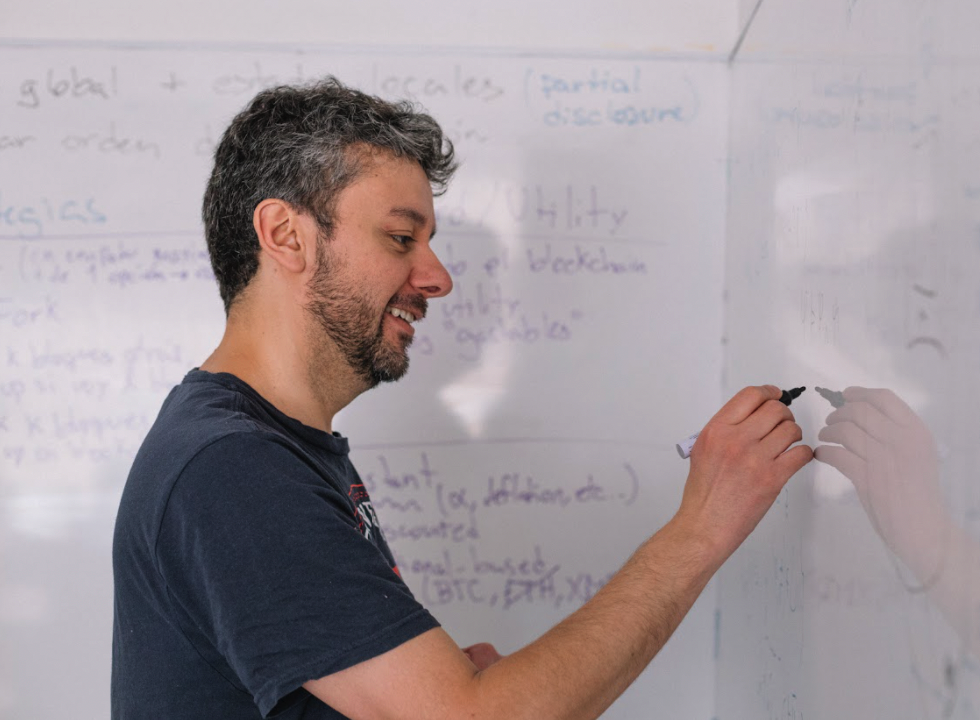
Career
Arenas is a faculty member at the Departamento de Ciencia de la Computación (DCC UC) and the Instituto de Ingeniería Matemática y Computacional (IMC UC) at Universidad Católica, and holds a PhD in Computer Science from the University of Toronto, Canada.
He served as director of IMFD between 2018 and 2023. Before that, from 2013 to 2018, he directed the Center for Semantic Web Research, which gave rise to the institute.
Arenas has also taken part in public policy and international standardization initiatives. He was a member of the Committee of Experts that supported the Chilean government in drafting the National Artificial Intelligence Policy (2021). Internationally, he participated as an invited expert in the World Wide Web Consortium (W3C) working group that standardized a language for translating relational databases into RDF, and in the OECD Global Science Forum on digital skills for data-intensive science.
His research areas include data management, applications of logic in computer science, knowledge representation, and explainable artificial intelligence.
Recognitions
In 2021 he was named a Distinguished Member of the Association for Computing Machinery (ACM), and in 2024 he was elected a Fellow of the same organization for his contributions to the foundations of data management.
He has received nine best paper awards at international conferences, including PODS, ISWC, ICDT, ESWC, and WWW. In 2016 he received the Ten-Year Award from the Semantic Web Science Association for the paper “Semantics and Complexity of SPARQL,” and in 2020 the ACM SIGMOD Research Highlight Award.
In October of this year, he once again appeared on the World’s Top 2% Scientists ranking, compiled by Stanford University and the publisher Elsevier. In the 2026 edition, with 154 publications and more than 6,500 citations, he ranks 306th among 19,463 researchers in the information systems subfield.