Rock-Paper-Scissors with AI: Students learned about Monte Carlo Simulations during visit to the Millennium Institute for Foundational Research on Data (IMFD)
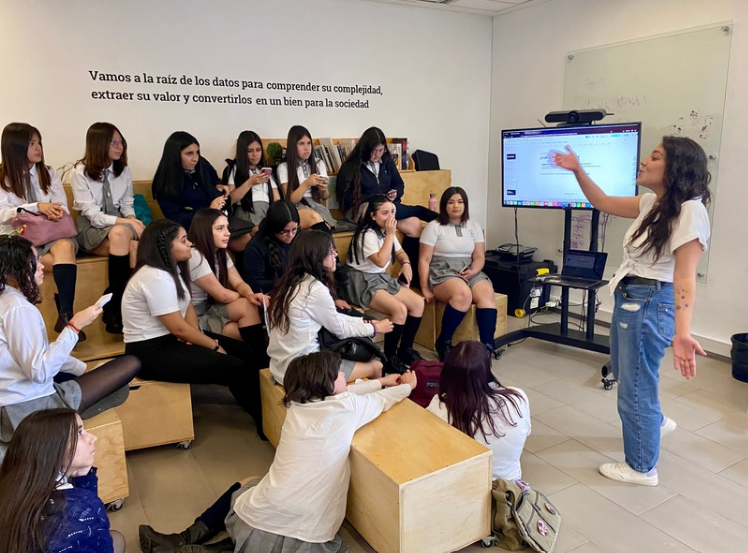
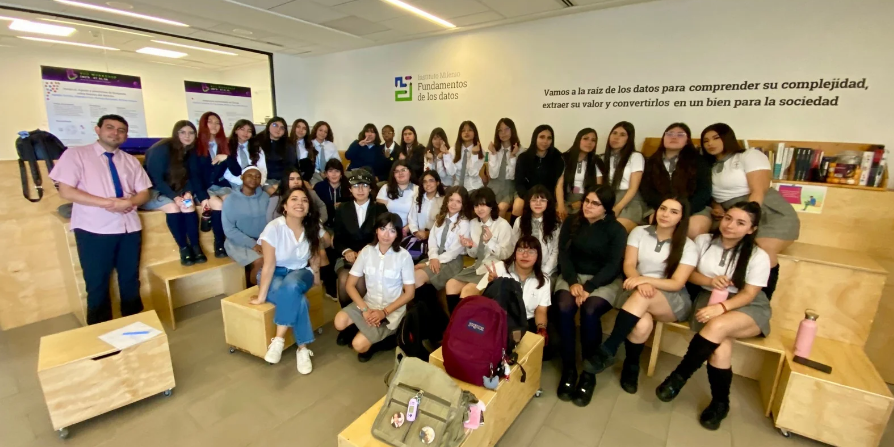
More than 70 students from Colegio Ascensión Nicol took part in workshops organized by the Millennium Institute for Foundational Research on Data (IMFD), where they learned how Monte Carlo simulations make it possible to study random phenomena, identify patterns, and explore different scenarios.
How many times do you need to repeat an experiment to know whether a result is due to chance or reflects a real pattern? That was one of the questions explored by eleventh-grade students from Colegio Ascensión Nicol, in Estación Central, during the workshop “El Cachipún de la IA” (“AI Rock-Paper-Scissors”), held by the Millennium Institute for Foundational Research on Data (IMFD).
The initiative was organized at the school’s request, with the goal of connecting the content of the Probability and Statistics course with everyday applications and showing how these tools are used in scientific research and data science.
The initiative was organized at the school’s request, with the goal of connecting the content of the Probability and Statistics course with everyday applications and showing how these tools are used in scientific research and data science.
From Chance to Patterns: Learning Through Simulations
The workshop began with a game: in groups, the students played 20 rounds of rock-paper-scissors and identified which moves worked best to win. In several groups, one move seemed to be “the best,” even though in theory rock, paper, and scissors are all equally good choices. Then, they ran computer simulations of rock-paper-scissors tournaments with 10, 100, 1,000, and 10,000 plays, which allowed them to see that with few repetitions, chance invents winners, while with thousands of repetitions, the real behavior emerges.
“At school, students see statistics from a mathematical perspective, but random events are better understood when you see what happens on average and how much the results vary. To see that in real life, a good approach is to use a computer and simulate the phenomenon thousands of times”, explains Juan Reutter, director of IMFD and faculty member at the Department of Computer Science (DCC) and the Institute for Mathematical and Computational Engineering (IMC) at Universidad Católica, who built the computer program used in the workshop.
The Monte Carlo Method: From Games to Research
The students learned about the Monte Carlo method, a technique developed by scientists in the 1940s that uses repeated simulations to study phenomena involving uncertainty and estimate their possible outcomes. Its name refers to the Monte Carlo casino in Monaco, as a symbol of chance.
To show its applications beyond games, the students learned about a study conducted by IMFD and the United Nations Development Programme in Chile (UNDP) in 2022 on the Constitutional Convention. Based on 3,363 real votes, 20,000 simulations were run per vote to study what would have happened if the Convention’s composition had included 35% women instead of gender parity. The analysis showed that 28 approved provisions would have been rejected, including the Comprehensive Care System, Comprehensive Sexual Education, and the rights of nature, while three other provisions would have been approved under that hypothetical composition.
Can a Student Beat ChatGPT?
In another exercise, the students tested different rock-paper-scissors strategies against each other and against ChatGPT. Over 500 plays, the winning strategy belonged to a student who always repeated the same sequence: rock, paper, scissors. She beat both her classmates and the AI agent, which failed to recognize the pattern.
“Adding ChatGPT to the mix showed that artificial intelligence is not automatically a good strategist: a simple rule designed by a student beat it, because the machine did not recognize an obvious pattern. The lesson is that winning does not depend on who is smarter, but on who understands their opponent better, and that drawing reliable conclusions requires repeating the experiment many times”, adds Camila.
The activity showed that simulations are useful for far more than studying a game: they make it possible to formulate questions, explore scenarios, and identify patterns to understand scientific and social phenomena.