
Ten IMFD researchers featured in the World’s Top 2% Scientists 2026 ranking
Gonzalo Navarro ranks sixth among scientists affiliated with Chile in the classification measuring career-long impact. Five other researchers also rank among the most prominent for citations received during 2025.
Ten researchers from the Millennium Institute for Foundational Research on Data (IMFD) were included in the 2026 edition of the World’s Top 2% Scientists ranking, produced by Stanford University and the scientific publisher Elsevier. Published since 2019, this study identifies researchers from around the world whose publications have a high impact within their respective fields of knowledge. The ranking includes the 100,000 authors with the highest scores, as well as those within the top 2% most cited in their area of specialization.
One of the most notable results is that of Gonzalo Navarro, a professor at the Computer Science Department of Universidad de Chile (DCC U. de Chile), who ranks sixth among the 328 scientists affiliated with Chile in the career-impact classification. On that same list, Ricardo Baeza-Yates, a professor at DCC U. de Chile also affiliated with Universitat Pompeu Fabra, KTH Royal Institute of Technology, and Northeastern University, and recipient of the 2024 National Prize for Applied Sciences and Technology, ranks 22nd.
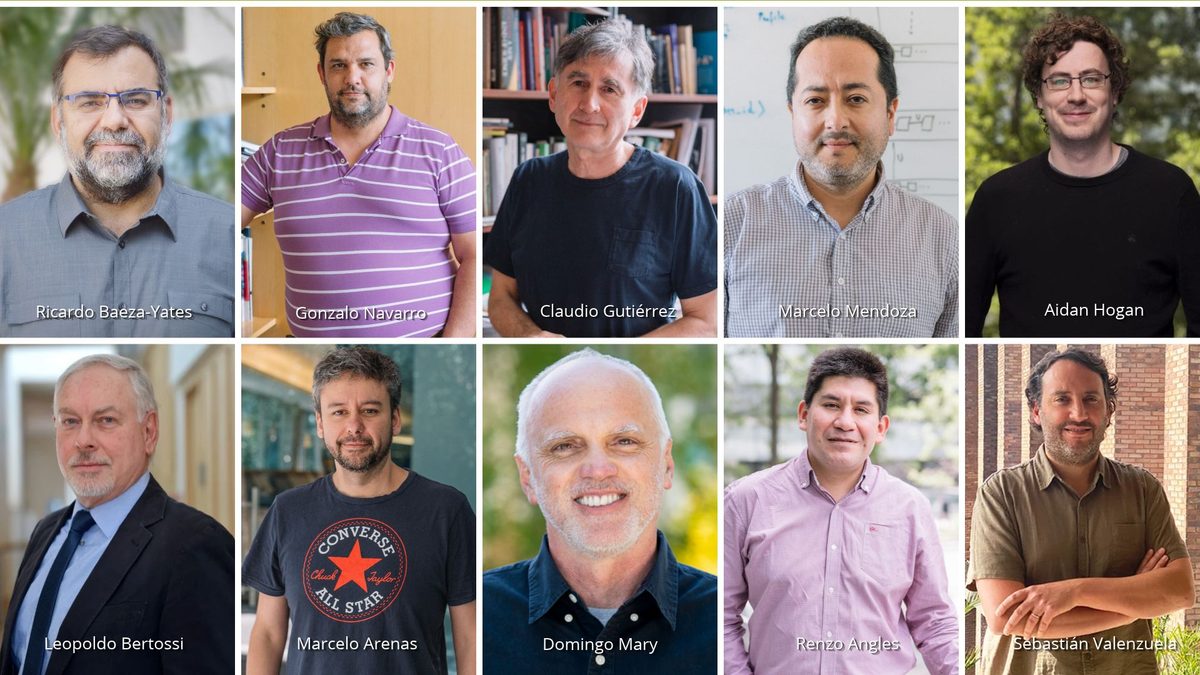
Researchers recognized for their scientific career and 2025 impact
Each edition of the ranking includes two classifications: one measuring the cumulative impact over an entire scientific career, and another considering citations received during the most recent year evaluated, in this case, 2025. Both use a composite indicator that combines six metrics, including citations received, the h-index (the ratio between publications and citations), and the researcher’s position as sole, first, or last author.
This last criterion can produce significant differences, since in papers where authors are listed alphabetically, those whose surnames fall in the middle are disadvantaged in the composite calculation.
Researchers recognized for career impact in the World’s Top 2% Scientists 2026
The earliest recorded publications by these researchers span a 22-year period, from 1987 to 2009. In addition, six of them have affiliation records linked to publications in more than one country, including the United States, Canada, Spain, and Ireland.
|
First publication in Scopus |
Researcher |
Countries associated with their publications |
|
1987 |
Ricardo Baeza-Yates |
United States, Chile, and Spain |
|
1990 |
Leopoldo Bertossi |
Canada and Chile |
|
1995 |
Gonzalo Navarro |
Chile |
|
1998 |
Marcelo Arenas |
Chile and Canada |
|
1998 |
Claudio Gutiérrez |
Chile |
|
1998 |
Domingo Mery |
Chile |
|
2000 |
Marcelo Mendoza |
Chile and United States |
|
2005 |
Renzo Angles |
Chile |
|
2005 |
Aidan Hogan |
Chile and Ireland |
|
2009 |
Sebastián Valenzuela |
Chile and United States |
The ranking based on citations received during 2025 also includes six researchers from the Institute: Renzo Angles, Ricardo Baeza-Yates, Aidan Hogan, Domingo Mery, Gonzalo Navarro, and Sebastián Valenzuela.
The 2026 edition of the ranking was published on October 7 and uses Scopus data extracted in August of that year. The annual list considers citations received between January and December 2025.
Research Areas: Artificial Intelligence, Communications, and Information Systems
Eight of the ten IMFD researchers on the World’s Top 2% Scientists 2026 list are classified in the subfield of Artificial Intelligence and Image Processing, which brings together more than 517,000 researchers in this measurement.
The Institute’s presence also extends to other disciplines. Sebastián Valenzuela appears in Communication and Media Studies and ranks 84th among more than 16,000 researchers in that area on the 2025 impact list. Meanwhile, Marcelo Arenas appears in Information Systems, where he ranks 306th among more than 19,000 researchers on the career-long list.
The 2026 edition also includes Pablo Barceló, a professor at Pontificia Universidad Católica de Chile, who served as deputy director of the IMFD between 2018 and 2023 and as a researcher at the Institute from 2018 to October 2026. His name appears on the 2025 impact list, in the area of Theoretical Computer Science and Mathematics.
The official repository, published by Stanford and Elsevier where the data is available, can be found at the following link: data.mendeley.com/datasets/btchxktzyw