
Researcher Domagoj Vrgoč Wins Prestigious International Award for Database Research
The SIGMOD Research Highlight Award is one of the most prestigious awards in this field and has been presented annually since 2016. The research, in which the IMFD researcher and IMC UC faculty member collaborated with researchers from RelationalAI and other universities, focuses on relational databases currently used in complex transactions, banking systems, and e-commerce, among other areas.
A research project involving Domagoj Vrgoč, a faculty member at the Institute of Mathematical and Computational Engineering (IMC UC) and a researcher at Millennium Institute Foundational Research on Data IMFD), has just been awarded one of the SIGMOD Research Highlight Awards. This is one of the most prestigious awards in the field of database research and has been presented annually since 2016 to works that not only address a key problem but also represent a definitive milestone in its resolution and demonstrate significant impact both within and outside their community.
The work was recognized by the Special Interest Group on Management of Data (SIGMOD) of the Association for Computing Machinery (ACM), an organization founded in 1947 as the first scientific and educational society in the field of computing. The research is titled “Rel: A Programming Language for Relational Data,” and the IMFD researcher collaborated on its development with Molham Aref (Relational AI), Paolo Guagliardo (University of Edinburgh), George Kastrinis (Relational AI), Leonid Libkin (Relational AI), Victor Marsault (LIGM, Gustave Eiffel University, CNRS), Wim Martens (Relational AI), Mary McGrath (Relational AI), Filip Murlak (University of Warsaw), Nathaniel Nystrom (Relational AI), Liat Peterfreund (Hebrew University), Allison Rogers (Relational AI), Cristina Sirangelo (Relational AI), David Zhao (Relational AI), and Abdul Zreika (Relational AI).

This paper falls within the field of relational databases, which organize information into structured tables (rows and columns) with predefined relationships, ensuring high data consistency and integrity. Today, they are essential in fields such as banking, where they are used in transactions that require a high level of integrity and consistency. They are also used in e-commerce for inventory management, user profiles, and order processing, as well as in human resources systems that handle payroll, employee personal data, and organizational structure, using SQL to securely manage critical data.
“In this work, carried out in collaboration with colleagues from academia and industry, we address the long-standing problem of impedance mismatch. For more than 50 years, relational data management has been confined to a split system that relies exclusively on the SQL query standard for data retrieval, while relying on a standard programming language for application logic,” explains Vrgoč. This division, the researcher adds, creates “inherent friction, as the declarative nature of SQL clashes directly with the imperative, step-by-step execution of traditional programming languages.”
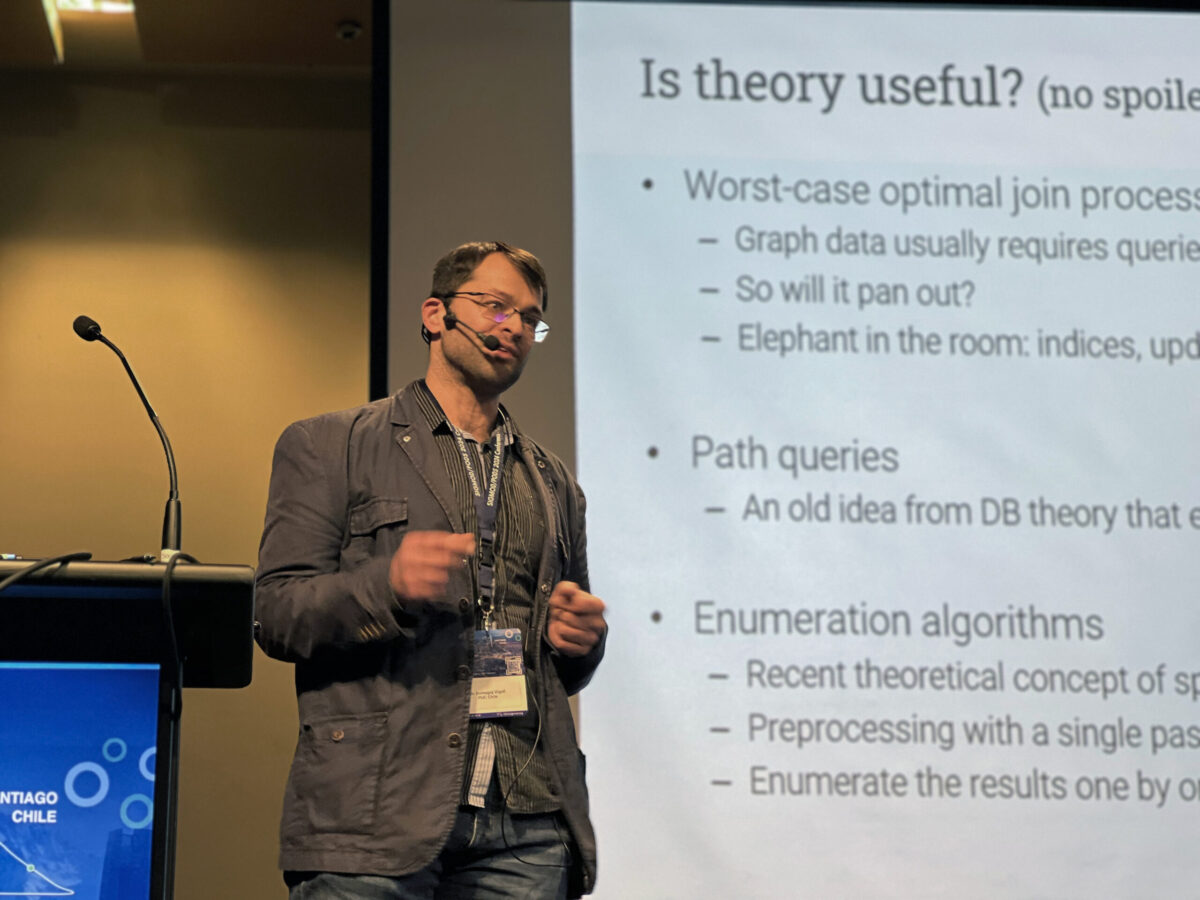
In the paper, the scholar notes, Rel is described as a“language that breaks radically and ambitiously with this paradigm. Rather than treating relational queries as an add-on, Rel is designed from the ground up as a full-fledged programming language in which the relationship itself is the central element.”
Regarding this research, scholars Viktor Leis and Thomas Neumann (Technical University of Munich) note that “it charts a compelling path toward simpler architectures, more reusable data logic, and relational systems based on more robust principles.”
Source: IMC UC