
AI system will help doctors filter the flood of scientific information on COVID-19
A text classifier based on deep neural networks that helps to automatically categorize different types of medical articles on a large scale: ranging from thousands to hundreds of thousands. This is the work of Andrés Carvallo, a PhD researcher at the Departamento de Ciencia de la Computación (DCC) de la U. Católica, funded by the Millennium Institute for Foundational Research on Data (IMFD), and under the supervision of his advisor Denis Parra, Associate Professor at DCC UC and adjunct researcher at IMFD.

This development, which consists of an artificial intelligence (AI) system, will be incorporated into the platform of Fundación Epistemonikos: an organization dedicated to bringing scientific-medical evidence closer to citizens and authorities, promoting informed decision-making in health, through evidence-based medicine.
“This task is vital for the work the foundation does, especially in the current context of the COVID-19 pandemic. With this system they will be able to review more quickly and effectively what science says regarding forms of contagion, symptoms, treatments, and different aspects of the disease,” explains Denis Parra.
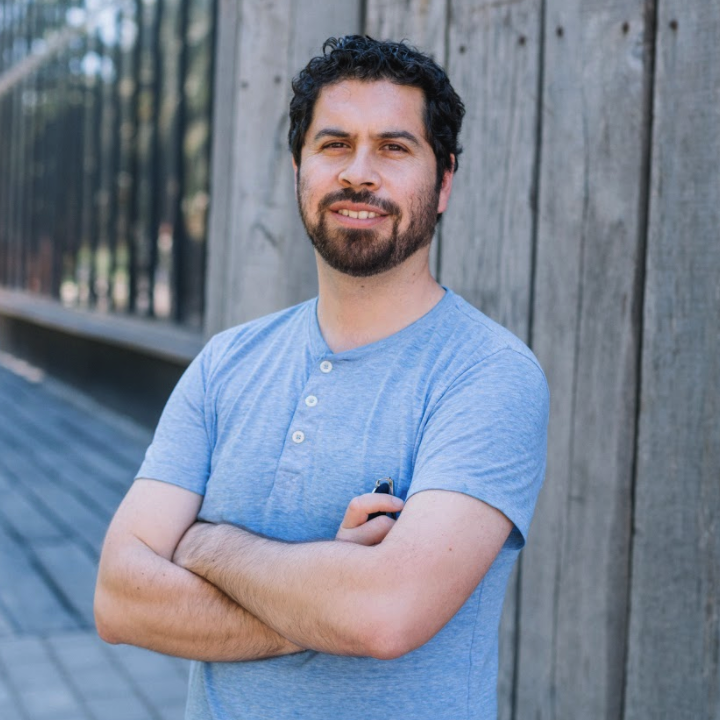
The researcher adds that this task “has become very overwhelming due to the flood of scientific articles in recent months, reporting research in this area.” In fact, a recent article in the journal Science (Scientists are drowning in COVID-19 papers. Can new tools keep them afloat?) indicates that this is a global problem and that AI tools are expected to help with this challenge.
Dr. Gabriel Rada, founder and president of Epistemonikos, highlights the importance of collaborative work, not only in academic or clinical settings, but also in technological development. “For us, collaborating with other experts in artificial intelligence has tremendous value, as it allows us to stay at the forefront of this discipline, whose role is fundamental to several of the processes behind our tools,” says Dr. Rada.

“The combination of cutting-edge technology and collaboration from a broad network of experts allows us to offer the largest source of evidence on COVID-19 worldwide, moving us closer to our goal of promoting better decisions, both individual and collective, based on solid and reliable evidence,” adds the academic, a specialist in evidence-based medicine.
Collaborative work has been key, Parra agrees: “The participation of the Epistemonikos team, led by Dr. Gabriel Rada, along with engineers Daniel Pérez, Juan Ignacio Vásquez, and Camilo Vergara, has been fundamental to this result.”
The art of document classification
The classification method developed by Andrés Carvallo and Denis Parra takes a medical article as input, and produces as output “the probability of the type of medical document,” says Parra, who gives examples of output types such as “systematic review, randomized primary study, broad synthesis, non-randomized primary study, and excluded.” The system created “represents the input text, that is, the title and abstract of the medical articles, using a recent text representation model called XLNet. The XLNet representation is then used as input to a traditional classification model,” details Andrés Carvallo.
Parra points out that this model has performed better than other recent state-of-the-art models, such as BERT. The reason, he explains, is that “XLNet is capable of processing much longer input texts, while BERT forces a limit on the number of input words for the model.” These insights, notes the academic, “come from collaboration with other IMFD researchers such as Jorge Pérez, Álvaro Soto, Hans Lobel, and Marcelo Mendoza, with whom we meet weekly to review and discuss the latest articles in the field, as well as our own research.” These researchers are part of IMFD’s flagship project Explainable Artificial Intelligence.
Collaborations: the key to progress
The researchers’ collaboration with Fundación Epistemonikos dates back to 2017. They initially developed joint research on a system that allows automatically finding articles with answers to medical questions, making the most efficient possible use of doctors’ expertise to label documents, using machine learning (ML) techniques such as relevance feedback and later active learning. Unlike traditional supervised learning in ML, which requires a large database of already labeled questions and documents, both relevance feedback and active learning are techniques that incrementally and interactively use the knowledge of experts —specialist physicians— in order to “save them work” while feeding and training these AI/ML systems.
Andrés Carvallo is a PhD student in Engineering, with a specialization in Computer Science at the U. Católica. His areas of interest are information retrieval, text mining, recommender systems, and the development of machine learning algorithms with visual explanations.
His thesis project relates to the automatic and explainable review of medical papers to improve efficiency in the practice of evidence-based medicine. He is currently part of the research labs IALab UC —the AI lab of the DCC at U. Católica— and SocVis —Social Computing & Visualization Group— at the same university.
If you would like to learn more about Parra and Carvallo’s work on Active Learning, check out this link: https://link.springer.com/article/10.1007/s11192-020-03648-6