
In an interview with Cooperativa Ciencia, Juan , director of the IMFD, discussed the 2026 Alonzo Church Prize and how AI is transforming programmer training
Juan , director of Millennium Institute Foundational Research on Data IMFD) and a professor at the Catholic University (UC), spoke with Cooperativa Ciencia about the research behind the award presented this month in London and also discussed how artificial intelligence is changing the landscape for students.
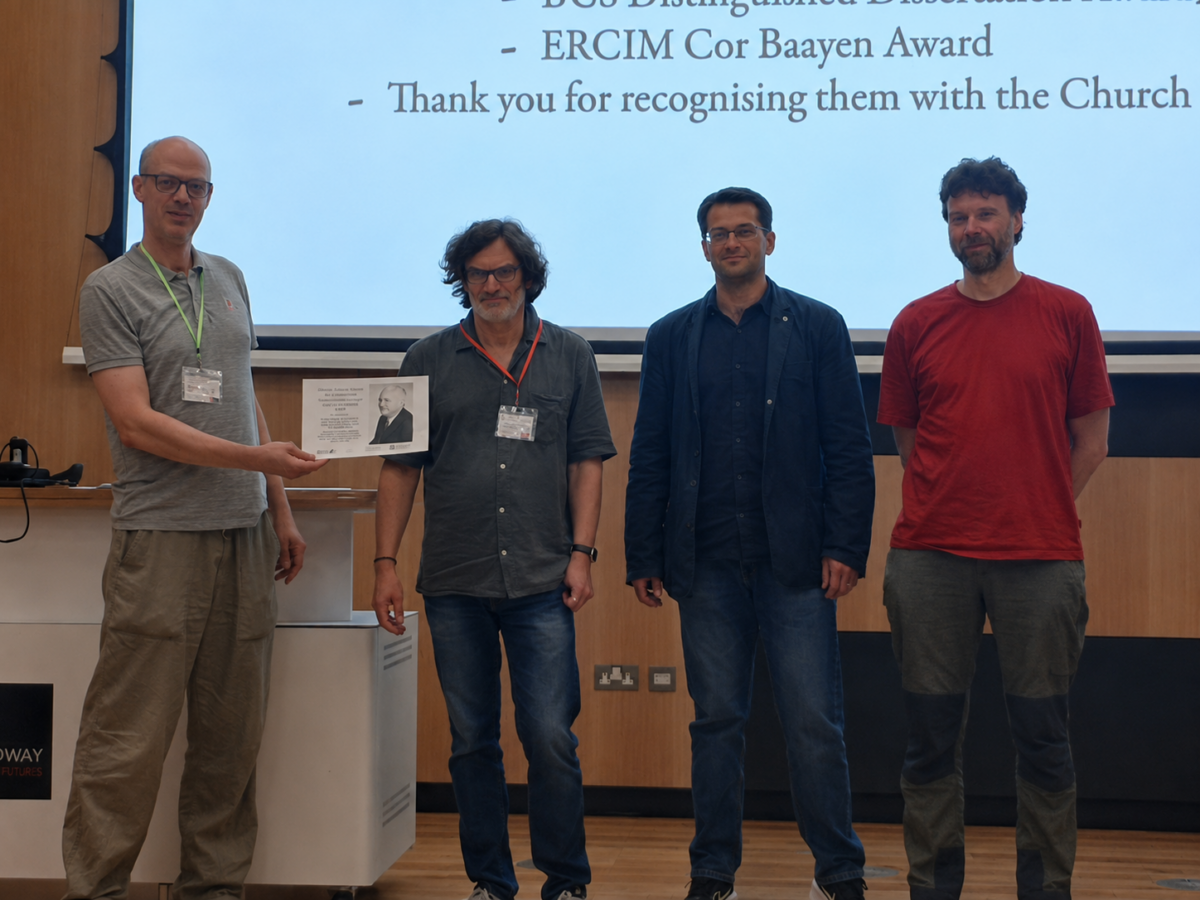
On July 9, the International Colloquium on Automata, Languages, and Programming (ICALP) was held at the University of London in England. During the event, an international group of researchers—three of whom are from the IMFD—received the 2026 Alonzo Church Prize, one of the most prestigious awards in the field of theoretical computer science.
Reutter, one of the IMFD award-winning researchers alongside Domagoj Vrgoč and Pablo Barceló, explained in the interview the origins of the work that led to the recognition, which was linked to the doctoral dissertations that he, Vrgoč, and fellow awardee Miguel Romero developed around 2009 and 2010:“At that time, graph database systems were beginning to emerge. They operate on the idea that if you have data, it is interconnected, and the interesting part is finding the path between data points and the new connections that can be generated from them. (What we did to deserve the award was), from a mathematical perspective, to explain what could be done efficiently on a computer—and what could not—by providing a theoretical framework for how access to these graph databases should be structured.”
That framework was later adopted by international industry and academic groups as a starting point for defining the standards now known as SQL/PGQ and GQL, which are used by companies such as Oracle, Amazon, Google, and SAP for querying graph databases.
On AI in academic education: “We need to understand the limitations and identify the roles: what is the role of humans and what is the role of machines?”
When asked about the effects of artificial intelligence on the education of future generations, Reutter said that the programming profession is changing: “Five years ago, programmers would just write and write code. Today, programmers mostly write prompts, so the skill now lies in identifying when to write a prompt and when not to, and what to check and what not to.”
The director of the IMFD, who is also a faculty member in the Department of Computer Science (DCC UC) and the Institute of Mathematical and Computational Engineering (IMC UC), also warned of a gap between the everyday use of these tools and a true understanding of their limitations: “What I see with my students is that they’re completely at home with chatbots and artificial intelligence, but they still need to understand the limitations and identify the roles: what is the role of the human and what is the role of the machine—and that’s what we’re seeing today.”
“If you’re in school, you’ve probably noticed that there’s a chatbot that can answer all your questions, but there’s a big difference between that and thinking it’ll do everything right and that you no longer need to do anything—and technologically, we’re nowhere near that point,”he added.
In that context, he explains that as a professor at UC, they’ve had to go back to paper-based exams: “In a way, that’s bringing analytical skills back to a higher level—which is the skill needed to deal with a chatbot. As a society, we probably let this analytical aspect slip away a little, but I think we realized it quickly, and in a way, we’re regrouping and identifying the areas where we know human influence is necessary.”